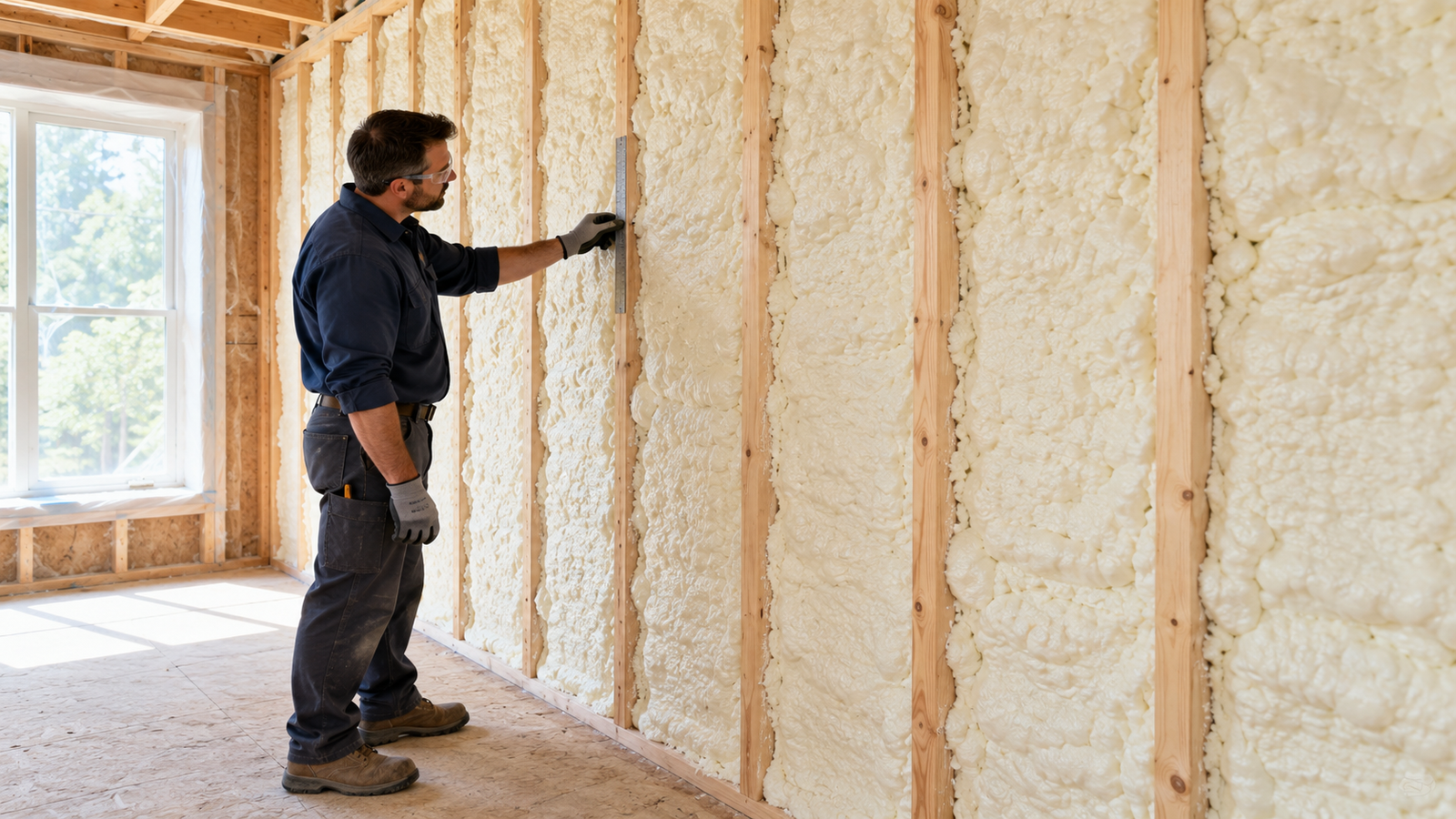
Spray foam insulation cost depends on the foam type, treated surface area, installed thickness and preparation required. HomeGuide lists approximately $1.50–$5.00 per square foot with professional installation. A contractor’s price can fall outside that range when thickness, access or the project scope differs.
Measure the surfaces receiving foam, not simply the home’s floor area. Before comparing proposals, confirm the product, minimum thickness, target R-value, installation locations and work excluded from the price.
Table of Contents
Spray Foam Insulation Cost at a Glance
HomeGuide’s spray foam cost guide publishes these installed references:
| Foam category | Published installed cost per square foot |
|---|---|
| General spray foam reference | $1.50–$5.00 |
| Open-cell foam | $1.50–$3.50 |
| Closed-cell foam | $3.00–$5.00 |
The source does not assign one universal thickness to each range. These figures are broad budgeting context, not equal-R-value comparisons or fixed prices for any depth.
Do not add the rows together. Open-cell and closed-cell describe alternative foam specifications; a hybrid design requires its own quantities and price.
HomeGuide also reports minimum job charges of around $1,000–$2,000 or more. Confirm the contractor’s minimum before estimating a small rim-joist or isolated-wall project by area alone.
Square Feet vs. Board Feet: Why Thickness Matters
A square foot measures surface area. A board foot measures volume: one square foot covered one inch thick.
Use this calculation:
Board feet = treated square feet × thickness in inches
| Treated area | Foam thickness | Calculated volume |
|---|---|---|
| 600 square feet | 2 inches | 1,200 board feet |
| 600 square feet | 3 inches | 1,800 board feet |
| 600 square feet | 5 inches | 3,000 board feet |
These are volume examples, not recommended thicknesses. The correct specification depends on the product, assembly, climate and applicable requirements.
If a contractor charges by board foot, ask whether the quantity is measured finished volume, estimated chemical yield or another billing basis. For areas receiving different depths, calculate each area separately before adding quantities.
A square-foot rate without a stated thickness is incomplete.
Example Spray Foam Cost Calculation
The following is a fictional calculation, not a market-price recommendation.
Assume a proposal covers 600 square feet at a specified three-inch thickness, with a hypothetical installed rate of $1.40 per board foot:
- 600 square feet × 3 inches = 1,800 board feet
- 1,800 board feet × $1.40 = $2,520
- Equivalent price: $2,520 ÷ 600 = $4.20 per square foot
The $4.20 figure already reflects the three-inch depth. Do not multiply it by three again.
The $2,520 is the calculated foam-installation line, not automatically the complete project bill. Removal, repairs, protective coverings, required barriers, finish restoration or other exclusions may still need pricing.
Open-Cell vs. Closed-Cell Spray Foam
Open-cell foam is generally lighter and less dense. Closed-cell foam is denser and generally provides more thermal resistance per inch. Product-specific performance and moisture behavior matter more than the category name alone.
| Comparison | Open-cell | Closed-cell |
|---|---|---|
| General physical form | Lower-density foam | Higher-density foam |
| Thickness for a similar thermal target | Often greater | Often less |
| Moisture-design question | Check vapor control and drying strategy | Check vapor resistance at the specified thickness |
| Quote requirement | Exact product, depth and rated performance | Exact product, depth and rated performance |
Do not assume either type is suitable for every wall, roof or below-grade location. Ask the contractor to explain the proposed assembly and provide the product’s technical documentation.
A lower board-foot rate does not prove that one option is cheaper at the same performance level. Compare the completed assembly, including any additional vapor-control or protective layers.
Define the Surfaces Before Asking for Prices
A “2,000-square-foot house” is not necessarily a 2,000-square-foot insulation project. Wall cavities, sloped roof surfaces, gable ends, rim joists and floors can produce very different quantities.
Ask for a location schedule showing:
- Each wall, roof, floor or rim-joist area
- Measured treated area
- Excluded openings and inaccessible sections
- Foam type and product at each location
- Minimum finished thickness
- Target R-value
- Access and restoration work
When an existing wall is closed, confirm how the contractor will gain access. Spraying an open cavity and injecting a product into a closed cavity are different scopes and may involve different materials and procedures.
Walls, Rim Joists and Roof Areas Have Different Requirements
Open wall cavities
Exposed framing can simplify access, masking and inspection. Confirm how framing transitions, penetrations and adjoining air-control layers will be handled before drywall conceals the work.
Rim joists and floor edges
Small, interrupted spaces can take more preparation than their area suggests. Ask how access, obstructions and continuity at adjoining surfaces are included.
Attic and roof assemblies
Insulating an attic floor and insulating the roof deck change different building boundaries. Do not approve a roof-deck conversion solely because the foam price looks attractive.
Ventilation, moisture control, existing equipment and roof condition need coordinated review. Our attic insulation cost guide compares the broader attic options.
Basement and crawlspace areas
Identify water entry, drainage and substrate condition before selecting insulation. Spray foam should not be proposed as a substitute for repairing an active leak.
The appropriate location of insulation and air-control layers depends on the whole assembly, not simply where the installer can reach.
What Increases Spray Foam Installation Cost?
Existing insulation and finish removal
Old insulation, wall finishes or stored belongings may need removal before access is available. Ask who bags, hauls and disposes of material and who restores disturbed surfaces.
Substrate preparation and repairs
The installer should assess the surfaces receiving foam against the product’s application requirements. Leaks, damaged framing, contamination or unsuitable conditions can require correction first.
Require written approval and pricing for concealed repairs.
Access, masking and protection
Tight spaces, high roof areas, occupied rooms and numerous penetrations can increase preparation time. The quote should identify surfaces and equipment protected from overspray.
Thickness and installation specification
More volume generally requires more material. However, selecting thickness is a design decision, not a way to make unlike quotes appear equivalent.
Ask how finished depth and coverage will be documented and how areas below specification will be corrected.
Required coverings and other trades
Ask which thermal or ignition-barrier provisions apply to the specific product, location and approved assembly. These requirements are not interchangeable, and exposed foam is not automatically an acceptable finished condition.
Confirm whether specified coverings, coatings, inspections and finish work are included in the contract.
Installation Safety and Returning Home
Professional spray polyurethane foam installation involves chemicals that require controlled work practices. Occupants and unprotected workers should stay out of the application area as directed.
EPA’s archived spray-foam safety guidance explains that re-entry depends on the product and installation conditions. Do not treat “24 hours” as a universal clearance rule.
Before booking, obtain a written plan covering:
- Who must vacate and which areas are restricted
- Protection and separation of occupied spaces
- Ventilation and HVAC precautions
- Cleanup before re-entry
- The manufacturer’s re-occupancy instructions
- Who confirms those conditions have been met
Follow current product instructions and qualified professional guidance. If exposure causes breathing problems or other health concerns, leave the affected area and seek medical attention.
Air Sealing, Moisture and Ventilation
Insulation must work with the home’s air, water and vapor-control layers. The Department of Energy’s building-science guidance emphasizes evaluating these interactions as part of the whole-house approach.
Ask whether the proposed work changes the home’s ventilation needs or affects combustion-air arrangements for existing equipment. Any necessary evaluation or modifications should be identified before installation.
A proposal should not promise that foam will solve every comfort or moisture problem. If priorities are unclear, our home energy audit cost guide explains how an assessment can help define the work.
Compare the Complete Installed Quote
This fictional example assumes the same product, treated area, finished thickness and performance specification.
| Scope item | Contractor A | Contractor B |
|---|---|---|
| Foam installation | $2,520 | $2,950 |
| Removal and disposal | $250 | Included |
| Specified protective barrier | $400 | Included |
| Total | $3,170 | $2,950 |
Contractor A’s foam line is lower, but its complete total is $220 higher.
Do not add an item again if it is already included. If a required component is missing, obtain a revised written quote rather than assuming the lowest total covers it.
What a Spray Foam Quote Should Include
A useful proposal specifies:
- Exact manufacturer and product
- Open-cell, closed-cell or a defined hybrid system
- Installation locations and measured area
- Thickness, R-value and quantity basis
- Preparation, removal and repair responsibilities
- Masking and overspray protection
- Air, water and vapor-control details
- Required coverings or coatings
- Ventilation, occupancy restrictions and cleanup
- Inspection and completion documentation
- Exclusions, change-order terms and payment schedule
- Product and workmanship warranties
Use our contractor hiring checklist when checking credentials, insurance, references and written terms.
Questions to Ask Before Signing
- Why is this foam and assembly appropriate for this location?
- What treated area and minimum thickness have you priced?
- Is the rate per square foot or board foot?
- Does the quote include removal, repairs and required coverings?
- What product instructions and evaluation documents apply?
- How will you verify substrate suitability and completed coverage?
- What is the written ventilation and re-occupancy plan?
- Are mechanical-system changes or inspections required?
- How are defects and additional work handled?
- What records and warranties will I receive?
Frequently Asked Questions
How much does spray foam insulation cost per square foot?
HomeGuide publishes a broad installed reference of $1.50–$5.00 per square foot. The depth, product and included work must be specified before using that range to compare local quotes.
How much does it cost to spray foam 1,000 square feet?
Multiplying the broad reference gives $1,500–$5,000, but this is arithmetic budgeting context, not a quote for any thickness. Treated surface area, job minimums and exclusions still matter.
Is closed-cell foam always the better choice?
No. Compare product performance with the assembly’s thermal, moisture, space and code requirements. The higher-priced option is not automatically the appropriate design.
Can I compare two quotes by board-foot price alone?
Only when the foam product, finished quantity, installation conditions and included work are comparable. A cheaper unit rate can still produce a higher complete bill.
Can spray foam be left exposed?
Ask the installer and local authority which protective provisions apply to the exact product and approved use. The quote should identify and price any required covering or coating.
Will spray foam guarantee lower energy bills?
No specific saving is guaranteed. Results depend on existing conditions, the scope of work, installation quality, climate, equipment and household use.
Bottom Line
Spray foam insulation cost is a comparison of product, area, thickness and complete installation scope. Start with measured surfaces and a suitable assembly, then compare written proposals with the same specification.
Resolve moisture, required coverings, ventilation and re-occupancy arrangements before work begins. A clear scope is more useful than a low square-foot rate without a stated depth.
Sources and Further Reading
- HomeGuide–Spray foam insulation cost
- South Central Services–Spray foam estimating method
- DOE Building Science Education–Types of insulation
- EPA archived guidance–Spray polyurethane foam safety
- EPA archived guidance–Vacating and safe re-entry
Editorial note
Sources reviewed October 19, 2026. Published prices are budgeting references with differing assumptions, not site-specific quotations. South Central Services’ estimating article dates from 2023; its regional rates are not used as current national prices here. EPA links are archived guidance; obtain current product-specific installation and re-occupancy instructions. Both worked examples are illustrative, and the quoted rates and contractor comparison are fictional.