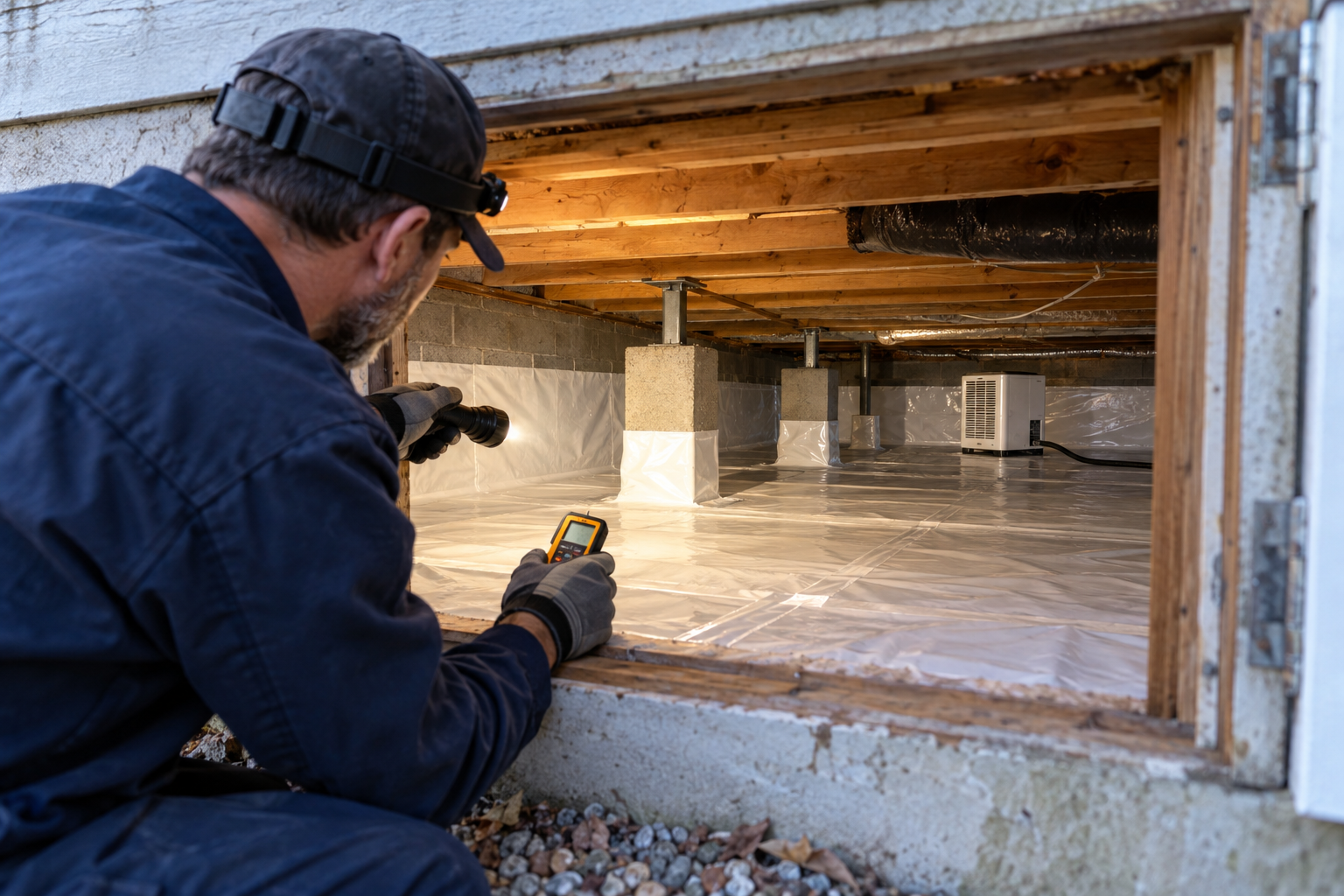
Crawl space encapsulation costs commonly range from $3,000 to $15,000, with published installed estimates of approximately $3 to $10 per square foot. Your actual price depends on the crawl space’s size, accessibility, condition, and the moisture-control equipment included. These are national planning estimates, not a quotation for your home.
Before comparing prices, establish what each contractor means by “encapsulation.” A ground vapor barrier, a sealed crawl space and a complete system with drainage and humidity control can represent very different scopes of work.
Your first step: arrange an inspection that identifies the moisture source, documents existing damage and explains the proposed solution. Then request written quotes covering the same work.
Table of Contents
Crawl Space Encapsulation Cost at a Glance
| Budget question | Planning guidance |
|---|---|
| Common published project range | $3,000–$15,000 |
| Published installed cost per square foot | Approximately $3–$10 |
| What can increase the total? | Difficult access, preparation, drainage, equipment and repairs |
| Can larger or damaged spaces exceed the range? | Yes |
| Is a ground vapor barrier the same as full encapsulation? | No—compare the complete written scope |
The published range provides a starting point. It does not establish that every project includes insulation, a sump pump, a dehumidifier or structural repairs.
Ask which items are included before using a national estimate to judge a local quotation.
What Is Crawl Space Encapsulation?
Encapsulation is a coordinated approach to controlling moisture beneath a home. It generally combines a continuous ground vapor barrier, sealing details and an appropriate drying or humidity-control strategy.
Depending on the property, the project may also require drainage improvements, insulation, an improved access door or equipment.
The U.S. Department of Energy explains that ground covers help control moisture entering from soil. Its installation guidance emphasizes coverage, secured edges and properly treated seams and penetrations. Simply placing loose plastic over part of the floor does not provide the same result. Building Science Education
Homeowner question: “Which moisture sources will your proposal address, and which will remain outside the scope?”
Do You Need Encapsulation or a Smaller Repair?
A damp crawl space should be investigated before selecting a package.
Use the following questions to structure the inspection. They are starting points for assessment, not diagnoses.
| What you have noticed | What to ask the inspector |
|---|---|
| Water appears after rainfall | Where is water entering, and what drainage work is proposed? |
| Persistent dampness without visible pooling | What measurements were taken, and what moisture sources were identified? |
| A damaged or incomplete ground cover | Could repair or replacement address the identified problem? |
| Wet insulation or deteriorated wood | What must be repaired before anything is covered? |
| A plumbing leak | Who will repair the leak and confirm that the affected area has dried? |
| Sagging floors or damaged supports | Is a separate structural assessment required? |
Do not enter a crawl space with standing water, exposed electrical hazards or suspected structural instability. Request professional assessment and photographs instead.
A useful inspection should explain why the proposed work is suitable for your home. Photographs of damage alone do not establish that every item in an expensive package is necessary.
What Should an Encapsulation Quote Include?
Ask contractors to mark every item as included, excluded, optional or not required.
| Scope item | Details to request |
|---|---|
| Inspection and preparation | Findings, photographs, debris removal and disposal |
| Water management | Identified water source, drainage work and discharge arrangements |
| Ground vapor barrier | Manufacturer, product specification and coverage |
| Seams and penetrations | Sealing method and compatible materials |
| Walls and piers | Coverage and attachment details |
| Vents and access door | Proposed treatment and applicable local requirements |
| Insulation | Location, product, R-value and protective covering where required |
| Humidity control | Proposed method, equipment and commissioning |
| Electrical work | Connections, responsible trade and permit allowance |
| Existing damage | Repairs included and work requiring separate approval |
| Warranty | Product coverage, installation coverage and exclusions |
| Follow-up | Inspection, maintenance and service arrangements |
A short quotation stating only “complete encapsulation” leaves too much unresolved.
Ask for specifications before paying a deposit.
What Affects Crawl Space Encapsulation Cost?
Crawl Space Size and Layout
Larger spaces generally require more material and installation work. However, floor area alone does not describe the job.
Low clearance, separate compartments, numerous piers and difficult access can change the amount of work involved.
Ask whether the quoted area represents the crawl space floor, the home’s living area or the actual surfaces being covered.
Existing Condition
Preparation may involve more than removing a few stored items.
Ask contractors to separately identify damaged insulation, contaminated material, pest treatment and wood or foundation repairs. Confirm what happens if additional damage becomes visible during the work.
Water Entry and Drainage
Ground moisture and flowing water are different problems. A vapor barrier should form part of an appropriate moisture-management plan; it should not be used to conceal unresolved water entry.
DOE guidance also states that vapor-retarder work should preserve established drainage arrangements. DOE Vapor Retarder Job Aid
Ask where collected water will go and whether discharge work is included.
Barrier Specification and Installation
Request the product name and technical sheet rather than accepting “premium liner” as a specification.
Check the thickness units carefully. A mil is one-thousandth of an inch; it is not a millimeter. DOE’s ground-vapor-retarder guidance specifies a minimum thickness in mils.
Material thickness is only one consideration. Coverage, reinforcement, fastening and installation details also belong in the comparison.
Humidity Control and Insulation
Ask how the space will be kept dry after sealing.
The appropriate design can involve dehumidification or another compliant conditioning strategy. Insulation requirements also depend on the assembly and local conditions. Closing vents should be considered as part of the complete design. Building America Solution Center
For equipment, request the model, capacity, drainage arrangement, power requirements and maintenance instructions.
How to Compare Two Encapsulation Quotes
The following example uses fictional figures created by HDC to demonstrate the comparison method. It is not a market-price estimate.
Suppose two contractors propose work for the same crawl space, and the inspection has established that humidity-control equipment and electrical connections are required.
| Item | Quote A | Quote B |
|---|---|---|
| Initial quoted price | $6,200 | $8,100 |
| Agreed preparation and liner work | Included | Included |
| Required dehumidifier installation | $1,700 additional | Included |
| Required electrical work | $600 additional | Included |
| Comparable total | $8,500 | $8,100 |
| Structural repairs | Excluded | Excluded |
Quote A initially appears $1,900 cheaper. Once its required additions are counted, it becomes $400 more expensive.
This still does not prove that Quote B is the better choice. Compare product specifications, installation details, contractor qualifications and warranty terms before deciding.
Comparison rule: add required exclusions to the quoted price, then compare equivalent scopes.
If one contractor recommends a drain and another does not, resolve that design disagreement before treating the quotations as comparable.
Five Companies to Research for Crawl Space Services
These companies publish information about crawl-space encapsulation or related repair services on their official websites. They are reference options, not a ranked list or an endorsement. Availability and service quality must be checked with the actual business serving your address.
| Company or network | Relevant published offering | What to verify locally |
|---|---|---|
| Groundworks | Crawl-space encapsulation and repair | Contracting business, scope and service availability |
| Basement Systems | CleanSpace crawl-space systems | Installing dealer, equipment and warranty responsibilities |
| Crawl Space Ninja | Encapsulation and moisture-control services | Local location, preparation and follow-up service |
| Olshan Foundation Repair | Encapsulation and crawl-space repair | Recommended combination of repairs and moisture control |
| Ram Jack | Crawl-space repair and encapsulation | Whether the local operator provides the required services |
These offerings were checked against the companies’ official pages. Groundworks
You can also compare qualified independent local contractors. A familiar company name does not replace checking the local installer’s credentials, references and written terms.
Official websites
Questions to Ask Before Signing
Use these questions during contractor discussions:
- What is causing the moisture problem, and what evidence supports your findings?
- Which work is necessary, and which items are optional?
- What liner and equipment models will you install?
- What water-management work is included?
- Who handles electrical connections, permits and inspections?
- How will additional damage be documented and priced?
- What will demonstrate satisfactory completion?
- What maintenance is required to keep the warranty valid?
- Which business is responsible for warranty claims?
- What are the deposit, progress-payment and final-payment terms?
Also ask how the design accommodates termite inspections, any fuel-burning equipment, radon considerations and flood requirements. Building America guidance identifies these as matters to check against local requirements. Building America Solution Center
What to Check When the Work Is Complete
Agree on completion evidence before work begins.
Request:
- Photographs of the completed work, including difficult-to-access areas.
- Confirmation that the installed products match the proposal.
- Documentation of approved repairs and changes.
- Equipment testing and operating instructions.
- The agreed humidity-control settings and follow-up plan.
- Permit and inspection records where applicable.
- Written warranty documents and service contacts.
If you cannot safely inspect beneath the home, request photographs and a walkthrough of the records. For unresolved concerns, consider an independent inspection.
A clean appearance is useful, but it does not establish that drainage, sealing and equipment are working as intended.
Ongoing Costs to Ask About
Before choosing equipment, ask about:
- Electricity consumption.
- Filters and routine servicing.
- Pump testing and maintenance.
- Annual inspections.
- Warranty-related service obligations.
- Repairs if later plumbing or trade work damages the liner.
Request the annual service price and clarify whether maintenance is included, optional or required.
Avoid assuming that energy savings will repay the installation within a fixed period. The result depends on the home, existing problems, system design and operating costs.
Frequently Asked Questions
How much does crawl space encapsulation cost?
Published national estimates commonly place installed projects around $3,000–$15,000. Your written quote should explain the work, equipment and repairs included.
What is crawl space encapsulation cost per square foot?
Published estimates commonly use approximately $3–$10 per square foot. Confirm the area being measured and the scope behind the rate before comparing contractors.
Is a vapor barrier enough?
It depends on the identified problem. A ground cover may address ground vapor, but unresolved water entry, damage or humidity may require additional measures.
Does every crawl space need a dehumidifier?
Not necessarily. Ask the designer to explain the proposed drying or conditioning strategy and its suitability for your property.
Can encapsulation fix sagging floors?
Encapsulation does not replace structural repairs. Ask for the cause of the movement to be assessed and any repair work to be separately specified.
Is the cheapest quote the best choice?
Compare complete scopes first. A lower price can reflect omitted equipment, preparation or repairs rather than better value.
Your Next Steps
Today: record when the problem occurs and collect any existing inspection reports or safely obtained photographs.
Before requesting quotes: arrange an assessment that explains the cause and proposed remedy.
When comparing contractors: request at least three itemized proposals where practical, using the same scope checklist.
Before signing: resolve exclusions, specifications, payment terms, warranty responsibilities and completion checks.
Your goal is to buy an appropriate solution for the identified problem and understand the full cost before committing.
Related Homeowner Guides
For broader hiring checks, read our 21-Point Contractor Hiring Checklist.
If the inspection identifies structural damage, refer to our Foundation Repair Cost guide. For a proposed pump replacement, see Sump Pump Replacement Cost.
Sources and Further Reading.
HomeGuide — Published Encapsulation Cost Estimates
U.S. Department of Energy — Crawl Space Vapor Retarder Job Aid
DOE Building Science Education — Ground Moisture Control
Building America Solution Center — Unvented, Insulated Crawlspaces
Editorial Note
This guide uses published US cost estimates and government building-science guidance. Prices vary by location and project scope. The quote comparison is an illustrative HDC example. Company references confirm published services and do not constitute a ranking or guarantee of local workmanship.