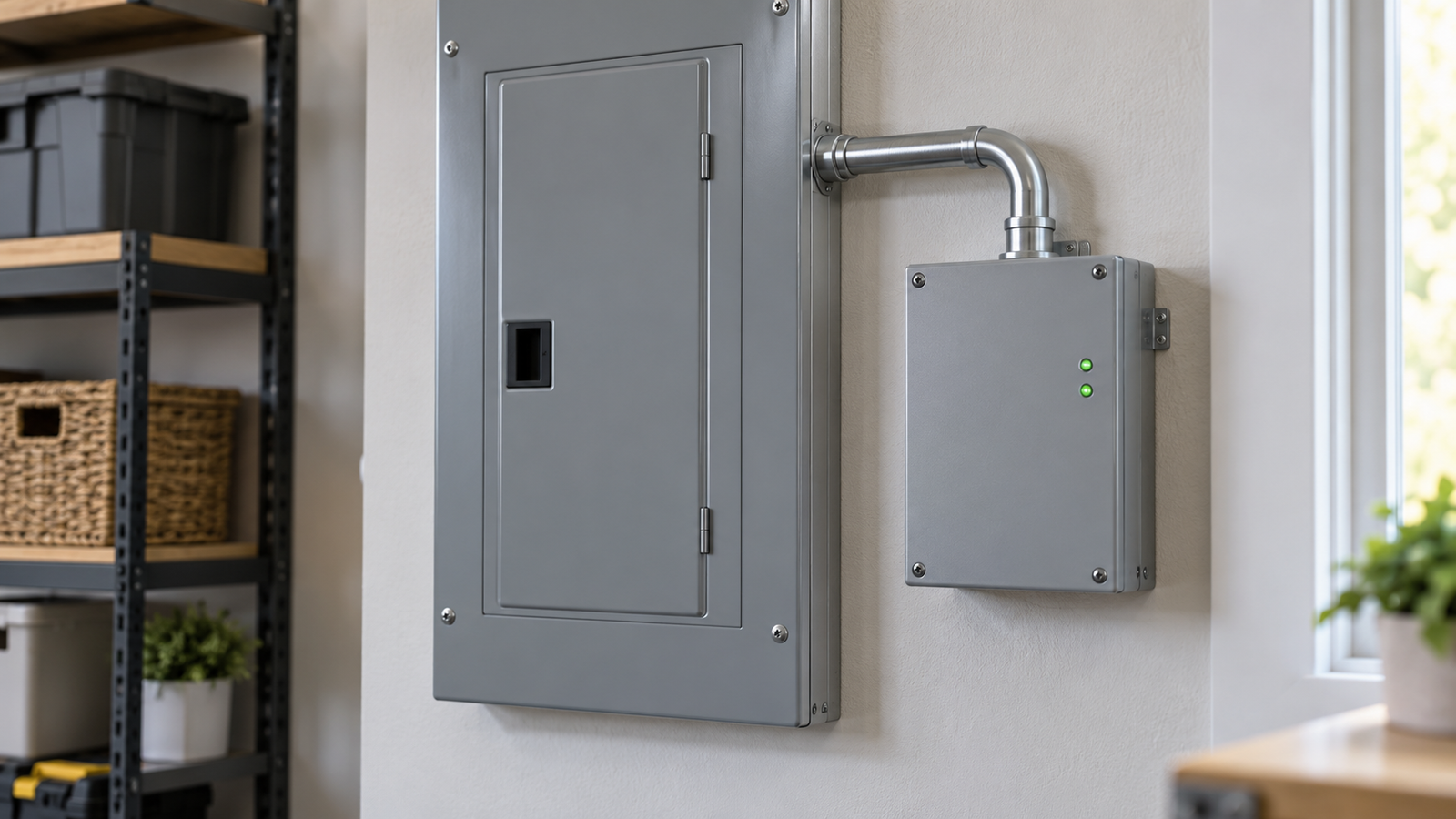
Whole house surge protector installation cost depends on the device, your electrical panel, local labor, and the work included in the quote. For one published regional reference, C&C Air lists $300–$600 installed in Central New Jersey, depending on panel configuration.
That is a contractor’s local price range, checked in October 2026—not a national average or a guaranteed price for your home. Use it as a starting reference, then compare written quotes for the same equipment and scope.
The most useful question is: What will the complete installation cost, and what protection am I buying?
Table of Contents
What Does the Published Price Include?
C&C Air’s whole-home surge protection page provides the regional benchmark below.
| Published reference | Installed price | Important qualification |
|---|---|---|
| C&C Air, Central New Jersey | $300–$600 | Depends on panel configuration; confirm the current total and inclusions directly |
The company also advertises a promotion. Do not automatically subtract a promotional discount from its published range; ask whether a written quote already includes it and whether you qualify.
A retail device price is a different number from a completed installation price. Before comparing either with a contractor quote, establish whether the total includes:
- The exact surge protective device, identified by manufacturer and model.
- Installation labor and required connection or mounting materials.
- Any necessary compatible breaker or other panel components.
- Permit and inspection charges, where required.
- Service-call charges and applicable taxes.
- Any separately identified electrical repairs.
Request a final payable total rather than a low starting price followed by unspecified extras.
What Affects Whole House Surge Protector Installation Cost?
A straightforward installation and a project involving electrical repairs are different scopes. Ask the electrician to explain which conditions apply to your home.
Panel Compatibility and Available Space
Have the installer identify the panel and confirm the proposed device and connection arrangement are suitable. Ask whether additional components or panel work are included.
If a quote includes a full panel replacement, request the specific reason and a separate price for that work. Compare it with our electrical panel replacement cost guide before deciding on the larger project.
Existing Electrical Problems
Ask whether the electrician found a grounding, bonding, damage, or equipment-condition issue that needs correction. Request a written description and an itemized repair price. A vaguely described “required upgrade” is difficult to assess or compare with another quote.
More Than One Panel or Building
Tell the electrician about subpanels, detached garages, workshops, and equipment you particularly want to protect. Ask for a written explanation of the proposed protection locations and the cost of each device. Avoid assuming that every subpanel automatically needs the same solution.
Permits and Scheduling
Confirm local requirements, who obtains any permit, and whether inspection coordination is included. Also ask whether the work requires an interruption to electrical service and how the installer will arrange it.
What Kind of Surge Protector Are You Buying?
A surge protective device is often abbreviated SPD. NEMA distinguishes devices by their intended installation location:
| Device type | General application |
|---|---|
| Type 1 | Permanently connected; suitable applications can be on either side of the main service overcurrent device |
| Type 2 | Permanently connected on the load side of the service overcurrent device |
| Type 3 | Protection at equipment, such as an appropriate plug-in protector |
These categories describe applications, not a simple good-better-best ranking. Ask for the manufacturer’s installation instructions and confirmation that the proposed model suits your system.
The NEMA Surge Protection Institute FAQ explains these classifications and product ratings. Ask the installer about UL 1449 listing, system-voltage compatibility, and suitability for the installation environment. Comparing one large advertised rating alone does not establish which complete installation is appropriate.
What Surge Protection Can and Cannot Do
An SPD limits transient voltage surges. It does not provide backup electricity or fix every power-quality problem. NEMA explains that sustained overvoltage is different from a transient surge and is generally outside an SPD’s intended protection.
Protection can also involve more than one layer. Ask whether selected equipment needs point-of-use protection in addition to the panel device.
For outages, Eaton’s explanation of surge suppression and UPS systems makes the distinction clear: surge protection does not keep equipment running when power fails. A suitable UPS can supply battery power to connected equipment for a limited period.
If your goal is household backup power, review our whole-house generator installation cost guide as a separate project. Ask the electrician how any existing generator, solar, or battery system affects the proposed surge protection design.
How to Compare Two Installation Quotes
Compare the same model and scope before deciding which offer costs less. The following figures are fictional arithmetic examples, not market prices or recommended charges.
| Item | Quote A | Quote B |
|---|---|---|
| Same specified device | $180 | Included |
| Installation and materials | $250 | Included |
| Permit allowance | $70 | Included |
| Total before any applicable tax | $500 | $475 |
Quote B is $25 lower only if its written scope includes the same device, materials, permit responsibility, and work. If its “included” items are undefined, request clarification before comparing totals.
Also establish whether an allowance can change. A permit allowance of $70 is not necessarily a fixed permit charge.
For help evaluating licenses, insurance, estimates, and contracts, use our guide to hiring a contractor.
Read the Warranty Before Paying More for It
Ask for the actual warranty document for the quoted model. Separate these questions:
- What does the device warranty cover?
- Who pays labor if the device needs replacement?
- Is there separate connected-equipment coverage?
- What registration, receipts, exclusions, deadlines, or claim procedures apply?
A large advertised coverage amount does not explain the conditions of a claim. Compare the written terms rather than assigning value to the headline dollar figure alone.
Keep the model number, invoice, installation date, warranty terms, and any required registration confirmation together.
What to Ask Before the Electrician Leaves
Have the installer show you the accessible status indicator and explain what its normal and warning conditions mean for your exact model. Ask what action to take if the indicator changes, disappears, or signals a problem.
Request the manufacturer’s instructions and written guidance on inspection or replacement after a significant electrical event. Keep any permit and inspection records with the invoice.
Panel work belongs with a qualified electrician. This guide is for evaluating quotes and the finished installation, rather than opening equipment or making electrical connections yourself.
Frequently Asked Questions
Is $300–$600 a Nationwide Installation Price?
No. It is one contractor’s published Central New Jersey range. Your written quote should reflect your location, equipment, panel, and required work.
Does a Whole-House Surge Protector Replace a Power Strip?
Ask the installer about a coordinated protection plan for your equipment. Panel protection and suitable point-of-use surge protection serve different locations; an ordinary power strip may offer no surge protection at all.
Do I Need a New Electrical Panel?
Request an assessment of your existing panel and an explanation of any proposed replacement. Compare the surge installation and panel work as separately described costs.
Will It Keep My Refrigerator Running During an Outage?
No. A surge protector supplies no backup electricity. Outage operation requires a separately designed backup-power solution.
How Often Should It Be Replaced?
Follow the specific manufacturer’s instructions and the installer’s guidance. Learn the device’s status indication and ask when professional assessment is needed rather than relying on a universal replacement interval.