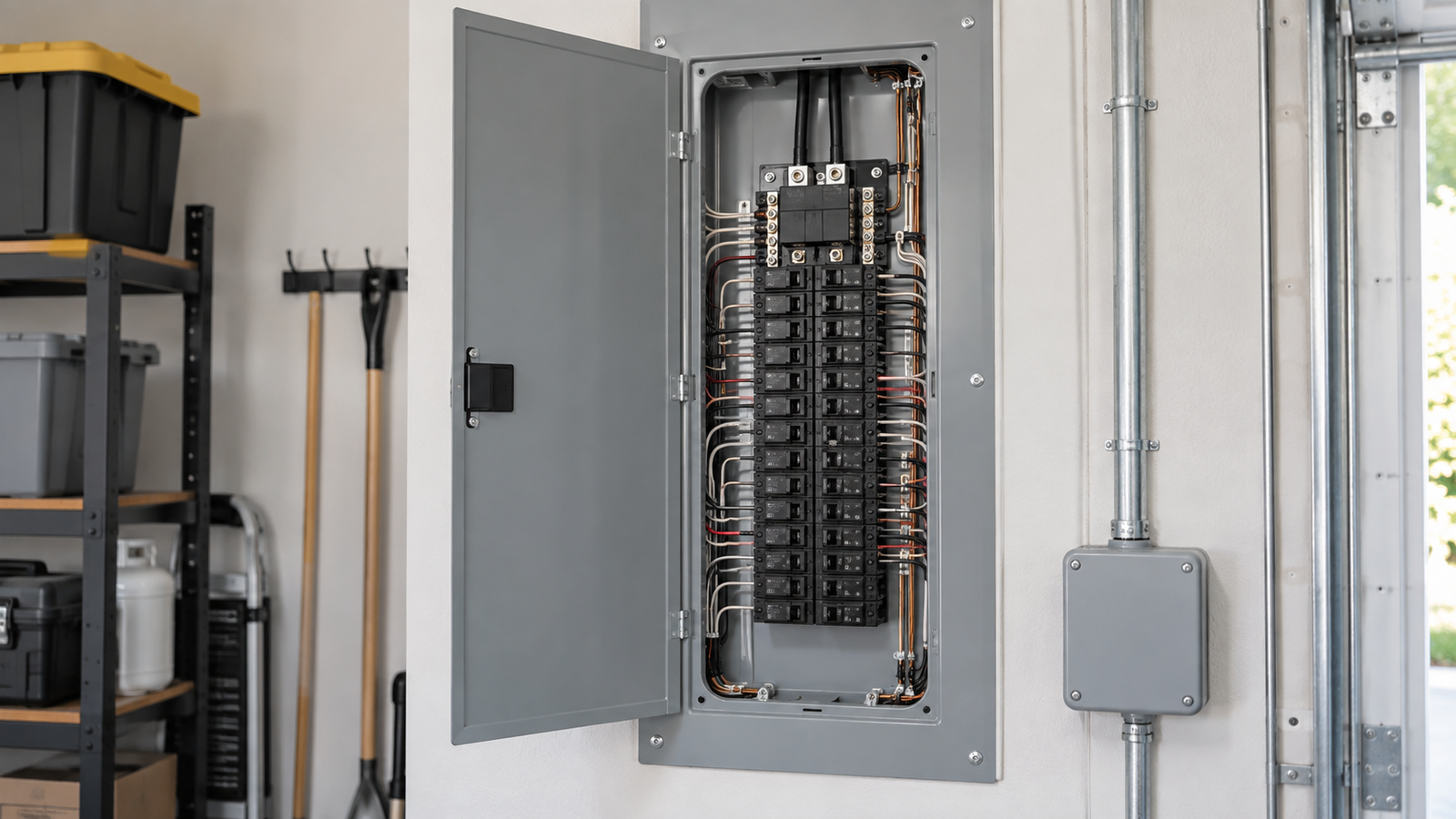
1. Quick answer: panel replacement and service upgrade are not the same job
Electrical panel replacement often costs a few thousand dollars, but a like-for-like panel change is not comparable with a complete service upgrade. This Old House’s March 2026 consumer guide reports a planning range of about $1,300 to $3,000 for many 200-amp upgrades. Costs can rise when work includes a new meter enclosure, service conductors, mast, underground trenching, relocation, utility construction, extensive circuit correction, or 300- to 400-amp equipment. These are commercial references—not government prices or quotations for your home.
The useful price is a written local proposal based on a documented load calculation, the existing service and panel condition, the desired capacity, utility requirements, permits, inspections, outage planning, and clearly stated corrective work. Compare at least three qualified electrical contractors against the same target scope whenever conditions allow.
| Immediate danger? If you see smoke, arcing, scorching, melting, water inside electrical equipment, or smell burning, keep away from the panel, do not remove its cover, and contact emergency services, the utility, or a qualified electrician as appropriate. Do not touch equipment in wet conditions. |
2. Identify why work is being proposed
A panel may be replaced because it is damaged, corroded, obsolete, overcrowded, recalled, improperly modified, unable to accept required breakers, or located where continued service is not allowed. An upgrade may instead be proposed to support new loads such as a heat pump, electric range, water heater, addition, workshop, solar-plus-storage system, or EV charger.
Dimming lights, repeated breaker trips, warmth, buzzing, burning odor, shocks, damaged wiring, and visible corrosion deserve professional investigation. CPSC advises homeowners not to open the panel interior because live parts can expose them to electrocution. Symptoms do not by themselves prove that an entire service must be upgraded; the electrician should document the condition and recommended remedy.
- Ask for photographs and a written description of every defect.
- Record the existing service rating, main breaker, panel manufacturer/model, spaces, circuit count, grounding and bonding arrangement, meter location, and service type.
- Separate urgent safety corrections from capacity improvements and optional future work.
- Ask whether repair, a subpanel, load management, circuit consolidation, or a same-amperage replacement was considered.
- Obtain an independent second opinion when the proposed scope is expensive or poorly explained.
3. Understand the four scopes commonly called a panel upgrade
| Scope | Typical meaning | Important exclusions to identify |
| Panel replacement | New panelboard and breakers, often at the existing rating and location | Meter, service conductors, mast, grounding, utility work, circuit extensions |
| Panel capacity upgrade | Higher-rated panel, subject to the service and calculated load | Whether utility service, meter and conductors also increase |
| Complete service upgrade | Panel plus some or all service entrance, meter, mast/underground conductors, grounding and utility coordination | Utility-side construction, trenching, restoration, relocation and delays |
| Subpanel or load management | Adds distribution space or controls loads without necessarily increasing utility service | Does not correct a damaged main panel; suitability depends on load and local approval |
The phrase ‘200-amp upgrade’ is incomplete unless the proposal states which equipment and conductors will actually be rated for 200 amps and who owns each portion. A 200-amp panel connected to an unchanged lower-capacity service is not automatically a 200-amp service upgrade.
4. Determine capacity through a documented load calculation
Service size should not be selected only from square footage or the number of breakers. A qualified professional should prepare the load calculation using the electrical code adopted by the local authority, the home’s existing loads, and planned equipment. ENERGY STAR also notes that a full panel is not, by itself, proof that utility service must be enlarged; qualified professionals may evaluate alternatives such as load management when permitted.
| Nominal service | Homeowner discussion—not a sizing rule |
| 100 amp | May serve some smaller or lower-load homes; new electrification loads can expose limitations |
| 150 amp | Intermediate capacity used in some existing homes; compatibility and future needs matter |
| 200 amp | Common target for many upgrades, but suitability requires a load calculation and utility confirmation |
| 300–400 amp | May be considered for very large or high-load properties; often adds equipment, space and utility complexity |
Ask the contractor to list each existing and proposed major load, the adopted code edition and method, any demand factors, the resulting calculated load, and the margin remaining after the project. If load management is proposed, the quote should identify the listed equipment, controlled loads, operating logic, failure behavior, monitoring, warranty, and local approval.
5. Cost factors that change the final price
Panel, breakers, and circuit corrections
Cost changes with panel rating, spaces, breaker type, availability, surge protection, labeling, and the number of circuits that must be extended or corrected. AFCI, GFCI, or dual-function protection may be required for parts of the work under the locally adopted code. The electrician should identify which circuits trigger new protection and why.
Meter and service entrance
A service upgrade may require a new meter socket, service-entrance conductors, overhead mast and weatherhead, underground conduit or trench, grounding electrode work, exterior disconnect, or relocation. Ownership and responsibility differ among utilities.
Location and working space
A panel in a closet, bathroom, stairway, cramped cabinet, finished wall, damp area, or inaccessible position may require relocation or building work. Fire-rated assemblies, siding, stucco, masonry, drywall, paint, landscaping, pavement, and weatherproofing can add trades and restoration.
Utility coordination and outage
The utility may need an application, engineering review, disconnect/reconnect, meter work, transformer review, overhead or underground construction, and evidence of passed inspection. PG&E’s published process illustrates why a homeowner should establish utility scope before treating a contractor’s price and schedule as complete; procedures differ by utility.
Permits and inspections
The National Electrical Code is a benchmark standard, but the enforceable edition and amendments are adopted locally. Permit, inspection, licensing, and homeowner-work rules vary by state and jurisdiction. The proposal should name the permitting authority, responsible applicant, inspections, fees, and corrections included.
6. Build an apples-to-apples electrical quote
| Quote section | What should be written |
| Diagnostic basis | Existing rating and condition, photos, defects, load calculation, planned loads and alternatives |
| Equipment | Manufacturer/model, bus and main rating, spaces, breakers, surge protection, disconnect, meter and listed assemblies |
| Service scope | Overhead/underground conductors, mast, weatherhead, meter socket, grounding/bonding, trench and utility boundary |
| Circuit scope | Circuit transfer, extensions, splices, labeling, AFCI/GFCI requirements, abandoned wiring and corrections |
| Authority/utility | Applications, permits, fees, inspections, disconnect/reconnect, utility construction and schedule dependencies |
| Restoration | Temporary power, drywall, siding, stucco, paint, trench, pavement, landscaping, cleanup and weatherproofing |
| Commercial terms | Fixed price, allowances, unit prices, exclusions, tax, deposit, milestones, change orders and closeout |
Preserve each original proposal. Then normalize the three bids to one target scope without hiding unknowns. If a utility charge, trench length, circuit correction, or restoration item cannot be known yet, compare the allowance, unit price, evidence requirement, notice procedure, and owner-approval process.
7. Utility, permits, outage, and inspection sequence
- Confirm whether the project is a panel replacement, panel rating change, or complete utility-service change.
- Ask the utility whether an application, engineering study, meter or service work, fees, or lead time applies.
- Obtain the required electrical permit before work begins.
- Coordinate shutdown, temporary power needs, refrigeration, security, medical equipment, remote work, and occupants.
- Complete contractor work and required rough/service/final inspections.
- Provide the utility with inspection release or approval when required, then complete reconnection and meter work.
- Receive panel schedules, labels, permits, inspection record, utility closeout, warranties, photographs and final invoice.
The exact order varies locally. Do not allow the contractor to promise a firm energization date until utility and inspection dependencies are understood. The homeowner should know how long power may be off and what happens if the work fails inspection or hidden conditions prevent same-day reconnection.
8. Incentives in 2026: verify before relying on them
Do not assume that the former federal Energy Efficient Home Improvement Credit is available for a panel installed in 2026. Current IRS material states that the relevant home-energy credits were available for qualifying property placed in service through December 31, 2025, and are not available afterward under the current law.
State-, territory-, Tribal-, utility-, or locally administered programs may still help. The U.S. Department of Energy says Home Energy Rebates are administered locally and eligibility depends on the program. An electrical panel or wiring upgrade may qualify only when it enables a qualifying electrification measure and when income, equipment, installation timing, application, and other rules are met. Never sign a contract based on an estimated rebate until the administering program confirms eligibility and reservation requirements in writing.
- Check the DOE Energy Savings Hub and the administering state, territory, or Tribal program.
- Ask whether approval must occur before purchase or installation.
- Confirm income limits, qualifying appliance linkage, contractor requirements, maximum amount, funding availability and stacking rules.
- Keep itemized invoices, permits, model numbers, payment proof and program approvals.
- Consult a qualified tax professional for tax questions; a contractor’s sales statement is not tax advice.
9. Contractor qualifications and payment controls
Electrical work can expose people to shock, arc, fire, and utility hazards. Verify the license classification required for the location and scope, active status, insurance, permit history where available, and experience with the serving utility. The Federal Trade Commission recommends multiple written estimates, a written contract, and caution with large upfront payments.
- Name the permit holder, supervising electrician, utility applicant, and inspection contact.
- Tie payments to documented milestones rather than dates alone.
- Do not pay the full amount before passed inspection, reconnection, labeling, cleanup, and closeout documents.
- Require a written change order describing evidence, scope, price and schedule effect before nonemergency extra work.
- Request lien releases or other locally appropriate payment protections.
Before choosing an electrician, review our 21-point contractor hiring checklist and our guide to understanding general contractor fees.
21-point contractor hiring checklist : https://homedecisioncompass.com/how-to-hire-a-contractor/
Guide to understanding general contractor fees : https://homedecisioncompass.com/general-contractor-fees/
10. Red flags that deserve clarification
- A higher service rating is recommended without a documented load calculation or planned-load list.
- The quote says ‘panel upgrade’ but does not define panel, meter, service conductors, grounding, utility work, circuit corrections, or restoration.
- Live equipment is opened or unsafe conditions are encouraged for homeowner inspection.
- The contractor cannot identify permit, inspection, license, utility, disconnect/reconnect, or outage requirements.
- A firm price and completion date ignore utility engineering, trenching, relocation, failed inspection, or unknown circuit conditions.
- A tax credit or rebate is guaranteed without current program documentation and preapproval requirements.
- The proposal uses broad allowances but provides no unit prices, evidence standard, or owner authorization process.
- Full payment is demanded before inspection and energization.
11. A practical homeowner decision checklist
- Document the safety concern, existing panel/service and reason for proposed work.
- List planned electrical loads and obtain a code-based load calculation.
- Ask whether repair, same-rating replacement, subpanel, load management, or full service upgrade is justified.
- Confirm utility-owned and customer-owned work, application, fees, schedule and outage.
- Require the same target scope from at least three qualified contractors when practical.
- Compare equipment, circuits, grounding, meter/service, permits, inspections, restoration, exclusions and first-year cost.
- Verify licensing, insurance, references, contract, payment milestones, change controls and warranty.
- Confirm any incentive before purchase and preserve all approvals and invoices.
- Select from the complete record—not the lowest headline price.
Download the EV-005 Electrical Panel Upgrade Quote Comparison Worksheet https://homedecisioncompass.com/wp-content/uploads/2026/09/EV-005_Electrical_Panel_Upgrade_Quote_Comparison_Worksheet.xlsx to compare three contractors’ scope, equipment, utility work, permits, restoration, warranties, exclusions, and total installed cost.
12. Frequently asked homeowner questions
How much does electrical panel replacement cost?
Many straightforward projects fall in the low thousands, but online ranges are only planning references. A complete service upgrade, relocation, meter or mast work, underground trenching, utility construction, circuit corrections, special breakers, permits and restoration can move the price substantially.
Do I automatically need 200-amp service?
No. A qualified professional should use the locally adopted code and a documented load calculation, including planned appliances and demand. Some homes need more capacity; others may support alternatives such as load management when permitted.
Does replacing the panel increase my utility service?
Not necessarily. A new panel can be installed at the existing service rating. A true service upgrade may also require meter, conductors, disconnect, mast or underground facilities and utility approval.
Can I replace an electrical panel myself?
This is hazardous work involving service conductors, utility coordination, permits and inspection. Use a properly qualified electrical contractor and follow local rules. Do not remove the panel cover for inspection.
How long will the power be off?
The outage depends on scope, utility scheduling, inspections, hidden conditions and whether reconnection can occur the same day. Obtain a written outage and contingency plan, especially for medical devices, refrigeration, security and remote work.
Is there a federal panel-upgrade tax credit in 2026?
Current IRS guidance indicates the prior home-energy credits ended for qualifying property placed in service after December 31, 2025. State-administered rebates or utility programs may still apply; verify the current program before contracting.
Should I choose the lowest quote?
Not automatically. Normalize capacity, equipment, service entrance, circuits, protection, utility work, permits, inspection, restoration, outage, warranty and exclusions. A lower price may simply omit necessary work.
Sources and editorial notes
- Consumer Product Safety Commission, Home Electrical Safety Checklist:https://www.cpsc.gov/safety-education/safety-guides/electronics-and-electrical-home/home-electrical-safety-checklist
- CPSC, Guide to Home Wiring Hazards:https://www.cpsc.gov/s3fs-public/518.pdf
- NFPA, Understanding NFPA 70, National Electrical Code:https://www.nfpa.org/education-and-research/electrical/understanding-nfpa-70-national-electrical-code
- ENERGY STAR, Make Your Home Electric Ready: https://www.energystar.gov/products/energy_star_home_upgrade/make_your_home_electric_ready
- U.S. Department of Energy, Energy Savings Hub: https://www.energy.gov/save
- Internal Revenue Service, Home Energy Tax Credits: https://www.irs.gov/credits-deductions/home-energy-tax-credits
- PG&E, Residential Project Resources: https://www.pge.com/en/account/service-requests/building-and-renovation/residential-project-resources.html
- Federal Trade Commission, How To Avoid a Home Improvement Scam: https://consumer.ftc.gov/articles/how-avoid-home-improvement-scam
- This Old House, Cost to Upgrade an Electrical Panel, updated March 31, 2026: https://www.thisoldhouse.com/electrical/cost-to-upgrade-electrical-panel