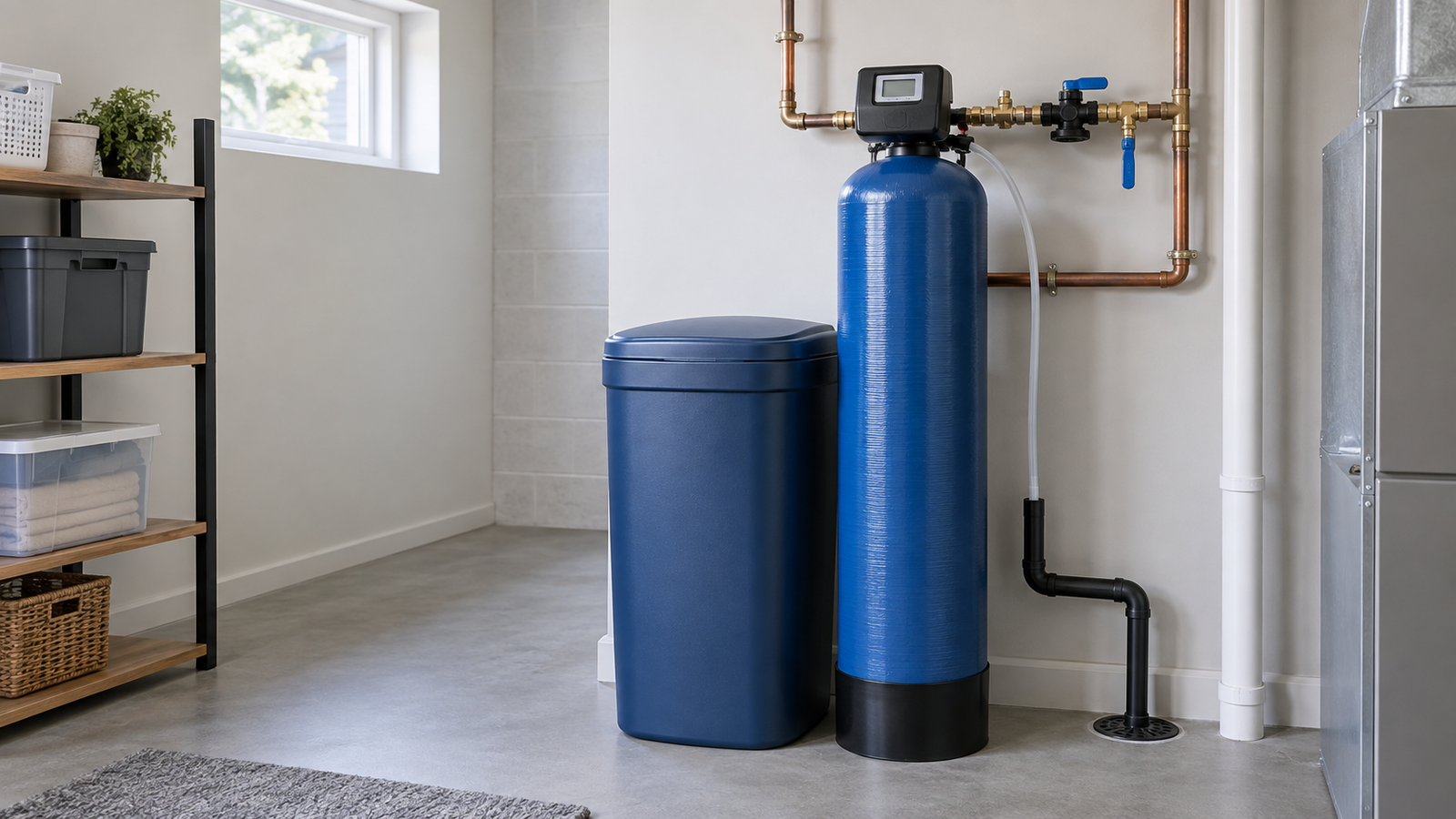
1. Quick answer: define the water and the installation before comparing prices
A professionally installed whole-house water softener commonly costs in the low thousands of dollars, but there is no single price that fits every home. This Old House reports a broad installed-cost range of approximately $200 to $6,000, depending on the system type, size, brand, location and installation conditions. This is a commercial planning reference, not a government price or a quotation for your property.
The useful number is a written local quote based on a current water test, the household’s demand, the chosen system and verified performance claims, and the actual plumbing scope. A straightforward replacement beside an existing softener loop is not comparable with a first-time installation that needs main-line alterations, a drain, an air gap, a receptacle, permits, wall repair, or work in a tight location.
| Best first step. Test the untreated water and identify the home’s peak water demand before selecting a model. Do not buy only from a claimed grain-capacity number or a limited-time sales presentation. |
2. What a water softener does—and what it does not do
Hardness is caused mainly by dissolved calcium and magnesium. A conventional cation-exchange softener removes hardness ions and exchanges them for sodium or potassium ions. The resin is periodically regenerated with a salt solution. EPA notes that this regeneration consumes water; efficiency and settings therefore matter over the life of the system.
A softener is not a universal water purifier. It does not automatically make microbiologically unsafe water safe, and it is not a substitute for treatment selected for arsenic, nitrate, lead, pathogens, volatile chemicals, or other contaminants. If the home uses a private well, use appropriate laboratory testing and address health-related contaminants separately. If anyone must restrict sodium intake, discuss softened drinking water with a qualified health professional and consider an appropriate unsoftened drinking-water tap or other treatment based on local advice.
Products marketed as salt-free conditioners may reduce certain scale effects but generally do not remove calcium and magnesium in the same way as a cation-exchange softener. Ask the seller to state exactly what is reduced, how performance was tested, and whether the proposal is for true softening or conditioning.
3. Test hardness and other relevant water characteristics
The U.S. Geological Survey classifies water as soft at 0–60 milligrams per liter (mg/L) as calcium carbonate, moderately hard at 61–120 mg/L, hard at 121–180 mg/L, and very hard above 180 mg/L. One grain per gallon (gpg) is approximately 17.1 mg/L. A result of 171 mg/L, for example, is about 10 gpg.
| Hardness as CaCO₃ | Approx. gpg | USGS classification |
| 0–60 mg/L | 0–3.5 | Soft |
| 61–120 mg/L | 3.6–7.0 | Moderately hard |
| 121–180 mg/L | 7.1–10.5 | Hard |
| >180 mg/L | >10.5 | Very hard |
Use the actual untreated-water result at the installation address. Public-water customers can review the utility’s current water-quality report, but hardness can vary across sources and operating conditions. A site test helps confirm the water reaching the home. Private-well owners may need a broader laboratory analysis.
Hardness, reported in mg/L as calcium carbonate or gpg.
Iron and manganese, because they can foul resin or require pretreatment and different sizing.
pH, total dissolved solids, turbidity, chlorine or other oxidants, and any known contaminants relevant to the proposed equipment.
Whether the source is municipal water or a private well, and whether the supply changes seasonally.
The test method, date, sample location, and laboratory or contractor that produced the result.
4. Choose the system type before comparing quotes
| System type | Best-fit discussion | Cost and scope questions |
| Single-tank demand-initiated softener | Common whole-house choice; regenerates when calculated capacity is used | Rated capacity at the proposed salt dose, service flow, reserve setting, regeneration water and salt use |
| Twin alternating tank softener | Can provide continuous softened water and serve high or continuous demand | Why continuous service is needed, space, controls, two tanks, installation and maintenance |
| Portable or exchange tank service | Provider exchanges regenerated tanks; can suit restrictions or temporary needs | Recurring service charge, exchange frequency, delivery access and contract terms |
| Salt-free conditioner | May address scale behavior but is not equivalent to ion-exchange softening | Specific verified claim, limitations, cartridge/media replacement and expected water result |
For a conventional residential softener, look for certification to NSF/ANSI 44 and confirm the exact manufacturer and model in an official certification listing. NSF explains that the standard covers residential cation-exchange softeners regenerated with sodium or potassium chloride and includes material safety, structural integrity, performance, and information requirements. Certification is model-specific; a logo in a brochure is not enough.
5. Size the softener from hardness, demand, and flow
A useful planning calculation is daily hardness load: untreated hardness in grains per gallon multiplied by estimated daily gallons of softened water. If a household uses 240 gallons per day and hardness is 10 gpg, the nominal load is 2,400 grains per day before any adjustment for iron, manganese, reserve capacity, or operating efficiency.
| Planning formula. Daily hardness load (grains/day) = hardness (gpg) × softened-water use (gallons/day). Use the worksheet for comparison, then have the supplier document all adjustments and settings. |
Do not size only by multiplying occupants by a generic number. Review actual utility records where available, which fixtures will receive softened water, changes in occupancy, and peak simultaneous use. The softener must also deliver enough service flow without an unacceptable pressure drop. A large household with multiple showers, a soaking tub, or high-flow fixtures may require different valve and resin sizing from a household with the same average daily gallons but lower peak demand.
Advertised ‘32,000-grain’ or ‘48,000-grain’ labels can be misleading if the usable capacity depends on an inefficient salt dose. Ask each bidder to state the certified or manufacturer-rated capacity at the programmed salt dose, the expected days between regenerations, reserve setting, service flow rate, pressure-drop basis, and estimated salt and regeneration-water use.
6. Installation conditions that change the price
Existing softener loop: a correctly located loop, drain, air gap, bypass arrangement, and nearby receptacle can reduce work.
Main-line access: finished walls, ceilings, crawlspaces, slabs, exterior routing, or congested mechanical rooms increase labor and restoration.
Drainage: regeneration discharge needs an approved receptor and air gap. Local rules may restrict discharge to a septic system, storm drain, dry well, or sanitary sewer.
Bypass and isolation: verify that the proposal includes a serviceable bypass and valves that allow the home to receive water during maintenance.
Electrical supply: many controls require a suitable nearby receptacle. Extension cords should not become the permanent plan.
Outdoor installation: freezing, heat, weather, sunlight, insects, and electrical protection may require an enclosure or make the location unsuitable.
Pretreatment: sediment, iron, manganese, chlorine, or other water conditions may require separate equipment and maintenance.
Permits and inspection: requirements vary by jurisdiction. Confirm who obtains and pays for them.
Removal and restoration: include disposal of old equipment, salt, cleanup, wall or floor repair, and protection from leakage.
A drain connection deserves special attention. The installer should identify the receptor, air-gap method, pipe size and route, maximum discharge rate, and local approval. Never assume that a floor drain, standpipe, sump, storm connection, or septic system may accept regeneration water merely because it is nearby.
7. What should be included in an installed price
| Quote section | What the written proposal should identify |
| Water basis | Test results, source, date, units, iron/manganese and any pretreatment assumptions |
| Equipment | Manufacturer, exact model, resin quantity/type, tank and valve, bypass, brine tank, certification and rated performance |
| Sizing | Household demand, hardness load, peak flow, capacity at programmed salt dose, reserve and regeneration frequency |
| Plumbing | Connection point, pipe and fittings, loop modifications, valves, drain/air gap, overflow and protection |
| Electrical/site | Receptacle or electrical work, equipment pad, enclosure, access and restoration |
| Commercial terms | Equipment, labor, permit, tax, removal, exclusions, allowances, payment schedule and change-order procedure |
| Closeout | Startup settings, hardness test, operating demonstration, manuals, warranty and service contact |
Preserve each original quote and compare the same target scope. If one contractor includes pretreatment and another excludes it, do not treat the headline totals as equivalent. Ask for a revised quote or record the difference visibly in the comparison worksheet.
8. Operating cost matters after installation
The installed price is only the first cost. A conventional softener uses salt or potassium chloride, water during regeneration, a small amount of electricity for controls, and periodic cleaning or service. Resin, seals, injectors, valves, meters, and electronic controls may eventually need repair or replacement. A filter or iron-treatment stage adds its own media and service schedule.
Estimated pounds of salt per regeneration and regenerations per month under the quoted settings.
Estimated gallons of water used per regeneration and the basis for that estimate.
Current local price and availability of salt or potassium chloride.
Required annual service, sanitizing, filters, cleaners, or proprietary supplies.
Warranty length and exclusions for tank, valve/control, resin, electronics, labor, travel, and water quality.
Whether service depends on an ongoing contract and what happens if the contract ends.
Efficiency claims should be tied to the exact model, settings, and water conditions. The cheapest unit may cost more to operate if it regenerates too frequently or uses an inefficient salt setting; an oversized unit can also operate poorly if programmed incorrectly.
9. Compare three water-softener quotes line by line
Give every bidder the same water-test results and household-demand information.
Request the exact manufacturer and model—not only a brand family or grain label.
Verify model-specific certification and performance information in the certifier’s listing.
Compare capacity at the proposed salt dose, service flow, pressure drop, reserve, and regeneration assumptions.
Separate equipment, labor, plumbing changes, electrical work, permits, tax, removal, restoration, pretreatment, and optional service plans.
Calculate the first-year total using the installed price plus estimated salt, service, filters, and other required operating items.
Check the contractor’s locally required license or registration, insurance, references, written contract, payment schedule, and change-order terms.
Select from the complete record—not from the lowest headline price or the highest claimed capacity.
Before selecting an installer, review our 21-point contractor hiring checklist and guide to understanding general contractor fees.
21 -point contractor hiring checklist : https://homedecisioncompass.com/how-to-hire-a-contractor/
Understanding general contractor fees: https://homedecisioncompass.com/general-contractor-fees/
| Downloadable tool. Use the EV-004 Water Softener Installation Quote Comparison Worksheet to record the water test, sizing assumptions, three proposals, installed totals, first-year costs, warranties, exclusions, and verification status. |
Download the EV-004 Water Softener Installation Quote Comparison Worksheet
10. Red flags that deserve clarification
A system is recommended without a hardness test or without asking about household flow and water use.
The seller promises to remove every contaminant or describes a conditioner as a softener without a specific verified claim.
Only a large grain-capacity label is shown; capacity at the programmed salt dose and service flow are omitted.
The exact model, certification listing, resin quantity, valve, bypass, drain, or installation scope is missing.
Regeneration discharge is routed to an unapproved location or without an appropriate air gap.
The proposal omits permits, electrical work, plumbing restoration, old-equipment removal, startup testing, or required pretreatment.
Savings, equipment life, health benefits, or water quality are guaranteed without evidence and stated conditions.
A large deposit or full payment is demanded before documented progress, contrary to applicable local law or ordinary safeguards.
11. Frequently asked homeowner questions
How much does water softener installation cost?
Commercial cost guides currently place many installed projects in the low thousands, with broad ranges extending below and well above that level. Your local cost depends on system type and capacity, water conditions, existing plumbing, drain and electrical access, permits, pretreatment, restoration, and what the quote includes.
What size water softener do I need?
Size from tested hardness, actual or reasonably estimated softened-water use, peak flow, iron or manganese conditions, desired regeneration interval, and capacity at the programmed salt dose. Ask the supplier to document the calculation and settings rather than relying only on a nominal grain label.
Is a salt-free conditioner the same as a water softener?
Generally, no. Conventional cation-exchange softeners remove calcium and magnesium hardness ions. Salt-free products may change scale behavior but should be evaluated by their specific verified performance claim, not assumed to produce the same water.
Should I soften every fixture?
That depends on local plumbing, water quality, household preferences, irrigation, plants, sodium considerations, and equipment design. Many installations bypass outdoor irrigation and may provide an unsoftened drinking-water tap. The proposed routing should be shown in writing.
Can a water softener discharge into a septic system or storm drain?
Do not assume it can. Discharge requirements vary by state, municipality, sewer utility, and onsite-wastewater authority. Identify the receptor and obtain local approval before installation.
How do I verify a certified model?
Record the exact manufacturer and model number and search the certification body’s current official listing. Confirm that the listing covers the relevant standard and claim; do not rely only on a logo or a statement that some products from the brand are certified.
Should I choose the lowest quote?
Not automatically. Normalize the water basis, equipment, sizing, flow, plumbing, drain, electrical work, permits, startup, warranty, service, exclusions, and operating cost. A lower total may omit work or transfer more risk to the homeowner.
Sources and editorial notes
U.S. Geological Survey, Hardness of Water: https://www.usgs.gov/water-science-school/science/hardness-water
U.S. EPA WaterSense, Cation Exchange Water Softeners: https://www.epa.gov/watersense/cation-exchange-water-softeners
U.S. EPA, Guide to Selecting Water Treatment Systems: https://www.epa.gov/system/files/documents/2024-11/ws-products-home-water-treatment-guide_508.pdf
NSF, NSF/ANSI 44 Technical Requirements: https://www.nsf.org/knowledge-library/nsf-ansi-44-technical-requirements
NSF, Certified Drinking Water Treatment Units: https://info.nsf.org/Certified/dwtu/
Federal Trade Commission, How To Avoid a Home Improvement Scam: https://consumer.ftc.gov/articles/how-avoid-home-improvement-scam
This Old House, How Much Does a Water Softener System Cost?, updated June 16, 2026:
https://www.thisoldhouse.com/plumbing/water-softener-system-cost
Modernize, Water Softener Installation Cost, updated April 22, 2026: https://modernize.com/water-treatment/types/water-softener-installation-cost
| Editorial boundary. National cost figures are planning references only. Recheck prices, publication dates, certification listings, links, and all local permit and discharge statements immediately before publication. Local authority requirements and the property-specific water test control. |