1. Quick answer and realistic planning range
The cost of sump pump replacement depends first on whether the contractor can reuse the existing basin, discharge pipe and electrical supply. A straightforward like-for-like replacement may be planned at roughly $600 to $1,500. A replacement that also needs discharge changes, a new check valve, electrical work, a sealed cover, an alarm or a backup system can move into roughly the $1,200 to $3,000-plus range. Creating an entirely new pit and drainage path is a different project and may cost substantially more.
These are planning ranges, not a national price promise. Labor rates, access, pump type, capacity, head height, backup design, permit requirements and local discharge rules can change the final quote. Ask every contractor to price the same written scope, then compare exclusions as carefully as the total.
| Project condition | Planning range | What usually changes the price |
| Simple replacement | $600–$1,500 | Existing basin, outlet and discharge are serviceable; limited piping changes |
| Replacement with upgrades | $1,200–$3,000+ | Backup, alarm, electrical or discharge modifications, sealed cover |
| New pit or drainage system | Often $1,500–$4,000+ | Concrete cutting, excavation, basin, drain tile or major discharge work |
2. Replacement versus repair versus an entirely new installation
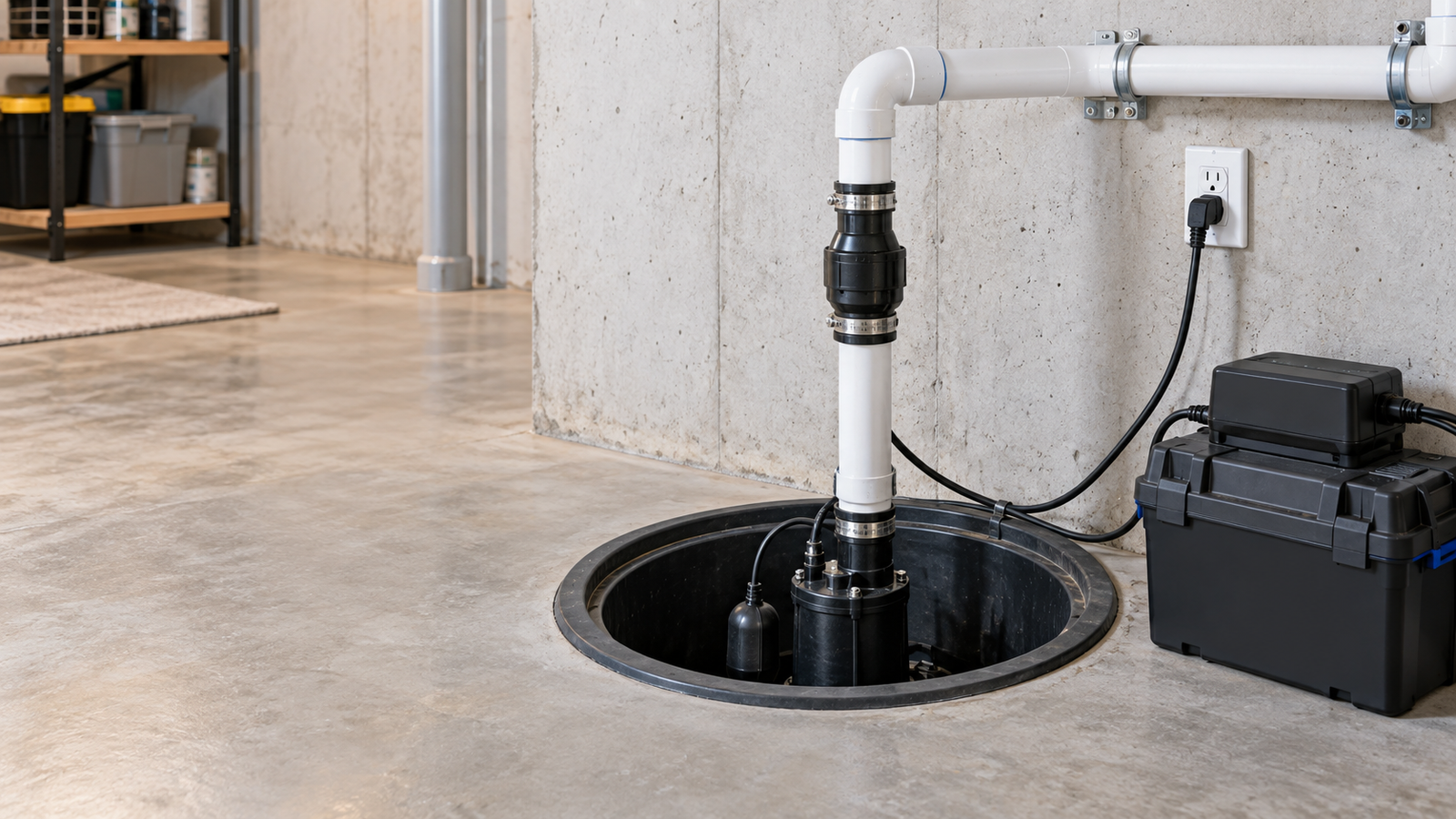
Replacement normally means removing a failed or undersized pump from an existing basin and connecting a new pump to usable discharge piping and power. Repair may be reasonable when the problem is limited to a switch, check valve, obstruction or connection and the pump is otherwise serviceable. A new installation can require a pit, basin, drainage collection, concrete work, a legal discharge route and a dedicated electrical supply.
Before accepting a replacement quote, ask the contractor to identify the failure. A pump that runs but cannot keep up may be too small, obstructed, worn, poorly matched to the discharge head, or receiving more water than the system was designed to handle. Replacing only the motor without correcting the cause can reproduce the same problem.
3. Pedestal versus submersible pumps
A submersible pump sits in the basin and is designed to operate in water. It is usually quieter and works with a covered basin, but the basin must be large enough for the pump and float to move freely. A pedestal pump keeps its motor above the basin. It may be easier to access and can suit a narrow pit, but it is more visible and may be noisier.
Do not choose only by horsepower or initial price. Compare the manufacturer’s performance curve, the required flow at the actual head, basin dimensions, switch clearance, solids-handling capability where relevant, duty rating, warranty and local service support.
4. Pump capacity head height and correct sizing
Pump capacity is commonly expressed in gallons per hour or gallons per minute at a stated head. Head is the resistance the pump must overcome: vertical lift is important, but pipe length, diameter, fittings, valves and the discharge outlet also add resistance. A pump advertised at a high flow rate at zero head will deliver less at the house’s actual operating head.
Ask the contractor to state the estimated vertical lift and total dynamic head used for selection.
Request the proposed model number and its flow rate at that head, not only its horsepower.
Confirm that the basin and float provide adequate run time without short cycling.
Confirm that the discharge pipe size and fittings match the manufacturer’s instructions.
Ask how the proposed capacity relates to the observed or estimated inflow during heavy rain.
5. Existing basin and discharge condition
The contractor should inspect the basin for damage, sediment, insufficient diameter, an unstable base, a restricted inlet and inadequate float clearance. The discharge system should be checked for leaks, freezing risk, poor support, an obstructed outlet and water returning toward the foundation.
A check valve helps prevent water in the discharge pipe from flowing back into the pit after the pump stops. Its orientation, accessibility and compatibility matter. Some pump manufacturers also require a relief or vent hole in a specified location to prevent air lock; follow the selected model’s instructions rather than applying one universal detail.
Discharge rules vary. In many communities, clear groundwater from a sump pump must not enter the sanitary sewer. The contractor should identify the approved destination and protect the outlet from erosion, blockage and recirculation toward the house.
6. Labor access electrical and site cost factors
Restricted crawlspace or finished-basement access
Removal of a corroded pump, seized fittings or heavy sediment
Concrete cutting, excavation or basin replacement
Long discharge runs, many fittings, wall penetrations or freeze protection
A new receptacle, circuit, alarm connection or code correction
Permit and inspection requirements
After-hours or emergency work
Removal, disposal and restoration of finishes
Keep plumbing, electrical and restoration allowances visible as separate line items. If a quote says “electrical by owner” or “restoration excluded,” obtain those prices before selecting the contractor.
7. Check valves alarms and sealed covers
A replacement quote should state whether the check valve is new or reused and whether a union or removable connection is included for future service. A high-water alarm provides warning when water rises above the normal pumping level. It does not remove water, but it can shorten the time between failure and response.
A fitted cover can reduce noise, odors, debris and accidental contact. If the sump participates in a radon-control system, the cover and penetrations may need airtight sealing while remaining serviceable. Ask a qualified radon professional before altering an existing sealed system.
8. Battery and water-powered backup options
A backup pump is a separate layer of protection, not merely a larger primary pump. Battery backup can operate during a power failure, but capacity and run time depend on the pump, battery, head, cycling frequency and battery condition. The quote should identify whether the battery, charger, controller, alarm and second check valve are included.
A water-powered backup uses pressurized municipal water to move sump water and does not depend on a battery. It may be unsuitable where local rules prohibit it, where water pressure or supply is unreliable, or where the property uses a private well that also loses power. Ask about required backflow protection and water consumption.
9. Power outages and flood limitations
Storms that increase groundwater can also interrupt utility power. A battery backup, water-powered backup or appropriately installed generator can reduce this risk, but each has limits. Battery duration is not fixed, and a backup may not match the primary pump’s full capacity.
A residential sump pump is not a guarantee against river flooding, prolonged inundation, sewer backup, surface water entering through doors or windows, or inflow that exceeds the system’s capacity. FEMA guidance warns that sump pumps depend on electricity and are not designed for unlimited water. Homeowners in flood-prone areas should evaluate broader flood-protection measures and insurance separately.
10. Questions to ask a sump pump contractor
Before contacting installers, review our 21-point contractor hiring checklist https://homedecisioncompass.com/general-contractor-fees/for licensing, insurance, written-contract and payment checks.
Is this quote for repair, like-for-like replacement, system upgrade or new installation?
What caused the existing system to fail or underperform?
What exact primary pump make and model is proposed?
What flow will it deliver at the estimated operating head?
Will the basin, cover, switch clearance and inlet arrangement be changed?
Are the check valve, unions, discharge fittings and outlet work included?
Where will the water discharge, and is that route permitted locally?
Is electrical work included, and who will perform it?
Are a high-water alarm and backup pump included or priced as options?
What battery, charger, controller and warranty are included with battery backup?
What permits, inspections, testing, cleanup and restoration are included?
What are the labor, pump, accessory and workmanship warranties?
What is excluded, provisional or subject to a change order?
Will the contractor test both primary and backup systems before handover?
11. Three quote comparison checklist
Use the downloadable Sump Pump Replacement Quote Comparison Worksheet to place three proposals side by side. Enter the model, flow at operating head, basin and discharge scope, backup system, electrical work, permits, warranties, exclusions and total cost. Do not select a quote only because its total is lowest.
Also review our guide to general contractor fees and pricing methods https://homedecisioncompass.com/how-to-hire-a-contractor/ when comparing labor charges, markups, allowances and exclusions.
Download the Sump Pump Replacement Quote Comparison Worksheethttps://homedecisioncompass.com/wp-content/uploads/2026/09/EV-006_Sump_Pump_Replacement_Quote_Comparison_Worksheet-1.xlsx
Same written scope and same performance requirement
Exact pump and backup model numbers
Clear discharge destination and piping responsibility
Separate allowances and exclusions
Testing and handover procedure
Evidence of required licensing, insurance and permit responsibility
Written warranty and payment schedule
12. Frequently asked homeowner questions
How much does sump pump replacement cost?
A straightforward replacement commonly falls within a planning range of about $600 to $1,500. Added electrical, discharge, basin, alarm or backup work can raise the total. A new pit and drainage installation should be estimated separately.
Can I replace only the pump?
Yes, when the existing basin, discharge, check valve arrangement and electrical supply are suitable. The contractor should still test the system and confirm the new model’s performance at the actual head.
Is a bigger horsepower pump always better?
No. An oversized or poorly matched pump may short cycle, disturb the basin or still fail to deliver the required flow at the actual head. Select from the performance curve and system conditions.
Do I need a battery backup?
It is worth considering where outages coincide with heavy rain, the basement contains valuable finishes or equipment, or the consequences of failure are high. Compare expected run time and capacity, and maintain the battery.
Can a sump pump discharge into the sanitary sewer?
Often no. Many municipalities prohibit it because groundwater consumes sanitary-sewer capacity and can contribute to overflows. Follow the local authority’s approved discharge requirements.
Will a sump pump prevent every basement flood?
No. It addresses water collected by the sump system within its capacity. It does not eliminate every surface-water, sewer-backup, plumbing-leak or major-flood risk.
13. Sources and editorial notes
FEMA, Urban Flooding Guidance for Homeowners and Renters
FEMA, Homeowner’s Guide to Retrofitting
FEMA, Be Flood Smart Protect Your Property
US EPA, Building Radon Out Step-by-Step Guide
City of Madison Wisconsin, Sump Pumps
Zoeller Pump Company, Product Support and Sizing Resources
The Home Depot, How to Replace a Sump Pump
This Old House, How Much Does a Sump Pump Cost
Forbes Home, Sump Pump Replacement and Installation Cost Guides
Editorial note: Costs are planning ranges synthesized from accessible US cost guides and should be verified with local written quotes. Manufacturer instructions and local codes control equipment selection and installation details. Source access and facts should be rechecked at each evidence refresh. Angi was intentionally excluded because the source was not reliably accessible during review.
Reviewed for US terminology and homeowner decision support. Evidence refresh date: September 10, 2026.