1. Quick answer and realistic planning range
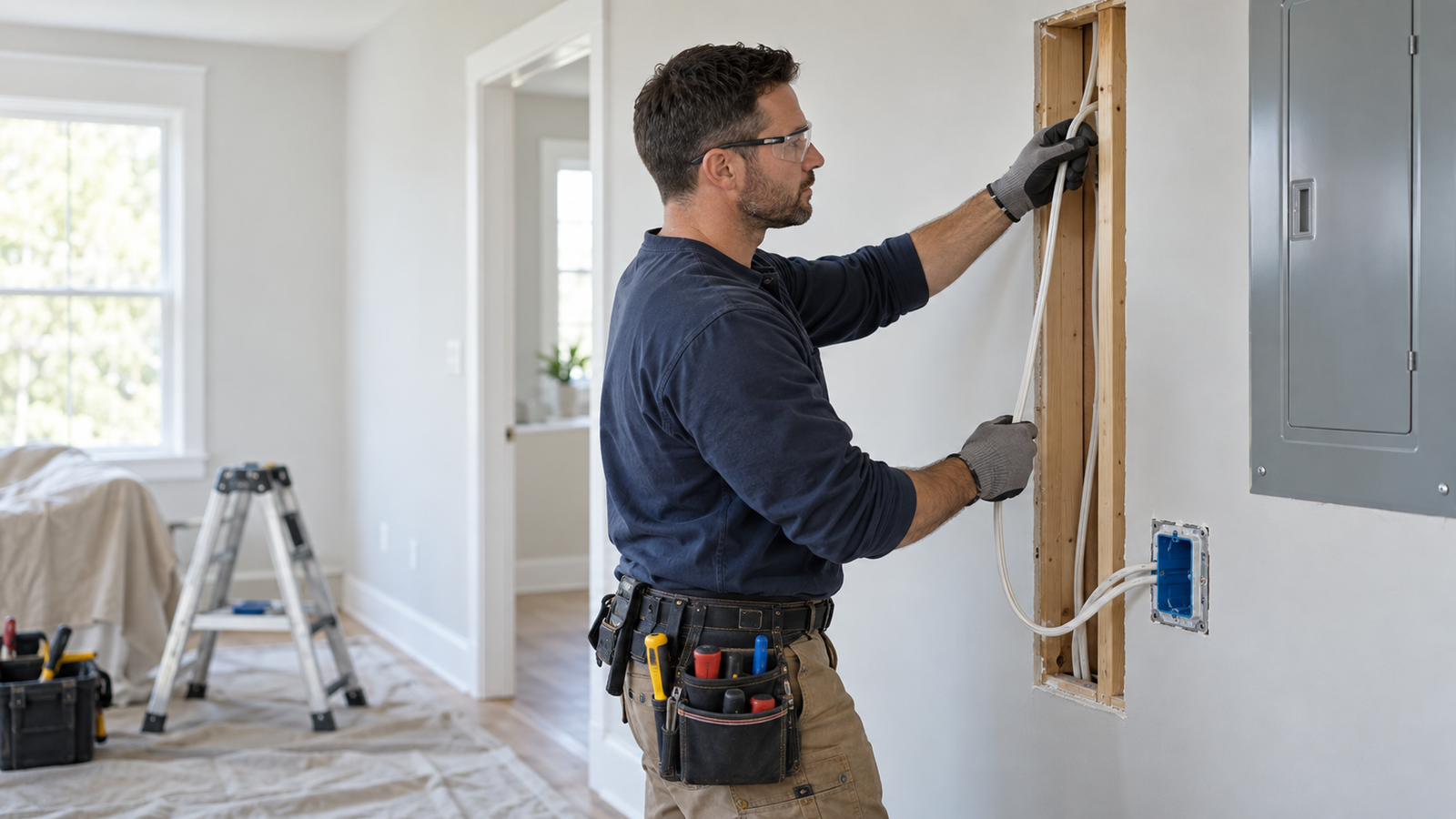
The cost of home rewiring depends more on scope and access than on one national average. Replacing one defective circuit may cost hundreds to a few thousand dollars. Partial rewiring commonly moves into several thousand dollars. A complete rewire of a finished home can reasonably require a planning allowance of about $8,000 to $30,000 or more, particularly when wiring is difficult to reach, the house is large, plaster must be repaired, or the project includes a service or panel upgrade.
Published US estimates vary widely because some sources describe only cable and electrical labor, while others include outlets, switches, new circuits, permits, wall opening and restoration. For an equal comparison, give each electrician the same written scope and require separate prices for electrical work, panel or service changes, permits, testing, drywall or plaster repairs, painting and temporary living arrangements.
| Scope | Planning allowance | Typical boundary |
| One circuit or localized correction | $500–$2,000+ | Limited route and accessible termination points |
| Partial rewiring | $2,000–$10,000+ | Selected rooms, circuits or hazardous sections |
| Whole-house rewiring | $8,000–$30,000+ | New branch-circuit wiring throughout a finished home |
| Panel, service and restoration | Price separately | May materially increase the complete project cost |
2. Repair partial rewiring and complete rewiring
A repair addresses a defined defect such as a damaged cable, loose connection or failed device. Partial rewiring replaces selected circuits, rooms or portions of an older system. Whole-house rewiring generally replaces branch-circuit wiring serving receptacles, lighting and fixed equipment throughout the home. These terms are not interchangeable, so the proposal should list every circuit and opening included.
A panel replacement or service-capacity upgrade is related but separate. New branch circuits must terminate in a suitable panel, yet a house does not automatically need a larger service merely because it is being rewired. A qualified electrician should evaluate existing and planned loads, panel condition, available spaces, grounding and bonding, utility requirements and local code.
3. Warning signs and the inspection decision
Frequent breaker trips, blown fuses, dimming or flickering lights, warm or discolored receptacle plates, buzzing, sparks, burning odors, shocks and damaged insulation can indicate an electrical problem. Turn off and stop using affected equipment when it can be done safely, and contact a qualified electrician. Do not remove the service-panel cover or attempt concealed-wiring repairs yourself.
Age alone does not prove that every cable must be replaced. The decision should follow an inspection of wiring type and condition, connections, grounding, overcurrent protection, panel condition, previous alterations and present electrical demand. Ask for photographs, test results or a circuit-by-circuit explanation supporting a recommendation for partial or complete rewiring.
4. Existing wiring type and condition
Older homes may contain knob-and-tube wiring, cloth-covered cable, ungrounded two-wire circuits, early nonmetallic cable, aluminum branch-circuit conductors or a mixture created by later renovations. Each condition requires a specific assessment; the mere presence of an older wiring type does not justify an undefined blanket price.
The US Consumer Product Safety Commission has issued specific guidance for homes with aluminum branch-circuit wiring and advises homeowners not to make repairs themselves. If aluminum wiring is suspected, ask an electrician experienced with that system to identify affected circuits and recommend an accepted repair or replacement approach.
5. Home size circuit count and electrical demand
Square footage is only a preliminary budgeting tool. Two homes of equal size can have very different circuit counts, appliance loads, outlet layouts and access conditions. The proposal should identify the number and type of circuits, receptacles, switches, fixtures, smoke or carbon-monoxide alarms, dedicated appliance circuits and future loads included.
Heat pumps, electric water heaters, induction cooking, clothes dryers, spas and electric-vehicle charging can change the load analysis. Ask whether the electrician has evaluated the home’s present and planned demand rather than simply assuming that a standard service size is sufficient.
6. Accessibility and finish restoration
Access is often the largest cost variable. An unfinished basement, crawlspace or attic may allow cable routes with limited disturbance. Finished walls, plaster, masonry, fire blocking, vaulted ceilings, built-in cabinets and multistory construction can require more labor and openings.
Who will create and patch wall or ceiling openings
Whether plaster, drywall, trim, wallpaper and paint matching are included
How dust and occupied rooms will be protected
Whether furniture removal, storage or temporary relocation is required
Who is responsible for concealed asbestos, lead paint, mold or other hazardous materials
Do not accept “minor patching by owner” without identifying the likely number, size and location of openings and obtaining a restoration allowance.
7. Panel service grounding and bonding
The electrician should state whether the existing panel and service remain, are modified, or are replaced. The scope should distinguish the service entrance, meter equipment, main disconnect, panelboard, breakers, grounding electrode system, bonding and branch circuits. Utility coordination and exterior equipment may fall outside the rewiring price.
If new electric appliances are planned, request a documented load calculation. A panel with no spare spaces may need reconfiguration or expansion, but capacity is not determined by empty spaces alone. Avoid duplicate costs by coordinating this article’s scope with the separate Home Decision Compass electrical-panel replacement guide. https://homedecisioncompass.com/electrical-panel-replacement-cost/
Section 10
8. Permits inspections and protective devices
Electrical codes and adopted editions vary by state and local jurisdiction. The proposal should identify the authority having jurisdiction, who obtains the permit, the inspections required and who corrects failed inspection items. Do not rely on a contractor’s statement that “no permit is normally needed” without checking the local authority.
Depending on the adopted code and scope, the project may require arc-fault circuit-interrupter protection, ground-fault circuit-interrupter protection, tamper-resistant receptacles, updated smoke or carbon-monoxide alarms, surge protection, grounding or bonding corrections and other upgrades. Ask each bidder to use the same code assumptions so one quote is not artificially low because required work is omitted.
9. Occupied-home logistics and project sequencing
Whole-house rewiring can interrupt power, lighting, internet, heating or cooling and appliance use. The proposal should state the work sequence, daily shutdown periods, rooms unavailable, security arrangements and whether the home can remain occupied. Coordinate electrical rough-in, inspections, wall closure and painting before final devices and testing.
Ask how the contractor will label circuits, protect belongings, secure openings, remove abandoned wiring where required, manage debris and restore essential power at the end of each workday.
10. Questions to ask an electrician
Before requesting proposals, use our 21-point contractor hiring checklist https://homedecisioncompass.com/how-to-hire-a-contractor/ to verify licensing, insurance, contracts, payments and warning signs.
What exact defect or limitation supports the recommended scope?
Is the proposal for repair, partial rewiring or complete branch-circuit replacement?
Which circuits, outlets, switches, fixtures and fixed appliances are included?
What wiring method and conductor sizes are proposed?
Are the panel, service, grounding and bonding included or excluded?
Was a load calculation performed for present and planned appliances?
Which permit, inspection and adopted-code requirements are included?
Are AFCI, GFCI, surge protection and alarm upgrades included where required?
How many wall and ceiling openings are anticipated?
Who performs patching, plaster repair, painting and cleanup?
Can the home remain occupied, and what shutdowns are expected?
What testing, labeling and documentation will be provided at handover?
What labor and material warranties apply?
Which allowances, exclusions and possible change orders remain?
11. Three quote comparison checklist
Use the downloadable Home Rewiring Quote Comparison Worksheet to compare three electricians against the same circuit schedule and finish-restoration assumptions. Record license and insurance verification, wiring method, device counts, panel or service work, permits, protective devices, openings, restoration, testing, warranty and total price.
Review our guide to general contractor fees and pricing methods https://homedecisioncompass.com/general-contractor-fees/ when comparing labor charges, allowances and exclusions.
Download the Home Rewiring Quote Comparison Worksheet https://homedecisioncompass.com/wp-content/uploads/2026/09/EV-007_Home_Rewiring_Quote_Comparison_Worksheet.xlsx
The same rooms, circuits and devices are included in all quotes
Electrical work and finish restoration are priced separately
Panel and service work are clearly included or excluded
Permits, inspections and corrections are assigned
Allowances and unit prices are stated
Testing, circuit labeling and closeout documents are included
Payment milestones follow inspected progress
12. Frequently asked homeowner questions
How much does it cost to rewire a house?
A whole-house rewire may require roughly $8,000 to $30,000 or more, but size alone does not determine the price. Finished-wall access, circuit count, local labor, panel work, permits and restoration can materially change the total.
Does an old house automatically need complete rewiring?
No. Age is a reason to inspect, not proof that every circuit must be replaced. The electrician should document wiring type, condition, hazards, capacity and previous alterations before defining the scope.
Is the electrical panel included in a rewiring quote?
Not necessarily. Require the proposal to state whether the service, meter equipment, main disconnect, panel, breakers, grounding and bonding are included or priced separately.
Will walls have to be opened?
Often some openings are needed, but their number depends on access, construction and routing. Ask bidders to state their access method and responsibility for patching and painting.
Can I live in the home during rewiring?
Sometimes, but the answer depends on phasing, shutdowns, dust, open walls and local inspection sequencing. Obtain a written occupancy and temporary-power plan.
Can a homeowner perform whole-house rewiring?
This guide does not recommend it. Rewiring presents shock and fire hazards and normally involves code, permits, inspections and specialized testing. Use a qualified, appropriately licensed electrician as required locally.
13. Sources and editorial notes
US Consumer Product Safety Commission, Guide to Home Wiring Hazards
US Consumer Product Safety Commission, Repairing Aluminum Wiring
National Fire Protection Association, Electrical Safety in the Home
Electrical Safety Foundation International, AFCI versus GFCI
ENERGY STAR, Make Your Home Electric Ready
US Department of Energy, Home Electrification and Electric Panel Upgrades
Homewyse, Cost to Rewire a Home 2026
HomeGuide, Cost to Rewire a House 2026
SoFi, Cost to Rewire a House 2026
This Old House, Electrician Cost Guide
Editorial note: Cost figures are broad planning allowances synthesized from accessible US cost guides. They are not bids and should be replaced by local written quotes for a defined scope. Code requirements, licensing, permits and inspection practices vary by jurisdiction. Technical claims were checked against government, NFPA, ESFI, ENERGY STAR and Department of Energy sources. Angi was excluded because it was not reliably accessible during earlier Project Everest source testing.
Reviewed for US terminology, homeowner safety and quote comparison. Evidence refresh date: September 11, 2026.