Quick answerer
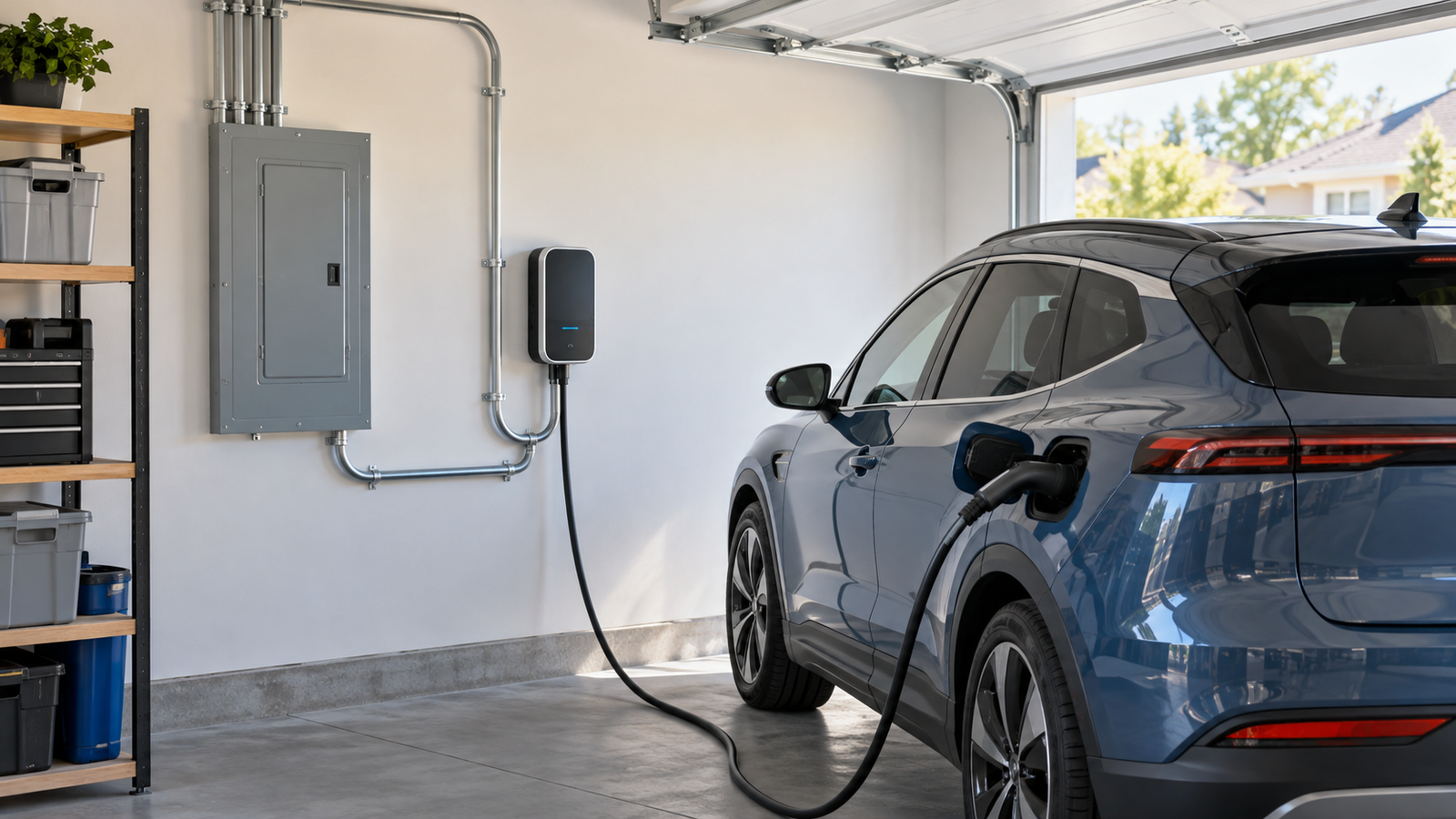
For a typical US home, a Level 2 EV charger commonly requires a planning budget of roughly $700 to $3,000 for equipment and installation when the electrical panel has adequate capacity and the wiring route is straightforward. The US Environmental Protection Agency currently lists approximately $400 to $1,000 for Level 2 equipment and $300 to $2,000 for installation, depending on the home setup. A long cable route, finished-wall work, trenching, load-management equipment, panel replacement or utility service work can raise the total by thousands of dollars.
The correct price starts with the vehicle’s charging limit, daily driving need, parking location and the home’s available electrical capacity. More amperage is not automatically better. A correctly sized lower-power Level 2 circuit may meet overnight charging needs while avoiding unnecessary electrical upgrades.
Obtain an electrical load calculation and written quotes from qualified electricians. Require each quote to identify the charger, circuit rating, conductor route, panel work, permits, inspection, utility coordination, surface restoration and warranty. Verify current local rebates before ordering equipment; do not assume a past federal incentive is still available.
1 Define the residential charging project
This guide covers installation of Level 1 or Level 2 electric vehicle supply equipment at a US single-family home. It does not price public or commercial charging stations, fleet depots, DC fast charging, vehicle purchases or an electrical-panel replacement as the principal project.
Homeowners commonly say EV charger, while codes and technical documents often use EVSE, meaning electric vehicle supply equipment. The EVSE safely supplies electricity and communicates with the vehicle; the vehicle’s onboard charger controls the battery-charging process.
Before requesting quotes, record the vehicle model, connector requirement, maximum AC charging rate, parking position, approximate distance to the electrical panel and whether a second EV or other major electric appliance is likely.
2 Decide whether Level 1 or Level 2 meets the need
Level 1 normally uses a 120-volt receptacle and may meet the needs of a plug-in hybrid, a low-mileage driver or a vehicle parked for long periods. The Alternative Fuels Data Center notes that Level 1 may require no additional installation when a suitable receptacle on a dedicated branch circuit is already available near the parking location.
Level 2 uses 240-volt power and is the common home upgrade for faster overnight charging. ENERGY STAR reports that Level 2 charging is faster and, on average, more efficient than Level 1. Charging speed still depends on the circuit, EVSE output and the vehicle’s onboard charging limit.
Estimate daily miles that must be replaced, not only the battery’s full capacity.
Confirm the vehicle’s maximum AC input before buying a high-output EVSE.
Consider whether scheduled overnight charging at a lower current will satisfy normal use.
Keep occasional long trips separate from everyday charging needs.
3 Build a realistic installation budget
EPA’s current home-charging guide provides a useful baseline of $400 to $1,000 for Level 2 equipment and $300 to $2,000 for installation. Treat this as a planning reference, not a quotation. The Alternative Fuels Data Center cites approximately $1,300 per residential Level 2 connector for charging equipment, excluding labor and permitting, based on a national laboratory cost study. The sources define cost components differently, which explains part of the variation.
| Cost component | What the quote should show | Why the price changes |
| EVSE equipment | Brand, model, connector, output and warranty | Power, cable length, networking and outdoor rating |
| Dedicated circuit | Breaker, conductors, raceway and disconnect if required | Amperage, route length and construction type |
| Panel work | Capacity review, breaker space and any modifications | Existing rating, condition and available capacity |
| Permit and inspection | Applications, fees and correction responsibility | Local authority and project scope |
| Site work | Trenching, boring, mounting and surface restoration | Parking location, distance, soil and finishes |
| Utility work | Service or meter coordination when required | Local utility rules and available capacity |
A short surface-mounted run from a nearby garage panel is usually less expensive than concealed wiring through finished rooms or an outdoor route requiring trenching. Ask for alternate prices when charger power, route or mounting method can be changed without compromising the homeowner’s needs.
4 Require a load calculation before choosing amperage
An EV charging load can be one of the largest sustained electrical loads in a home. The electrician should evaluate the service rating, panel rating, existing loads, breaker space and applicable code requirements rather than judging capacity from an empty breaker position alone.
If an upgrade is recommended, review our guide to electrical panel replacement cost before comparing the additional work.
If capacity is limited, compare three possibilities: a lower charging current, approved energy-management or load-management equipment, and a panel or service upgrade. Smart charge management can sometimes control charging during high household demand, but the equipment and design must be accepted by the authority having jurisdiction and compatible with the EVSE.
Do not accept a panel upgrade solely because a salesperson says Level 2 always requires one. Conversely, do not install a large continuous load without a documented capacity assessment.
5 Compare charging power with actual driving needs
Level 2 equipment is offered at several output ratings. The circuit and EVSE must be coordinated, and the vehicle may accept less power than the EVSE can provide. A high-output unit cannot force a vehicle to charge faster than its onboard limit.
Ask the electrician to show the expected charging power and the estimated range recovered during the normal overnight parking period. Consider future vehicles, but price the electrical consequences of future-proofing rather than treating maximum output as automatically necessary.
6 Choose hardwired or plug connected equipment
A hardwired EVSE is permanently connected to the circuit. A plug-connected unit uses a compatible receptacle and plug. Local requirements, EVSE rating, installation location and manufacturer instructions determine what is permitted.
A receptacle installation adds the receptacle, enclosure and connection points and may have specific ground-fault protection requirements. A hardwired installation can reduce connection points and may suit outdoor or higher-output locations. Portability alone should not override electrical safety, code compliance or equipment instructions.
The quote should identify the exact connection method, receptacle type if any, mounting height, cable reach, weather protection and whether a separate disconnect is required.
7 Plan the circuit route and parking position
Route length is a major labor and material factor. Ask the electrician to mark the proposed panel-to-EVSE path and state whether wiring will be surface mounted, concealed in walls, routed through an attic or crawlspace, or installed underground.
Locate the EVSE so the charging cable reaches the vehicle inlet without extension cords, tight bends or a trip hazard. Consider the vehicle’s normal orientation, a future vehicle with a different inlet location and protection from impact, water, snow and direct traffic.
Outdoor or detached-garage work may involve trenching, boring, underground raceway, grounding considerations, separate structures, landscape restoration and utility locating. Require these items to be priced clearly.
8 Select safe compatible charging equipment
Choose equipment listed or certified by a recognized testing organization and suitable for the installation environment. ENERGY STAR certified models can reduce standby energy use and provide a searchable product list, but energy certification does not replace electrical listing, correct installation or vehicle compatibility.
Confirm connector compatibility with the present vehicle and likely future vehicles. Adapter availability and connector standards are changing, so verify the vehicle manufacturer’s current instructions rather than relying on a sales description.
Record the manufacturer, model number and maximum output.
Confirm indoor or outdoor rating and operating-temperature range.
Check charging-cable length and replacement availability.
Understand Wi-Fi, app, access control and subscription requirements.
Confirm warranty registration and who handles equipment failure.
9 Check permits utility rules and incentives
Charging equipment must comply with applicable national, state and local requirements. The Alternative Fuels Data Center advises using a qualified electrical contractor and obtaining required permits. Ask who files the permit, attends inspection and corrects rejected work.
Contact the electric utility when its approval, service evaluation, meter program, time-of-use rate or rebate may apply. Some utilities require preapproval, specified equipment or installation by a participating contractor. Obtain written program terms before buying the charger.
Federal rules have changed. IRS guidance states that the Alternative Fuel Vehicle Refueling Property Credit is not allowed for property placed in service after June 30, 2026. Because this article is being prepared after that date, homeowners should not assume a federal residential charger credit is available. Verify current federal law and separately check state, local and utility incentives.
10 Compare written quotes on the same scope
Obtain at least three written quotes when practical. Give each electrician the same vehicle, parking, panel and route information. Compare the complete evaluated project cost, not only the circuit-installation price.
Homeowners should also understand general contractor fees and pricing methods https://homedecisioncompass.com/general-contractor-fees/ when evaluating markups, allowances and additional charges.
Identify the EVSE brand, model, output, connector and who supplies it.
State the circuit voltage, breaker rating, conductor system and route length.
Include the load calculation and available-capacity conclusion.
Separate panel modifications, load management and service-upgrade alternatives.
Describe hardwired or receptacle connection and required protective devices.
Price permits, inspection, utility coordination and correction responsibility.
Price trenching, wall repair, firestopping, painting and landscape restoration.
List exclusions, allowances and unit prices for uncertain work.
State the schedule, electrical outage, commissioning and homeowner instruction.
Require written approval before additional work proceeds.
Use the downloadable EV Charger Installation Quote Comparison Worksheet to compare all bidders on the same scope.
11 Ask the electrician these questions
What charging output does my vehicle accept, and what output do you recommend?
What load calculation supports the proposed circuit?
Can a lower charging current meet my daily driving needs?
Is load-management equipment a suitable alternative to a panel or service upgrade?
What breaker, conductors, raceway and connection method will you install?
Is the EVSE listed and suitable for this indoor or outdoor location?
Who obtains the permit and attends the inspection?
Does the utility require approval, a special rate, meter work or specific equipment?
Which walls, ceilings, pavement or landscaping will be disturbed and restored?
How will the system be tested and commissioned?
What labor and equipment warranties apply?
What items could create a change order?
12 Protect the contract payment and closeout
The contract should name the licensed electrical contractor where required and define the EVSE, circuit, route, panel work, protective devices, permits, restoration, dates, price, allowances, payment schedule, warranty and change-order process.
Before signing an agreement, use our 21-point contractor hiring checklist https://homedecisioncompass.com/how-to-hire-a-contractor/ to verify qualifications, insurance, contract terms and payment protections.
Tie payments to observable milestones such as approved equipment delivery, completed rough work, passed inspection, successful commissioning and completed restoration. Do not make final payment while permit corrections, app setup, labeling or damaged finishes remain unresolved.
Keep the load calculation, permit, inspection approval, photographs, circuit directory, equipment manual, warranty, utility correspondence, rebate records, invoices and written change orders.
13 Watch for quotation red flags
The electrician recommends amperage without asking about the vehicle or daily driving.
Panel capacity is judged only by visible breaker spaces, with no load assessment.
A panel upgrade is declared mandatory without an explanation or alternatives.
The quote says charger installation but omits the model, output, circuit or route.
Permits or inspections are dismissed without checking local requirements.
Trenching, wall repair, firestopping or restoration is left entirely undefined.
The EVSE lacks a clear electrical listing or suitability for the location.
A rebate or tax credit is promised without current written eligibility rules.
Full payment is requested before inspection and commissioning.
Verbal promises do not appear in the signed agreement.
Frequently asked homeowner questions
How much does home EV charger installation cost?
EPA currently lists about $400 to $1,000 for Level 2 equipment and $300 to $2,000 for installation. Straightforward projects may fall within that combined range, while panel, service, trenching or restoration work can increase the total substantially.
Does every EV owner need a Level 2 charger?
No. Level 1 may meet the needs of some plug-in hybrid owners and low-mileage drivers. Level 2 is commonly selected for faster overnight charging.
Does a Level 2 charger always require a panel upgrade?
No. The answer depends on service and panel capacity, existing loads, charger output and applicable rules. A load calculation should support the decision.
Is a 50 amp charger always faster?
No. Circuit rating, EVSE output and the vehicle’s onboard charger all limit charging power. More available power does not help when the vehicle accepts less.
Is hardwired installation better than a plug?
Neither is universally better. Rating, location, local rules, manufacturer instructions and homeowner needs determine the suitable connection.
Can I install an EV charger myself?
Do not assume so. Level 2 work usually involves a dedicated 240-volt circuit, permitting and inspection. AFDC guidance recommends a qualified electrical contractor.
How long does installation take?
A simple nearby circuit may be completed in several hours. Permits, long routes, trenching, panel work, utility coordination and corrections can extend the project.
Is a federal EV charger tax credit available in late 2026?
IRS guidance states that the Section 30C credit is not allowed for property placed in service after June 30, 2026. Check current law and available state, local and utility programs before relying on an incentive.
14 Make the decision and preserve the record
Choose the proposal that meets actual charging needs and documents electrical capacity, equipment, circuit, route, permits, restoration and final evaluated cost. Resolve every blank, allowance and exclusion before signing. The lowest electrical price is not the lowest project cost when necessary panel work, trenching or restoration is omitted.
After commissioning, confirm that the vehicle charges normally at the intended setting, the circuit directory and equipment labels are complete, the cable is stored safely and the homeowner understands scheduling, utility rates, app access and emergency shutdown instructions.
Download the EV Charger Installation Quote Comparison Worksheet https://homedecisioncompass.com/wp-content/uploads/2026/09/EV-010_EV_Charger_Installation_Quote_Comparison_Worksheet.xlsx
You can explore additional project-planning articles in our Cost Guides: https://homedecisioncompass.com/cost-guides/
Sources and editorial notes
US EPA Getting Started with Home EV Charging
ENERGY STAR Electric Vehicle Chargers
ENERGY STAR Make Your Home Electric Ready
Alternative Fuels Data Center Charging Electric Vehicles at Home
Alternative Fuels Data Center Procurement and Installation
Alternative Fuels Data Center Electric Vehicle Charging Stations
IRS Alternative Fuel Vehicle Refueling Property Credit for Individuals
IRS 2025 Law Change Frequently Asked Questions
Cost figures are planning references from federal sources whose definitions differ. Local contractor quotations, vehicle requirements, electrical conditions, utility programs and authority requirements determine the actual project cost. This article does not endorse an electrician, EVSE manufacturer, connector, utility program or charging output.
This guide provides general US homeowner information. It is not an electrical design, code ruling, tax determination, rebate eligibility decision or substitute for evaluation by a qualified electrician, the electric utility and the authority having jurisdiction.