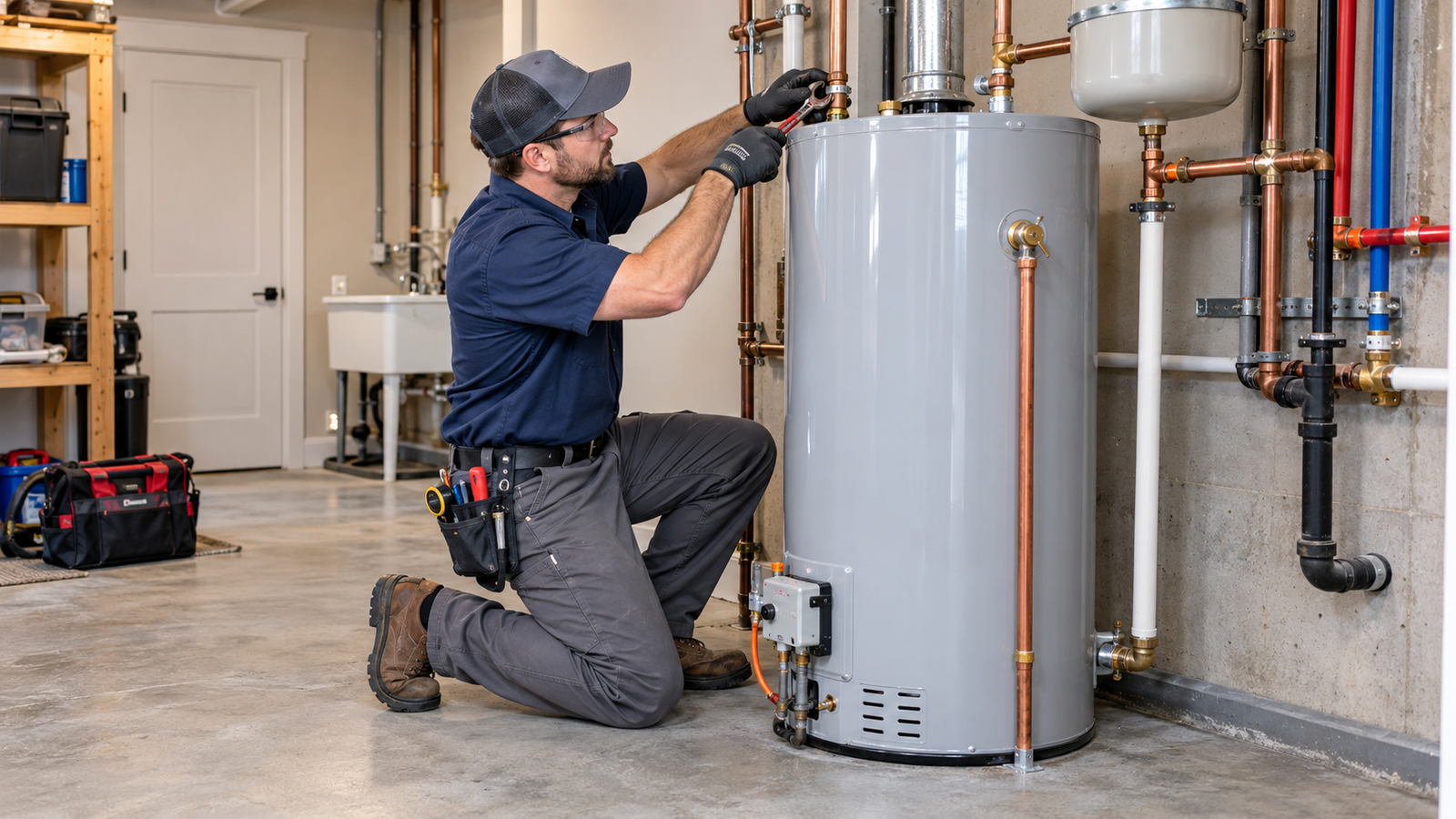
Replacing a water heater can cost anywhere from several hundred dollars for a straightforward tank replacement to several thousand dollars for a tankless, heat pump or complex conversion project. The final water heater replacement cost depends on the equipment type, capacity, fuel source, installation location and any plumbing, electrical, gas-line, venting or code upgrades required.
This guide explains typical 2026 water heater prices, the factors that affect installation costs and what homeowners should confirm before approving a contractor’s proposal.
Quick Answer
For a standard 40- to 50-gallon tank water heater, homeowners can expect an installed cost of approximately $600 to $3,100. A tankless water heater generally costs about $1,400 to $5,600 installed, while a hybrid heat pump water heater may cost approximately $2,000 to $4,600.
A simple like-for-like replacement normally falls near the lower end of the range. Projects requiring a different fuel type, upgraded electrical service, a larger gas line, new venting, relocation or code-related work can cost considerably more.
Water Heater Replacement Cost by Type
| Water-heater type | Typical equipment cost | Typical installed cost |
|---|---|---|
| Standard tank, 40–50 gallons | $400–$2,100 | $600–$3,100 |
| Tankless | $600–$2,600 | $1,400–$5,600 |
| Hybrid heat pump | $1,500–$3,000 | $2,000–$4,600 |
| Indirect | $1,500–$3,000 | $2,000–$4,500 |
| Solar | $1,000–$6,000 | $3,000–$9,000 |
These figures are national planning ranges rather than fixed quotations. Local labor rates, permit requirements, equipment availability and the condition of the existing plumbing or utility connections can materially affect the final price.
When comparing estimates, confirm whether the quoted amount includes the water heater, installation labor, removal of the old unit, permit fees, inspections, new connections and all necessary safety or code upgrades.
Standard Tank Water Heater Cost
A conventional tank water heater is usually the least expensive option when replacing an existing unit with another heater of the same size and fuel type. Standard tank systems store heated water and maintain it at the selected temperature until it is needed.
The lower end of the cost range generally represents a straightforward replacement in an accessible location. Prices rise for premium equipment, larger tanks, difficult access, extensive connection work or upgrades required to satisfy current building and plumbing codes.
Tankless Water Heater Cost
A tankless water heater heats water as it flows through the unit instead of storing hot water in a tank. A complete tankless installation commonly costs between $1,400 and $5,600.
Electric tankless systems generally cost less to install than gas models, but a whole-house electric unit may require new high-capacity circuits or an electrical-panel upgrade. A gas tankless conversion may require a larger gas line, new venting and a condensate drain.
Tankless units should therefore be compared using the complete installed cost—not only the equipment price. Installation labor, permits and additional materials can add approximately $800 to $3,000 to a tankless project.
Hybrid Heat Pump Water Heater Cost
A hybrid heat pump water heater uses electricity to transfer heat from the surrounding air into the stored water. It usually costs more initially than a standard electric tank heater but can reduce long-term energy consumption.
The installation location must be evaluated carefully. ENERGY STAR recommends an interior space that generally remains between 40°F and 90°F and provides approximately 1,000 cubic feet of surrounding air space. The installer must also provide a suitable condensate-drain arrangement.
Additional costs may arise if the project requires a dedicated electrical circuit, changes to the electrical panel, relocation of plumbing or modification of the installation area.
Indirect Water Heater Cost
An indirect water heater uses the home’s boiler to heat water stored in a separate tank. It may be suitable for homes that already use an efficient boiler for space heating.
Installation costs depend on the existing boiler, available capacity, piping arrangement and location of the new storage tank. This option should be evaluated as part of the entire heating system rather than as a stand-alone appliance.
Solar Water Heater Cost
Solar water-heating systems generally have the highest initial cost. The project may include rooftop collectors, a storage tank, pumps, controls, piping and a conventional backup heating source.
Roof condition, solar exposure, climate, system size and installation complexity can substantially affect the price. Homeowners should request a site-specific assessment instead of relying on a general online estimate.
Equipment Cost Versus Installation Cost
The advertised equipment price is only one part of the total water heater replacement cost. A complete contractor quotation may include:
- Water heater and manufacturer-supplied components
- Delivery and placement
- Removal and disposal of the old unit
- Installation labor
- Water-supply and hot-water connections
- Shutoff valves and flexible connectors
- Drain pan and discharge piping
- Expansion tank, where required
- Gas-line, electrical or venting work
- Permit and inspection fees
- Start-up, testing and cleanup
A low quotation may exclude some of these items. Ask every contractor to state clearly what is included, excluded and charged separately.
What Affects Water Heater Replacement Cost?
Water-Heater Type
Standard tank heaters normally have the lowest initial installation cost. Tankless, heat pump, indirect and solar systems require different equipment and may require additional modifications.
Fuel Source
Electric, natural-gas, propane and solar systems have different installation requirements. Changing from one fuel source to another can require new wiring, gas piping, venting or other supporting work.
Tank Capacity and Hot-Water Demand
Larger tanks and higher-capacity tankless units usually cost more. The correct capacity depends on household size, simultaneous fixture use and peak hot-water demand.
Do not automatically select a larger unit without checking whether the existing electrical, gas, venting and installation arrangements can support it.
Like-for-Like Replacement Versus Conversion
Replacing an existing water heater with a similar model in the same location is usually less expensive than converting to another technology.
For example, changing from a gas tank heater to an electric heat pump model may require a new electrical circuit. Converting from a tank system to a gas tankless unit may require a larger gas line and different venting.
Installation Location and Accessibility
A water heater located in an open garage or basement may be easier to replace than one installed in an attic, closet, crawlspace or confined utility area.
Difficult access can increase labor time and may require additional workers, temporary removal of doors or finishes, or special equipment.
Gas-Line and Venting Requirements
Gas water heaters require a properly sized fuel supply and an approved venting system. High-efficiency and tankless models may use different vent materials or configurations from the existing heater.
The quotation should specify whether the existing gas line and vent can be reused or whether modifications are included.
Electrical Requirements
Electric tank, electric tankless and heat pump water heaters have different power requirements. A new unit may require a dedicated circuit, new wiring, a suitable breaker or an electrical-panel upgrade.
Ask whether electrical work is included in the contractor’s price and whether a licensed electrician will perform it.
Plumbing and Code Upgrades
Older installations may not meet current requirements. Depending on local regulations and site conditions, the project may need an expansion tank, drain pan, discharge piping, shutoff valve, seismic restraint, combustion-air changes or other safety improvements.
Local requirements vary, so the contractor should identify applicable upgrades and permit responsibilities in writing.
Permits and Inspections
Some jurisdictions require a permit and inspection for water heater replacement. Permit fees vary by location and may or may not be included in the initial quotation.
Confirm who will obtain the permit, arrange the inspection and correct any installation issues identified by the inspector.
Emergency and After-Hours Work
A leaking or failed water heater may require immediate replacement. Emergency, weekend or after-hours service can increase labor charges and reduce the time available to compare equipment and quotations.
Planning before the existing unit fails gives homeowners more time to evaluate options, efficiency ratings, warranties and contractors.
Tank Versus Tankless Water Heater
| Factor | Standard tank | Tankless |
|---|---|---|
| Initial cost | Usually lower | Usually higher |
| Hot-water storage | Stores a fixed quantity | Heats water on demand |
| Space requirement | Requires floor space | Compact wall-mounted unit |
| Retrofit complexity | Usually simpler | May need gas, venting or electrical upgrades |
| Standby heat loss | Present | Reduced |
| Maintenance | Periodic inspection and flushing | Periodic flushing and descaling |
| Best use | Lower-cost replacement | Homes suited to on-demand operation |
A tankless system does not automatically provide unlimited hot water for every fixture at the same time. Its performance depends on flow rate, incoming water temperature and the number of fixtures operating simultaneously.
Ask the contractor to calculate the required gallons per minute and temperature rise before recommending a model.
How to Choose the Correct Water-Heater Size
For a tank water heater, consider storage capacity and first-hour rating. The first-hour rating estimates how much hot water the system can supply during a period of high demand.
For a tankless water heater, sizing depends primarily on the required flow rate and the temperature increase needed to heat incoming water.
Consider:
- Number of household occupants
- Number of bathrooms
- Simultaneous shower use
- Dishwasher and clothes-washer use
- Large tubs or high-flow fixtures
- Incoming groundwater temperature
- Expected changes in household size
The capacity of the existing water heater can be used as a starting point, but it should not be the only basis for the decision.
How to Compare Contractor Quotes
Ask at least two or three qualified contractors to inspect the property and provide itemized written proposals.
Each quotation should identify:
- Manufacturer and exact model number
- Water-heater type, capacity and fuel source
- Efficiency rating
- Equipment warranty
- Contractor labor warranty
- Removal and disposal of the existing heater
- Plumbing connections and valves
- Electrical, gas-line or venting work
- Drain pan, expansion tank and discharge piping
- Permit and inspection fees
- Start-up and testing
- Project schedule
- Payment terms
- Exclusions and possible additional charges
Do not compare quotations based only on the final price. Two proposals may cover substantially different equipment and work.
Important Questions to Ask the Contractor
- Is your company appropriately licensed and insured for this work?
- Which exact water-heater model are you proposing?
- Why is this capacity suitable for my household?
- Does the price include removal and disposal of the old unit?
- Are permit and inspection fees included?
- Will any plumbing, electrical, gas-line or venting upgrades be required?
- Are all code-related components included?
- Will you use employees or subcontractors?
- What manufacturer and labor warranties apply?
- What circumstances could increase the final price?
- How long will the installation take?
- Who is responsible for warranty service after installation?
Record the answers and request any important commitments in writing.
Signs That a Water Heater May Need Replacement
A water heater should be inspected if you notice:
- Water leaking around the tank
- Rust or visible corrosion
- Rust-colored or discolored hot water
- Insufficient or inconsistent hot water
- Unusual popping, rumbling or banging sounds
- Repeated repairs
- Increasing energy use without another explanation
- Moisture around plumbing or safety connections
- A unit approaching or exceeding its expected service life
A leaking tank can cause serious property damage. If active leakage is observed, follow the manufacturer’s safety instructions and contact a qualified professional. Gas or electrical equipment should not be disconnected or modified by an unqualified person.
Energy Costs and Efficiency Labels
The purchase price should be considered together with expected operating costs. A less expensive water heater may cost more to operate over its useful life.
The yellow EnergyGuide label displays estimated annual energy consumption and operating cost under standardized test assumptions. It also helps homeowners compare the energy use of similar models.
Actual operating costs will depend on local utility prices, household hot-water use, temperature settings and climate.
Rebates and Tax Incentives
Rebates and incentive programs vary by state, utility provider, manufacturer and equipment type. Check current eligibility requirements before purchasing equipment because programs can change and may require an approved model or participating contractor.
The federal Energy Efficient Home Improvement Credit described by the IRS applied to qualifying improvements placed in service through December 31, 2025. It should not be assumed to be available for a water heater installed in 2026.
Homeowners considering a heat pump or other high-efficiency water heater should check current federal, state and utility programs using their location and proposed model number before signing a contract.
How to Reduce Water Heater Replacement Costs
- Plan the replacement before the existing heater fails.
- Compare itemized proposals from multiple qualified contractors.
- Request the exact model number before approving the quotation.
- Avoid changing fuel types without comparing the complete conversion cost.
- Check utility and manufacturer rebates.
- Confirm permit, disposal and supporting work are included.
- Select the correct capacity rather than automatically buying the largest unit.
- Compare estimated annual operating costs, not only purchase prices.
- Schedule non-emergency work when practical.
- Keep written copies of warranties, permits and invoices.
The lowest initial quotation is not always the lowest total cost. Missing permit fees, electrical work, venting changes or code upgrades can substantially increase the final amount.
Frequently Asked Questions
How much does it cost to replace a 40- or 50-gallon water heater?
A standard 40- to 50-gallon tank water heater commonly costs approximately $600 to $3,100 installed. A straightforward like-for-like replacement will normally cost less than a project requiring relocation, upgraded connections or code-related work.
Is a tankless water heater more expensive to install?
Yes. A tankless system generally has a higher initial installation cost, especially when converting from a storage-tank heater. Gas-line, venting, electrical or plumbing modifications may be required.
Does water heater replacement require a permit?
Permit requirements vary by jurisdiction. Many locations require a plumbing, mechanical or electrical permit and a final inspection. Ask the contractor to confirm local requirements and include applicable fees in the quotation.
Can a gas water heater be replaced with an electric model?
It may be possible, but the home’s electrical system must support the proposed unit. The project may require a dedicated circuit, new wiring or a panel upgrade. The complete conversion cost should be compared with a like-for-like gas replacement.
How long does water heater replacement take?
A straightforward tank replacement may be completed within several hours. Conversions, relocations and projects involving electrical, gas-line, venting or permit work can take longer.
Should a working but old water heater be replaced?
Age alone does not determine whether replacement is necessary. Consider the unit’s condition, maintenance history, efficiency, repair frequency and risk of leakage. Planning before failure allows more time to compare options and avoid emergency pricing.
Should homeowners install a water heater themselves?
Water heater installation can involve pressurized plumbing, electricity, combustible gas, venting, combustion air and safety controls. Improper installation can cause leakage, fire, electrical shock or carbon-monoxide exposure. Professional installation may also be required for permits, inspections and warranty protection.
Final Takeaway
Water heater replacement cost depends on much more than the advertised price of the unit. Equipment type, capacity, fuel source, installation location and required plumbing, electrical, gas-line, venting and code upgrades can all affect the final amount.
Before committing, obtain itemized proposals that identify the exact model, complete scope of work, permits, warranties, exclusions and potential additional charges. Comparing equivalent proposals will help you choose a system that meets your household’s hot-water needs without unexpected costs.
Sources
- HomeGuide — Water Heater Installation or Replacement Cost
https://homeguide.com/costs/water-heater-installation-cost - HomeGuide — Tankless Water Heater Installation Cost
https://homeguide.com/costs/tankless-water-heater-installation-cost - ENERGY STAR — Heat Pump Water Heaters
https://www.energystar.gov/products/heat_pump_water_heaters - Federal Trade Commission — EnergyGuide Labeling
https://www.ftc.gov/business-guidance/resources/energyguide-labeling-faqs-appliance-manufacturers - Internal Revenue Service — Energy Efficient Home Improvement Credit
https://www.irs.gov/credits-deductions/energy-efficient-home-improvement-credit