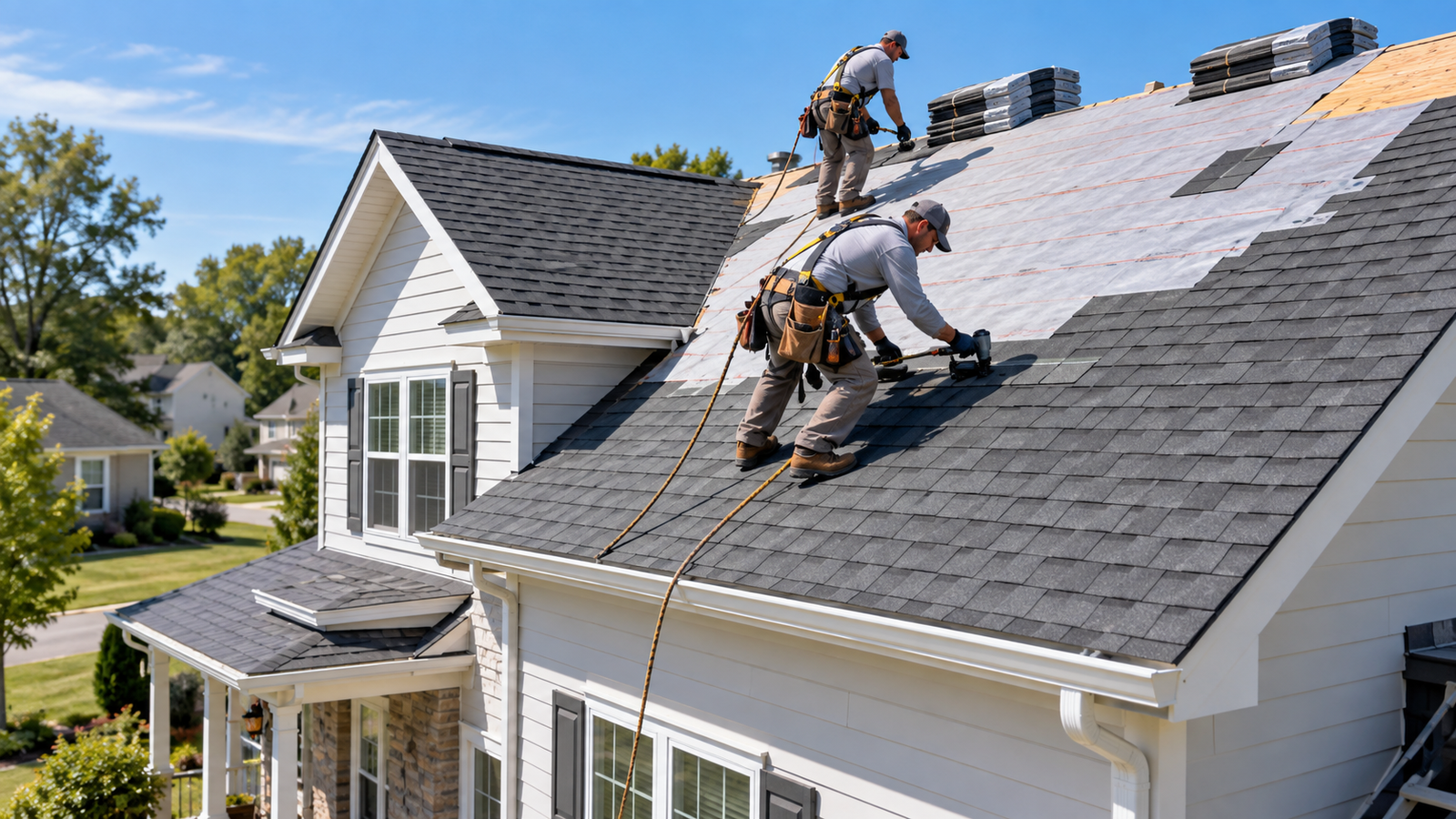
Replacing an asphalt shingle roof is a major home expense, and quotations can vary substantially even for the same property. The final asphalt shingle roof replacement cost depends on the roof area, shingle grade, number of existing layers, roof pitch, access, tear-off requirements, damaged decking, flashing, ventilation, permits and local labor rates.
This guide explains typical 2026 prices, the work that should be included and how homeowners can compare roofing proposals before signing a contract.
Quick Answer
An asphalt shingle roof commonly costs approximately $3 to $5 per square foot installed, or about $5,700 to $12,000 for many replacement projects. Architectural or dimensional shingles generally cost around $4 to $6 per square foot installed, with many projects falling between approximately $7,500 and $16,000.
These figures are national planning ranges—not quotations for a particular property. Large or steep roofs, multiple tear-off layers, difficult access, premium shingles, deteriorated decking and extensive flashing work can push the final price higher.
Asphalt Shingle Roof Replacement Cost by Type
| Asphalt-shingle type | Typical installed cost per square foot | General characteristics |
|---|---|---|
| 3-tab shingles | $3–$5 | Lower initial cost and simpler appearance |
| Architectural or dimensional shingles | $4–$6 | Thicker appearance and generally greater durability |
| Premium or designer shingles | $6–$9+ | Heavier construction, distinctive profiles and higher material cost |
Material names and product classifications vary between manufacturers. Ask every contractor to identify the exact manufacturer, product line, color, wind rating and applicable warranty—not merely state “30-year shingle” or “architectural shingle.”
Estimated Cost by Roof Area
Roofing prices are normally based on the actual roof surface rather than the home’s interior floor area.
| Approximate roof area | Planning range at $3–$6 per square foot |
|---|---|
| 1,000 square feet | $3,000–$6,000 |
| 1,500 square feet | $4,500–$9,000 |
| 2,000 square feet | $6,000–$12,000 |
| 2,500 square feet | $7,500–$15,000 |
| 3,000 square feet | $9,000–$18,000 |
These calculations provide an early planning allowance. Minimum project charges, roof complexity, local pricing and additional work can produce a quotation outside the table.
What Is a Roofing Square?
Roofing contractors commonly measure a roof in “squares.” One roofing square equals 100 square feet of roof surface.
For example, a 2,000-square-foot roof contains approximately 20 roofing squares before waste is added. The contractor normally adds material for roof edges, ridges, valleys, starter courses, cuts and installation waste.
A proposal should state:
- Measured roof area
- Number of roofing squares
- Waste percentage
- Number of shingle bundles
- Unit price or total price
- Measurement method used
Do not assume that a 2,000-square-foot home has a 2,000-square-foot roof. Roof slope, overhangs, attached garages, porches and additions can increase the actual roof area.
What Is Included in a Complete Roof Replacement?
A complete asphalt shingle roof replacement may include:
- Site preparation and protection
- Removal of existing shingles and underlayment
- Debris handling and disposal
- Inspection of the roof deck
- Replacement of damaged roof sheathing
- Installation of underlayment
- Ice-and-water protection where required or specified
- Drip edge
- Starter shingles
- Field shingles
- Ridge-cap shingles
- Valley construction
- Flashing around walls, chimneys, skylights and penetrations
- Pipe boots and roof vents
- Attic-ventilation work
- Permit and inspection fees
- Magnetic nail cleanup
- Final inspection and warranty documents
A low quotation may omit several of these items. Require every contractor to identify what is included, excluded, reused or priced separately.
Material Cost Versus Installation Cost
The shingle price is only one part of the complete project. Roofing quotations may include material, labor, tear-off, disposal, underlayment, flashing, ventilation, permits, equipment and contractor overhead. To understand overhead, labor charges and contractor pricing methods, review our guide to general contractor fees.
HomeGuide reports that a complete roof replacement can cost approximately $400 to $900 per roofing square when removal, materials and labor are considered across different roofing scopes and products.
When comparing bids, separate at least these components:
- Existing-roof removal
- Shingle and accessory materials
- Installation labor
- Decking allowance
- Flashing work
- Ventilation work
- Permit and inspection
- Disposal and cleanup
- Optional upgrades
This makes it easier to identify whether a low bid represents efficiency or an incomplete scope.
What Affects Asphalt Shingle Roof Replacement Cost?
Roof Size
A larger roof requires more shingles, underlayment, flashing, fasteners, labor and disposal capacity. Ask for the measured roof area instead of accepting an estimate based only on the home’s floor area.
Shingle Type and Grade
Three-tab shingles are generally the least expensive. Architectural shingles cost more but provide a thicker, dimensional appearance. Premium shingles can imitate slate, wood or other materials and may require additional installation care.
Compare exact products rather than broad descriptions such as “standard,” “premium” or “lifetime.”
Tear-Off Versus Roof-Over
A tear-off removes the existing roof covering before the new system is installed. A roof-over or re-cover places new shingles over an existing layer.
A roof-over may reduce initial cost, but it can conceal roof-deck conditions and may not be permitted or recommended for every property. Existing layers, structural condition, manufacturer instructions and local codes must be evaluated.
The proposal should clearly state whether it includes complete removal or installation over the existing roof.
Number of Existing Layers
Removing multiple layers requires more labor and produces more debris. Local codes may restrict additional roof coverings when one or more layers already exist.
Ask the contractor to confirm the number and type of existing layers before finalizing the price.
Roof Pitch and Height
Steep roofs require additional safety procedures and can slow installation. Multistory homes may require more equipment and labor for material handling and fall protection.
The quotation should identify any steep-slope, height or access charge.
Roof Complexity
Simple gable roofs are generally less expensive to replace than roofs with numerous hips, valleys, dormers, intersecting sections, skylights, chimneys or wall connections.
Complex geometry increases cutting, flashing, waste and installation time.
Access and Site Conditions
Restricted driveways, landscaping, fences, overhead utilities and limited space for dumpsters or material delivery can affect labor and equipment costs.
The contractor should explain how the property, driveway, siding, windows and landscaping will be protected.
Roof-Deck Condition
After the existing shingles are removed, the contractor may discover rotten, delaminated or damaged plywood or oriented strand board.
Because concealed decking conditions cannot always be confirmed before tear-off, the contract should provide:
- An included decking allowance, if any
- A price per sheet
- A price per square foot
- The approval process for additional replacement
- Photographic documentation of damaged areas
Do not accept an unrestricted statement that all damaged wood will be replaced at an unspecified additional cost.
Underlayment and Water Protection
Underlayment provides a secondary layer beneath the shingles. Products may include asphalt-saturated felt or synthetic underlayment.
Ice-and-water protection may be installed at eaves, valleys and vulnerable transitions, depending on climate, local codes, manufacturer instructions and the agreed scope.
Ask the contractor to specify the product, installation area and number of layers.
Flashing
Flashing directs water away from roof intersections and penetrations. Important locations include:
- Chimneys
- Sidewalls and headwalls
- Valleys
- Skylights
- Plumbing vents
- Roof-to-wall connections
The proposal should state whether existing flashing will be reused, repaired or replaced. Reusing deteriorated or poorly detailed flashing can undermine an otherwise new roof.
Attic Ventilation
Roof replacement is an opportunity to evaluate attic ventilation, but additional vents should not be added without considering the complete intake-and-exhaust arrangement.
The proposal should identify existing and proposed intake vents, exhaust vents and any abandoned vents. Shingle warranty requirements may also depend on adequate ventilation.
Permits and Inspections
Roof-replacement permit requirements vary by jurisdiction. Confirm:
- Whether a permit is required
- Who will obtain it
- Whose name and license will appear on it
- Whether the permit fee is included
- Which inspections are required
- Who will correct rejected work
A contractor’s statement that permits are unnecessary should be verified with the local building department.
Season and Weather
Rain, snow, high winds and cold temperatures can interrupt roofing work. Asphalt shingles can become more difficult to handle in cold conditions, and their self-sealing strips may require suitable temperatures or manufacturer-approved procedures.
The contract should explain how the home will be protected if bad weather begins after the existing roof is removed.
Repair, Partial Replacement or Complete Replacement?
A roof leak does not automatically mean the entire roof must be replaced. Localized damage may result from failed flashing, damaged shingles, pipe boots or a limited storm impact.
Complete replacement may be more reasonable when:
- Shingles are extensively cracked, curled, missing or deteriorated
- Granule loss is widespread
- Leaks occur in multiple areas
- Previous repairs repeatedly fail
- The roof deck has widespread damage
- The existing roof has reached the end of its useful service life
- An additional roof layer is not permitted or appropriate
Ask the contractor to document the observed conditions with photographs and explain why repair, partial replacement or complete replacement is recommended.
Three-Tab Versus Architectural Shingles
| Factor | 3-tab shingles | Architectural shingles |
|---|---|---|
| Initial price | Generally lower | Generally higher |
| Appearance | Flat and uniform | Thicker and dimensional |
| Material weight | Lighter | Heavier |
| Wind performance | Product-specific | Product-specific, often higher |
| Expected service | Generally shorter | Generally longer |
| Best suited for | Cost-sensitive projects | Homeowners balancing appearance and durability |
Do not select shingles based only on category. Compare exact product specifications, climate suitability, installation requirements and warranty conditions.
How to Compare Roofing Contractor Quotes
Obtain at least three written proposals when practical and give every contractor the same questions.
Before selecting a roofer, use our 21-point contractor hiring checklist to verify licensing, insurance, references, contract terms and payment safeguards.
Each proposal should identify:
- Contractor’s legal business name
- Required license or registration
- Liability and workers’ compensation insurance
- Exact roof area and number of squares
- Shingle manufacturer and product line
- Shingle color and grade
- Existing layers to be removed
- Underlayment product
- Ice-and-water protection
- Drip edge and starter shingles
- Valley construction
- Flashing and pipe boots
- Ridge caps
- Ventilation work
- Decking allowance and unit price
- Permit and inspection responsibility
- Property-protection plan
- Debris removal and magnetic cleanup
- Start date and expected duration
- Material and workmanship warranties
- Payment schedule
- Exclusions and possible additional charges
Do not compare only the final totals. One contractor may include tear-off, new flashing, permits and damaged-decking allowances while another excludes them.
Important Questions to Ask a Roofing Contractor
- What conditions support complete replacement instead of repair?
- How did you calculate the roof area?
- How many existing roofing layers will be removed?
- Which exact shingle manufacturer and product are included?
- Which underlayment and water-protection products will be used?
- Will existing flashing be replaced or reused?
- How will valleys, chimneys, skylights and wall intersections be treated?
- Is roof-deck replacement included?
- What is the additional price for damaged decking?
- Will you evaluate attic ventilation?
- Who obtains the permit and schedules inspections?
- How will the property and landscaping be protected?
- What happens if rain begins during the project?
- Who supervises the installation crew?
- What manufacturer and workmanship warranties apply?
- Which actions could void the warranties?
- What is excluded or subject to a change order?
- What documentation will be provided at completion?
Record important answers in the written proposal or contract rather than relying on verbal assurances.
Manufacturer Warranty Versus Workmanship Warranty
Roofing projects may include two different warranties.
A manufacturer’s warranty generally covers qualifying defects in the roofing product, subject to its stated terms, exclusions and installation requirements.
A contractor’s workmanship warranty generally covers specified installation-related problems for the period stated by the contractor.
Ask for both documents before signing. Confirm:
- Who registers the product warranty
- Whether registration has a deadline
- Whether certified installation is required
- Which accessories must be used
- Whether ventilation affects coverage
- What the workmanship warranty covers
- Who handles a claim if the contractor closes or changes ownership
A “lifetime” warranty does not necessarily provide full replacement coverage for the homeowner’s lifetime. Read the definitions, prorating provisions, transfer rules, labor coverage and exclusions.
Insurance and Storm-Damage Considerations
If the roof was damaged by wind, hail, falling objects or another event, contact the insurer promptly and follow the policy’s claim procedures.
Insurance coverage depends on the cause of damage, policy terms, deductibles, exclusions, roof condition and settlement method. Normal aging or poor maintenance is generally different from sudden covered damage.
Avoid contractors who promise to determine coverage, waive deductibles improperly or pressure you to sign before the claim and scope are understood. Keep photographs, inspection reports, proposals, invoices and communications.
How to Reduce Roof Replacement Costs
- Plan replacement before widespread leakage damages the interior.
- Obtain multiple itemized proposals.
- Compare exact shingle products and accessories.
- Separate essential work from optional upgrades.
- Confirm the measured roof area and waste allowance.
- Establish decking unit prices before tear-off.
- Avoid changing the scope without a written change order.
- Check manufacturer promotions and legitimate local programs.
- Coordinate gutters, skylights or ventilation work where appropriate.
- Do not choose a bid solely because it is the lowest.
A complete, well-defined proposal can provide better value than a low price followed by exclusions and change orders.
Roof Replacement Safety
Roofing involves fall hazards, sharp materials, unstable surfaces and weather exposure. Homeowners should not climb onto the roof to verify quantities or inspect work.
Use photographs, ground-level observations, permit inspections and documentation from a qualified roofing professional. Keep children, pets and vehicles away from the work and debris areas.
Frequently Asked Questions
How much does it cost to replace an asphalt shingle roof?
Many asphalt shingle roof replacements cost approximately $5,700 to $12,000. Architectural shingle projects commonly fall between approximately $7,500 and $16,000, but roof size, pitch, access, tear-off, decking and local labor can change the total.
How much does an asphalt shingle roof cost per square foot?
Standard asphalt shingles commonly cost approximately $3 to $5 per square foot installed. Architectural shingles may cost around $4 to $6 per square foot, while premium products can cost more.
How much is one roofing square?
One roofing square equals 100 square feet of roof surface. A roof measuring 2,000 square feet contains approximately 20 squares before waste is added.
Can new shingles be installed over old shingles?
Sometimes, but the decision depends on existing layers, roof condition, structural considerations, manufacturer instructions and local codes. A roof-over does not allow the same inspection of the roof deck as a complete tear-off.
How long does asphalt shingle roof replacement take?
A straightforward asphalt shingle replacement may take approximately one to three days. Large, steep or complex roofs and projects requiring extensive deck or flashing repairs can take longer. Weather and inspections may also affect the schedule.
Should roof decking be included in the quotation?
The contractor may not know the full condition until tear-off. The proposal should nevertheless state an allowance or unit price for replacing damaged plywood or oriented strand board and require documentation before additional work proceeds.
Are architectural shingles worth the additional cost?
Architectural shingles can provide a more dimensional appearance and generally offer better durability than basic 3-tab products. Their value depends on the exact product, local climate, installation quality, price difference and how long the homeowner expects to keep the property.
Does roof replacement require a permit?
Requirements vary by location. Many jurisdictions require a roofing permit and inspection. Confirm requirements with the local building department and identify permit responsibility in the contract.
Can homeowners replace a roof themselves?
Roof replacement presents serious fall and weather-related hazards and requires correct installation of underlayment, flashing, ventilation and shingles. This guide recommends using a qualified roofing contractor and complying with local permit and inspection requirements.
Final Takeaway
Asphalt shingle roof replacement cost depends on more than roof size and shingle price. Tear-off, roof pitch, access, decking, underlayment, flashing, ventilation, permits, disposal and warranty terms can materially change the final quotation.
Request itemized proposals based on the same scope. Confirm the exact shingle product, complete roof-system components, concealed-damage pricing, permit responsibility, warranties and exclusions before signing.
The best quotation is not necessarily the lowest total. It is the proposal that clearly defines the complete work, uses suitable materials, assigns responsibility and minimizes the risk of unexpected charges.
Explore our complete collection of home improvement cost guides before planning another major home project.
Sources
- HomeGuide — Asphalt Shingle Roof Cost
https://homeguide.com/costs/asphalt-shingle-roof-cost - HomeGuide — Roof Replacement Cost
https://homeguide.com/costs/roof-replacement-cost - HomeGuide — Roofing Shingles Cost
https://homeguide.com/costs/roofing-shingles-cost - National Roofing Contractors Association — Consumer Roofing Resources
https://www.nrca.net/roofing-guidelines/resources - National Roofing Contractors Association — Selecting a Contractor
https://www.nrca.net/roofing-guidelines/selecting-a-contractor - ENERGY STAR — Cool Roofs
https://www.energystar.gov/products/cool-roofs