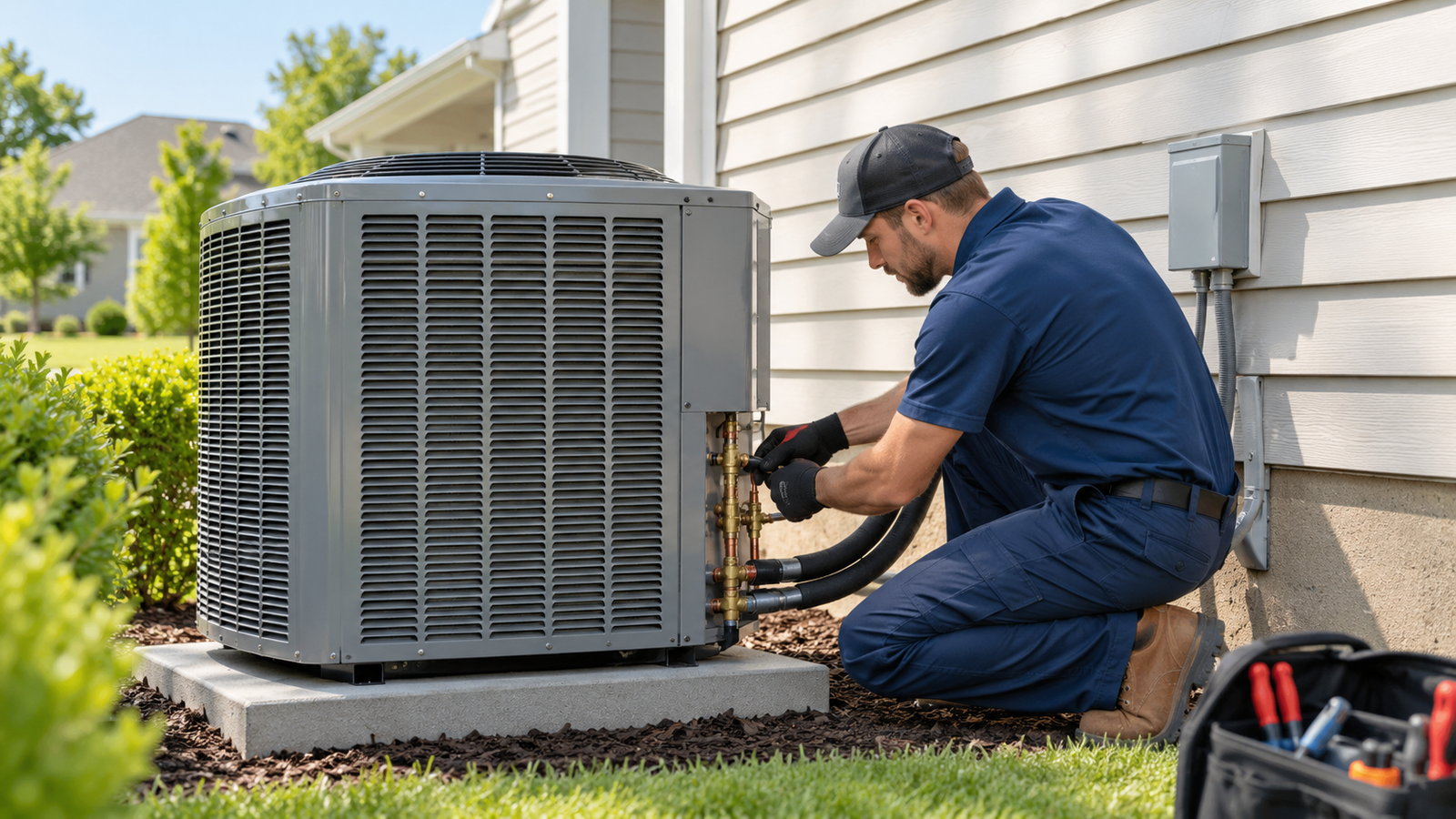
Replacing a central air conditioner is a major home expense, and two quotes for the same house can differ by thousands of dollars. Equipment size, efficiency, installation difficulty, duct condition, electrical work and local labor rates can all change the final price.
In 2026, a straightforward central air conditioner replacement commonly costs about $5,000 to $8,300 for a standard-efficiency system. Mid-range systems may cost $8,300 to $12,500, while premium high-efficiency installations can reach $12,500 to $14,000 or more. Broader market estimates extend from roughly $3,000 to $15,000 or more, depending on what the contractor includes.
These figures are planning ranges—not substitutes for a written local estimate. The most useful comparison is not simply the lowest total. It is the price of a properly sized, correctly matched and fully installed system with clearly defined warranties and exclusions.
Average Air Conditioner Replacement Cost in 2026
| Replacement level | Typical installed cost | Common features |
|---|---|---|
| Standard | $5,000–$8,300 | Basic single-stage equipment and standard efficiency |
| Mid-range | $8,300–$12,500 | Higher efficiency, two-stage operation or upgraded controls |
| Premium | $12,500–$14,000+ | Variable-speed equipment, advanced controls and higher efficiency |
The ranges above generally assume an existing central system and usable ductwork. Substantial duct replacement, electrical upgrades, structural work, difficult access or major changes to the system design can increase the total.
Carrier publishes a wider 2026 installed range of approximately $3,000 to $15,000 or more. That broader range helps explain why an online “average” may not closely match a quotation for a particular house.
What Is Normally Included in an AC Replacement Quote?
A complete replacement proposal may include:
- A new outdoor condensing unit
- A compatible indoor evaporator coil
- Refrigerant lines or approved reuse of the existing line set
- Refrigerant and system charging
- Removal and disposal of the old equipment
- Equipment pad, disconnect and basic electrical connections
- Condensate drain connections
- Thermostat installation or reconnection
- Start-up, testing and commissioning
- Permit and inspection fees where required
- Manufacturer and contractor warranty information
Do not assume every contractor includes every item. Ask for an itemized scope showing what will be replaced, reused, modified and excluded.
What Factors Affect Air Conditioner Replacement Cost?
1. Equipment capacity and proper sizing
Larger-capacity equipment generally costs more, but bigger is not automatically better. The contractor should calculate the home’s cooling load using its size, climate, insulation, windows, air leakage, orientation and other relevant conditions.
ENERGY STAR advises homeowners not to accept sizing based only on a rule of thumb. Oversized equipment can cycle on and off too frequently, reduce humidity control, affect comfort and shorten equipment life.
Ask whether the proposal includes an ACCA Manual J load calculation or an equivalent documented sizing method.
2. SEER2 efficiency rating
SEER2 measures seasonal cooling efficiency under the current federal testing procedure. A higher SEER2 rating can reduce electricity use, but higher-efficiency equipment normally costs more upfront.
The best choice depends on:
- Local climate and length of the cooling season
- Electricity prices
- How long you expect to own the home
- The premium charged for the higher-efficiency model
- Whether the complete indoor and outdoor equipment combination achieves the quoted rating
Ask the contractor for the exact model numbers and the AHRI certificate for the matched system. Comparing SEER2 labels without confirming the complete equipment match can be misleading.
3. Compressor and blower technology
Single-stage systems are usually the least expensive. Two-stage and variable-speed systems cost more but may provide steadier temperatures, quieter operation and better humidity control.
Premium controls can also increase repair costs later. Compare expected comfort and operating benefits with the initial price and warranty terms rather than selecting features only because they are described as advanced.
4. Indoor coil or air-handler replacement
The outdoor unit and indoor coil must be compatible. Replacing only the outdoor condenser may appear less expensive, but the old indoor coil may not deliver the intended efficiency or may not be approved with the new equipment.
Request the model number of every major component and written confirmation that the combination is manufacturer-approved.
5. Ductwork condition
Existing ducts can affect system performance as much as the equipment itself. Leaks, poor insulation, restricted returns, crushed flexible ducts and undersized supply runs can reduce airflow and comfort.
A basic quote may exclude duct repairs. Ask whether the contractor inspected the ducts, measured airflow and included necessary sealing or modifications. Complete duct replacement is a separate project and can materially increase the budget.
6. Refrigerant line-set requirements
The existing copper line set may sometimes be reused if its size, condition, routing and cleanliness meet the new manufacturer’s requirements. In other installations, it must be replaced or properly cleaned and tested.
The proposal should state whether the line set will be reused and what preparation or testing is included.
7. Electrical work
A new system may require a different breaker, disconnect, wiring size, surge protection or service capacity. Basic reconnecting may be included, while panel or circuit upgrades are commonly additional work.
If a contractor identifies a larger electrical problem, compare the requirement with the guidance in our Home Rewiring Cost guide before approving unrelated electrical work.
8. Installation access and project difficulty
Attic air handlers, rooftop equipment, narrow side yards, cranes, long refrigerant runs and difficult removal routes can increase labor and equipment charges.
Ask contractors to identify unusual access costs separately so you can compare equivalent scopes.
9. Permits, inspections and local labor rates
Permit rules and labor rates vary by location. Some proposals include permitting and code-required inspection; others list them as allowances or exclusions.
Confirm who obtains the permit and whether its cost is included in the signed price.
Refrigerant Changes Homeowners Should Understand
New residential air-conditioning equipment is moving toward lower-global-warming-potential refrigerants. As of 2026, R-410A components may still be manufactured and sold for servicing existing systems, but they cannot be combined to create a new R-410A system after the applicable installation deadline.
This does not mean an existing R-410A air conditioner must be immediately replaced. It may continue to be serviced with available parts and refrigerant. However, when comparing new-system quotes, ask:
- Which refrigerant does the proposed system use?
- Is every indoor and outdoor component approved for that refrigerant?
- Does the installation require updated safety procedures or components?
- Are local technicians trained and equipped to service the system?
- What refrigerant and parts warranty applies?
The refrigerant name alone should not determine the purchase. Correct design, installation quality, service availability and warranty support remain essential.
Additional Costs That May Appear
The following items may fall outside a basic replacement price:
| Possible additional work | Why it may be needed |
|---|---|
| Duct sealing or modification | Correct leakage, restrictions or poor airflow |
| Complete duct replacement | Replace damaged, contaminated or badly designed ducts |
| Electrical circuit work | Meet equipment and electrical-code requirements |
| Condensate pump or drain work | Provide reliable drainage and overflow protection |
| New thermostat or controls | Ensure compatibility with staged or variable equipment |
| Equipment relocation | Improve clearance, access or code compliance |
| Structural or roofing work | Support rooftop or difficult installations |
| Asbestos or hazardous-material handling | Safely address affected older materials |
| Permit and inspection fees | Meet local requirements |
| Temporary cooling | Maintain comfort during a delayed or complex project |
Ask for written unit prices or allowances wherever the final quantity cannot be known before work begins.
Should You Repair or Replace Your Air Conditioner?
Replacement may deserve serious consideration when:
- The system is more than 10 years old
- Breakdowns have become frequent
- A major component such as the compressor has failed
- Repair parts are difficult or expensive to obtain
- Cooling bills are rising despite normal maintenance
- The system cannot maintain temperature or humidity
- The equipment is badly sized for the house
- Duct or installation defects make further repairs poor value
ENERGY STAR recommends considering replacement when an air conditioner is over 10 years old, particularly when repairs are frequent or energy bills are increasing. This is guidance, not an automatic replacement rule. A well-maintained system with a minor repair may still be economical to keep.
Compare the repair price, equipment age, recent repair history, expected remaining life, comfort problems and the cost of a properly designed replacement. Be cautious with simple formulas that ignore these factors.
Should You Replace Central AC With a Heat Pump?
A heat pump provides both cooling and heating. ENERGY STAR notes that, in many cases, a central air conditioner can be replaced with a heat pump for a modest additional cost.
Request a heat-pump alternative when:
- Your existing air conditioner needs replacement
- Your furnace is also aging
- You want one system to provide heating and cooling
- Local electricity and fuel prices make the operating comparison attractive
- State, utility or manufacturer incentives are available
Compare the complete installed price, heating performance for your climate, backup-heat strategy, electrical requirements and estimated operating cost. Do not compare only the outdoor-unit prices.
Are Federal Tax Credits Available in 2026?
The federal Energy Efficient Home Improvement Credit previously covered qualifying central air conditioners, but the IRS states that the credit applied to eligible improvements placed in service through December 31, 2025.
Do not assume a 2026 central-air-conditioner installation qualifies for that expired federal credit. Before signing, check current federal rules and search for state, local-utility and manufacturer rebates applicable to your address and exact model.
How to Compare Air Conditioner Replacement Quotes
Obtain at least three detailed proposals when practical. Place the following information side by side:
- Contractor licence, insurance and relevant experience
- Cooling-load calculation and proposed equipment capacity
- Outdoor-unit, indoor-coil and furnace or air-handler model numbers
- AHRI matched-system certificate
- SEER2 and other rated performance information
- Refrigerant type
- Duct inspection, airflow testing and included duct work
- Line-set reuse or replacement plan
- Electrical, drain, pad and thermostat work
- Permit, inspection, removal and disposal
- Start-up and commissioning procedures
- Manufacturer parts warranty
- Compressor warranty
- Contractor labor warranty
- Exclusions, allowances and possible change-order items
- Payment schedule and estimated completion time
Use our 21-Point Contractor Hiring Checklist to evaluate the contractor as carefully as the equipment.
Questions to Ask an HVAC Contractor
- How did you calculate the required system size?
- Will you provide the load calculation?
- Are the indoor and outdoor components an AHRI-matched combination?
- What SEER2 rating will this exact combination deliver?
- Which refrigerant does it use?
- Did you inspect and test the existing ductwork?
- What airflow measurements will you take?
- Will the existing refrigerant lines be reused? Why?
- Are electrical or drainage upgrades required?
- Who obtains the permit and arranges inspection?
- What is excluded from the quoted price?
- What circumstances could produce a change order?
- Who registers the manufacturer warranty?
- What labor warranty do you provide?
- What maintenance is required to keep the warranty valid?
How to Control Air Conditioner Replacement Cost
- Plan before an emergency failure whenever possible.
- Compare equivalent written scopes, not verbal totals.
- Request good, better and best equipment options from each bidder.
- Avoid paying for excess capacity unsupported by a load calculation.
- Separate necessary code work from optional upgrades.
- Check state, utility and manufacturer incentives using exact model numbers.
- Ask about off-season scheduling where climate and system condition allow.
- Review financing by total repayment cost, not only monthly payment.
- Confirm that rebates are not already deducted from the quoted price.
- Keep a reasonable contingency for concealed duct, drain or electrical problems.
The cheapest proposal can become expensive if it omits necessary work. The most expensive proposal is not automatically the best. The objective is a clear, technically appropriate scope at a competitive price.
Frequently Asked Questions
How much does it cost to replace a central air conditioner in 2026?
A standard-efficiency replacement commonly costs about $5,000 to $8,300 installed. Mid-range systems may cost $8,300 to $12,500, while premium installations may exceed $12,500. Difficult access, ductwork, electrical upgrades and higher-capacity equipment can push the price above these ranges.
How long does an air conditioner replacement take?
A straightforward replacement may be completed in one working day. Duct alterations, electrical work, permits, equipment relocation or unexpected site conditions can extend the schedule.
Should the indoor coil be replaced with the outdoor AC unit?
Usually, the contractor should propose a compatible indoor coil that forms an approved matched system with the outdoor unit. Ask for all model numbers and the AHRI certificate rather than assuming an older coil is suitable.
Is a higher SEER2 rating always worth the extra price?
Not necessarily. Value depends on climate, electricity cost, usage, ownership period and the price premium. Compare the installed price and expected operating cost of specific matched systems.
Can an existing R-410A air conditioner still be repaired?
Yes. EPA guidance allows R-410A components to be manufactured and sold for servicing existing equipment. The restrictions prevent those service components from being used to assemble a new R-410A system after the applicable deadline.
Do I need new ductwork when replacing the air conditioner?
Not automatically. Existing ducts may be retained if they are correctly sized, adequately sealed, insulated where required and capable of delivering proper airflow. Ask for an inspection and testing before approving full replacement.
How many air conditioner quotes should I obtain?
Three detailed quotes are usually enough to reveal differences in equipment, scope, warranties and price. More quotes may be useful when the proposed system designs differ substantially.
Final Homeowner Checklist
Before approving an air conditioner replacement, confirm that you have:
- A documented cooling-load calculation
- Complete equipment model numbers
- An AHRI certificate for the matched system
- The proposed SEER2 rating and refrigerant type
- A written duct and airflow assessment
- A clear list of included electrical, drain and control work
- Permit and inspection responsibility in writing
- Removal and disposal included or separately priced
- Manufacturer and labor warranty terms
- Written exclusions and change-order procedures
- Comparable proposals from qualified contractors
- Verified current rebates or incentives
An air conditioner is not simply a box installed outside the house. Its performance depends on sizing, component matching, airflow, refrigerant charge, duct condition and installation quality. A careful quote comparison helps protect both the initial investment and the comfort the system is expected to provide.
Sources
- HomeGuide — AC Replacement Cost
- Carrier — Air Conditioner Prices in 2026
- ENERGY STAR — HVAC Quality Installation
- ENERGY STAR — When Is It Time to Replace?
- ENERGY STAR — Clean Heating and Cooling
- U.S. Department of Energy — Purchasing Energy-Efficient Residential Central Air Conditioners
- U.S. EPA — Frequent Questions on the Phasedown of Hydrofluorocarbons
- IRS — Energy Efficient Home Improvement Credit