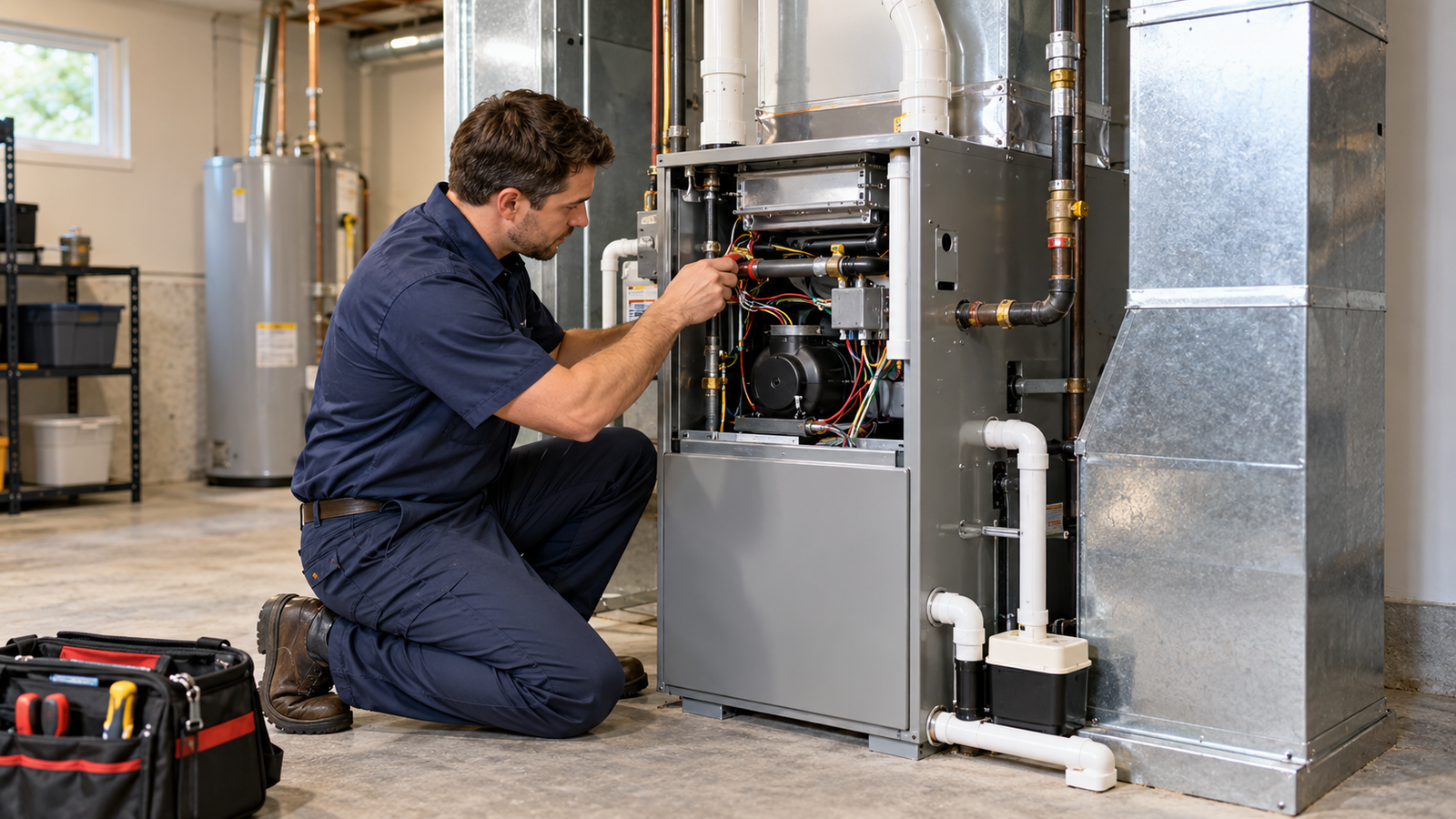
Replacing a furnace is a major home investment, and the lowest advertised equipment price rarely represents the complete installed cost. Furnace type, heating capacity, efficiency, venting, gas or electrical work, duct condition and local labor rates can all change the final quotation.
In 2026, many furnace replacement projects fall between approximately $3,800 and $14,200 installed. A gas furnace commonly costs about $3,800 to $12,000, while electric and oil systems have different equipment and installation requirements. Complex conversions, major ductwork, electrical upgrades or fuel-system modifications can move the final price outside these ranges.
Online figures are useful for early planning, but they do not replace an on-site heating-load calculation and a detailed local proposal. Homeowners should compare the complete installed scope—not only the furnace brand, BTU rating or headline total.
Average Furnace Replacement Cost in 2026
| Furnace type | Typical installed planning range | Important cost considerations |
|---|---|---|
| Natural-gas furnace | $3,800–$12,000 | AFUE, stages, venting, gas piping and condensate disposal |
| Electric furnace | $2,500–$7,000+ | Electrical capacity, circuit work and local electricity prices |
| Oil furnace | $2,500–$10,000+ | Tank condition, oil lines, chimney or venting and local fuel availability |
| Propane furnace | Often comparable to gas equipment, but project-specific | Tank, regulator, piping, fuel availability and conversion work |
Carrier reports that a new furnace can typically cost approximately $3,800 to $14,200 installed in 2026, depending on the home, system and installation. HomeGuide publishes a $3,800 to $12,000 range for many gas-furnace replacements and broader ranges for other fuel types.
These sources use different assumptions. Do not average the figures together. Instead, use them to identify whether a local quotation appears plausible and then examine what is included.
Gas Furnace Replacement Cost
Natural-gas furnaces are common in regions with established gas service and cold winters. Installed cost is influenced by efficiency, heating capacity, blower technology, venting and whether the existing gas line and connections are suitable.
A standard-efficiency gas furnace may use a metal flue or chimney, while a high-efficiency condensing furnace generally requires approved plastic intake and exhaust piping plus condensate drainage. Changing from one venting arrangement to another can add material, labor and wall or roof penetrations.
The quote should identify:
- Furnace manufacturer and complete model number
- Input and output heating capacity
- AFUE rating
- Single-stage, two-stage or modulating operation
- Blower type and compatibility with the cooling system
- Combustion-air and exhaust-venting scope
- Gas-line, shutoff and connection work
- Condensate drain, neutralizer or pump where required
- Start-up and combustion testing
Electric Furnace Replacement Cost
Electric furnaces usually cost less to purchase and install than many fuel-burning furnaces, but their operating cost depends heavily on local electricity rates and climate. A low initial price does not automatically mean the lowest lifetime cost.
The contractor should verify that the electrical service, panel, breaker, wiring and disconnect can support the proposed equipment. A higher-capacity electric furnace can require substantial electrical power, and an older home may need additional circuit or service work.
If the proposal includes major electrical modifications, compare that scope with our Home Rewiring Cost guide and request a separate electrical price where practical.
Oil and Propane Furnace Costs
Oil-furnace replacement may involve more than the heating appliance. The contractor should inspect the oil tank, supply line, filter, shutoff, chimney or vent, combustion air and existing burner arrangement. Tank replacement, environmental work or chimney repairs can materially increase the project cost.
For propane, confirm whether the tank is owned or leased, who supplies the fuel, whether the regulator and piping are adequate, and whether any conversion kit is manufacturer-approved. Fuel contracts and tank obligations can affect long-term cost even when the furnace quotation appears competitive.
Do not authorize abandonment or removal of an oil tank without understanding local rules, documentation requirements and possible environmental responsibilities.
What Does AFUE Mean?
AFUE stands for Annual Fuel Utilization Efficiency. It represents the percentage of fuel energy converted into useful heat over a typical heating season under the applicable test procedure.
For example, a 95% AFUE rating indicates that the rated furnace converts approximately 95% of the fuel’s energy into useful heat under test conditions, while the remainder is lost. AFUE does not include every real-world energy use or guarantee a particular utility bill.
Actual performance also depends on:
- Correct furnace sizing
- Duct leakage and insulation
- Airflow and filter condition
- Thermostat settings
- Installation and commissioning
- Climate and heating demand
- Home insulation and air leakage
- Fuel prices
A higher AFUE rating can reduce fuel consumption, but the value of the upgrade depends on the additional installed price and expected fuel savings in that home.
Furnace Cost by Efficiency and Heating Technology
Standard-efficiency furnaces
Standard-efficiency equipment generally has a lower initial price. It may be appropriate where the existing venting is compatible and the efficiency upgrade would require expensive changes. However, homeowners should compare expected fuel use and long-term ownership cost.
High-efficiency condensing furnaces
High-efficiency gas furnaces recover more heat from combustion gases. They normally require sealed combustion or dedicated intake and exhaust arrangements plus condensate management.
The higher equipment price may be only part of the upgrade cost. Ask for vent routing, drain work, termination locations and restoration to be included in writing.
Single-stage, two-stage and modulating furnaces
A single-stage furnace generally operates at full heating output whenever it runs. Two-stage equipment can operate at a lower level during mild conditions and increase output when needed. A modulating furnace can adjust heat output over a wider range.
Staged or modulating equipment may improve comfort and reduce temperature swings, but it usually costs more and may require compatible controls. Compare the price premium, warranty, service availability and actual homeowner priorities.
Blower motor and cooling-system compatibility
The furnace blower may also move air for the central air conditioner. Replacing a furnace therefore requires coordination with the existing indoor coil, outdoor cooling equipment, duct system and thermostat.
If the air conditioner is also near the end of its life, compare the staged replacement with a coordinated HVAC proposal. Our Air Conditioner Replacement Cost guide explains the cooling-side quote factors.
Furnace Size and Heating-Load Calculation
Furnace capacity is commonly expressed in British thermal units per hour, or BTU/h. The appropriate capacity cannot be determined reliably from floor area alone.
A heating-load calculation should consider:
- Local winter design temperature
- Home size and layout
- Insulation levels
- Window and door performance
- Air leakage
- Orientation and solar exposure
- Ceiling height
- Duct location and leakage
- Internal heat gains
- Building additions or energy improvements
An oversized furnace may heat the house quickly but cycle frequently, create uneven temperatures and place unnecessary stress on components. An undersized furnace may struggle during design conditions.
Ask whether the contractor will perform an ACCA Manual J calculation or another accepted, documented heating-load method. Replacing an old furnace with the same input rating is not proof that the old size was correct.
What Should a Furnace Replacement Quote Include?
A complete written proposal may include:
- New furnace with full model number and capacity
- Removal and disposal of the old furnace
- Supply and return transitions or sheet-metal modifications
- Filter cabinet or specified filter arrangement
- Flue, chimney liner or intake and exhaust piping
- Gas, oil, propane or electrical connections
- Condensate drain, neutralizer and pump where needed
- Thermostat and control wiring
- Duct inspection and required airflow corrections
- Permit and inspection fees
- Start-up, airflow balancing and safety testing
- Combustion analysis for fuel-burning equipment
- Manufacturer parts warranty
- Heat-exchanger warranty
- Contractor labor warranty
- Cleanup, homeowner instructions and warranty registration
Ask the contractor to distinguish included work, allowances, optional upgrades and exclusions. A low quote may simply omit required venting, controls, permits or duct corrections.
Major Factors Affecting Furnace Replacement Cost
1. Fuel type
Gas, electric, oil and propane systems require different equipment, utilities, venting and safety provisions. Changing fuel type generally costs more than replacing like for like.
2. Furnace capacity
Higher-capacity equipment usually costs more, but the selected capacity should follow a heating-load calculation rather than a rough square-foot rule.
3. Efficiency level
High-efficiency equipment costs more and may require new venting and condensate drainage. Compare the complete installation premium rather than only the furnace price.
4. Installation access
Furnaces located in attics, crawlspaces, tight closets or difficult basements may require additional labor, equipment or temporary removal of doors and finishes.
5. Venting and chimney condition
An existing chimney may require inspection, repair or a properly sized liner. Condensing equipment may require new sidewall venting and careful selection of termination locations.
6. Gas, oil or propane piping
The existing fuel supply may need modification for capacity, condition, code compliance or manufacturer requirements. Require fuel-piping work to be identified separately.
7. Electrical work
Even a gas or oil furnace uses electricity for the blower, controls and ignition. The contractor should confirm the circuit, disconnect, grounding and any backup-power considerations.
8. Ductwork and airflow
Restricted returns, undersized ducts, leakage or poor transitions can prevent a new furnace from delivering its rated performance. Ask what inspection and testing support the proposed scope.
9. Permits and inspections
Local jurisdictions may require mechanical, fuel-gas, electrical or building permits. Confirm who obtains and closes the permits and whether all fees are included.
10. Local labor rates and emergency timing
Prices vary by region and contractor workload. Emergency replacement during extreme weather may limit equipment choices and negotiation time.
Possible Additional Costs
| Additional work | Why it may be required |
|---|---|
| Duct sealing or resizing | Correct leakage, restriction or inadequate airflow |
| Return-air modification | Provide the airflow required by the new furnace |
| Chimney liner or repair | Match the vented appliance and protect safe operation |
| New intake and exhaust vents | Serve a condensing or sealed-combustion furnace |
| Gas-line modification | Meet capacity, pressure or code requirements |
| Electrical circuit work | Provide a suitable and safe power supply |
| Condensate drain or pump | Remove condensate from high-efficiency equipment |
| Thermostat or controls | Operate staged, modulating or communicating equipment |
| Asbestos or hazardous-material work | Safely address affected older materials |
| Oil-tank work | Repair, replace, abandon or document the existing tank |
| Structural or finish restoration | Repair openings created for access or venting |
| Temporary heat | Protect occupants and plumbing during delays |
Unknown conditions should be handled through written allowances or unit prices and an agreed change-order procedure.
Repair or Replace the Furnace?
Replacement may deserve serious consideration when:
- The furnace is approaching or beyond its expected service life
- Repairs have become frequent
- A major component such as the heat exchanger has failed
- Replacement parts are difficult to obtain
- Heating bills are rising despite normal maintenance
- The furnace cannot maintain comfort
- The equipment is incorrectly sized
- Venting or installation defects create safety concerns
- The cost of a reliable repair is high relative to a suitable replacement
Age alone does not determine the answer. A qualified contractor should diagnose the problem, identify any safety issue and provide a written repair option when repair is reasonable.
Be cautious with simple rules that compare only repair cost and equipment age. Consider condition, failure history, remaining warranty, safety, efficiency, comfort and the scope of the proposed replacement.
Furnace or Heat Pump?
A heat pump provides heating and cooling and may be a practical alternative to a new furnace in many homes. The right comparison depends on climate, electricity and fuel prices, electrical capacity, duct condition and the need for backup heat.
Ask for separate proposals showing:
- Furnace-only replacement
- Heat-pump system
- Dual-fuel system where appropriate
- Required electrical or duct modifications
- Estimated operating assumptions
- Available state, utility or manufacturer incentives
Do not compare only the outdoor equipment price. Compare the complete installed system and its expected use throughout the year.
Are Federal Furnace Tax Credits Available in 2026?
The federal Energy Efficient Home Improvement Credit previously included qualifying natural-gas, propane and oil furnaces. Current IRS guidance states that the credit applied to qualifying improvements placed in service through December 31, 2025.
Homeowners should not assume that a furnace installed in 2026 qualifies for the former federal credit. Before purchasing, verify current federal law and check state, local-utility and manufacturer programs using the exact proposed model number.
How to Compare Furnace Replacement Quotes
Obtain at least three detailed proposals when practical. Compare:
- Contractor licence, insurance and relevant experience
- Existing-system diagnosis
- Heating-load calculation and proposed capacity
- Furnace manufacturer and complete model number
- Input and output BTU/h
- AFUE rating
- Single-stage, two-stage or modulating operation
- Blower type and cooling-system compatibility
- Venting, combustion-air and chimney work
- Fuel-line or electrical scope
- Duct inspection and airflow corrections
- Thermostat and controls
- Permit and inspection responsibility
- Removal, disposal and cleanup
- Start-up, combustion and safety testing
- Parts, heat-exchanger and labor warranties
- Exclusions and change-order procedures
- Payment schedule and installation timing
Use our 21-Point Contractor Hiring Checklist to evaluate the business and contract in addition to the equipment.
Questions to Ask a Furnace Contractor
- What problem caused the existing furnace to fail or underperform?
- Is repair still a safe and economical option?
- How did you calculate the required heating capacity?
- Will you provide the load calculation?
- What are the proposed input and output BTU ratings?
- What is the AFUE rating?
- Is the furnace single-stage, two-stage or modulating?
- How will the blower work with the existing air conditioner?
- What venting or chimney work is included?
- Are fuel-line or electrical modifications required?
- Did you inspect the supply and return ducts?
- What airflow and static-pressure tests will you perform?
- Who obtains the permits and arranges inspections?
- What is excluded from the quoted price?
- What circumstances could produce a change order?
- What parts, heat-exchanger and labor warranties apply?
- Who registers the manufacturer warranty?
- What maintenance is required to preserve warranty coverage?
How to Control Furnace Replacement Cost
- Plan before an emergency failure whenever possible.
- Obtain comparable written scopes from qualified contractors.
- Request standard, mid-range and premium equipment options.
- Do not pay for unsupported excess capacity.
- Separate necessary safety and code work from optional upgrades.
- Confirm that high-efficiency venting and drainage are fully priced.
- Check incentives using exact model numbers before signing.
- Compare financing by total repayment cost, not only monthly payment.
- Ask whether off-season scheduling offers more equipment choice or flexibility.
- Maintain a contingency for concealed duct, venting, fuel-line or electrical conditions.
The cheapest quotation may omit essential work, while the highest price does not guarantee the best installation. A strong proposal explains the design, equipment, scope, testing, warranties and exclusions clearly.
Frequently Asked Questions
How much does furnace replacement cost in 2026?
Many installed furnace replacements fall between approximately $3,800 and $14,200. Gas furnaces commonly range from about $3,800 to $12,000, while electric and oil furnace costs vary with capacity, efficiency and installation requirements.
How long does furnace replacement take?
A straightforward like-for-like replacement may be completed in one working day. Duct changes, fuel conversion, chimney work, electrical upgrades, permits or difficult access can extend the project.
What furnace efficiency should I choose?
Compare the complete installed cost, AFUE rating, fuel prices, climate, venting requirements and expected ownership period. The highest efficiency is not automatically the best financial choice for every home.
Can a new furnace use the existing ductwork?
Yes, if the ducts are correctly sized, adequately sealed and capable of providing the required airflow. Ask the contractor to inspect the system and measure airflow or static pressure rather than assuming it is suitable.
Should I replace the furnace and air conditioner together?
Not always. Coordinated replacement may be useful when both systems are old or when blower, coil, controls and efficiency combinations would otherwise be compromised. Request separate prices and compare the technical reasons.
Is an electric furnace cheaper than a gas furnace?
An electric furnace often costs less to install, but operating costs depend on local electricity and fuel prices, climate and home efficiency. Compare estimated annual use, not only the purchase price.
How many furnace quotes should I obtain?
Three detailed quotes are generally enough to expose differences in sizing, equipment, venting, ductwork, testing, warranties and price. More may be helpful when contractors propose substantially different system designs.
Final Homeowner Checklist
Before approving furnace replacement, confirm that you have:
- A written diagnosis of the existing system
- A documented heating-load calculation
- Complete furnace model and capacity information
- AFUE and operating-stage details
- Cooling-system and thermostat compatibility
- A written duct and airflow assessment
- Defined venting, chimney and combustion-air work
- Defined fuel-line and electrical work
- Condensate drainage included where applicable
- Permit and inspection responsibility in writing
- Removal, disposal and cleanup included
- Start-up and safety-testing procedures
- Parts, heat-exchanger and labor warranty terms
- Written exclusions and change-order procedures
- Comparable proposals from qualified contractors
- Verified current rebates or incentives
A furnace is part of a complete heating and air-distribution system. Correct sizing, airflow, venting, fuel supply, controls and commissioning matter as much as the equipment nameplate. A careful quote comparison helps protect safety, comfort and long-term value.
Sources
- HomeGuide — New Furnace Replacement Cost
- HomeGuide — Gas Furnace Cost
- HomeGuide — Electric Furnace Cost
- Carrier — Gas Furnace Replacement Guide
- Carrier — New Gas Furnace Cost
- Carrier — Oil Furnace Replacement Cost
- ENERGY STAR — Furnaces
- ENERGY STAR — Furnace Key Product Criteria
- U.S. Department of Energy — Purchasing Energy-Efficient Residential Furnaces
- IRS — Energy Efficient Home Improvement Credit