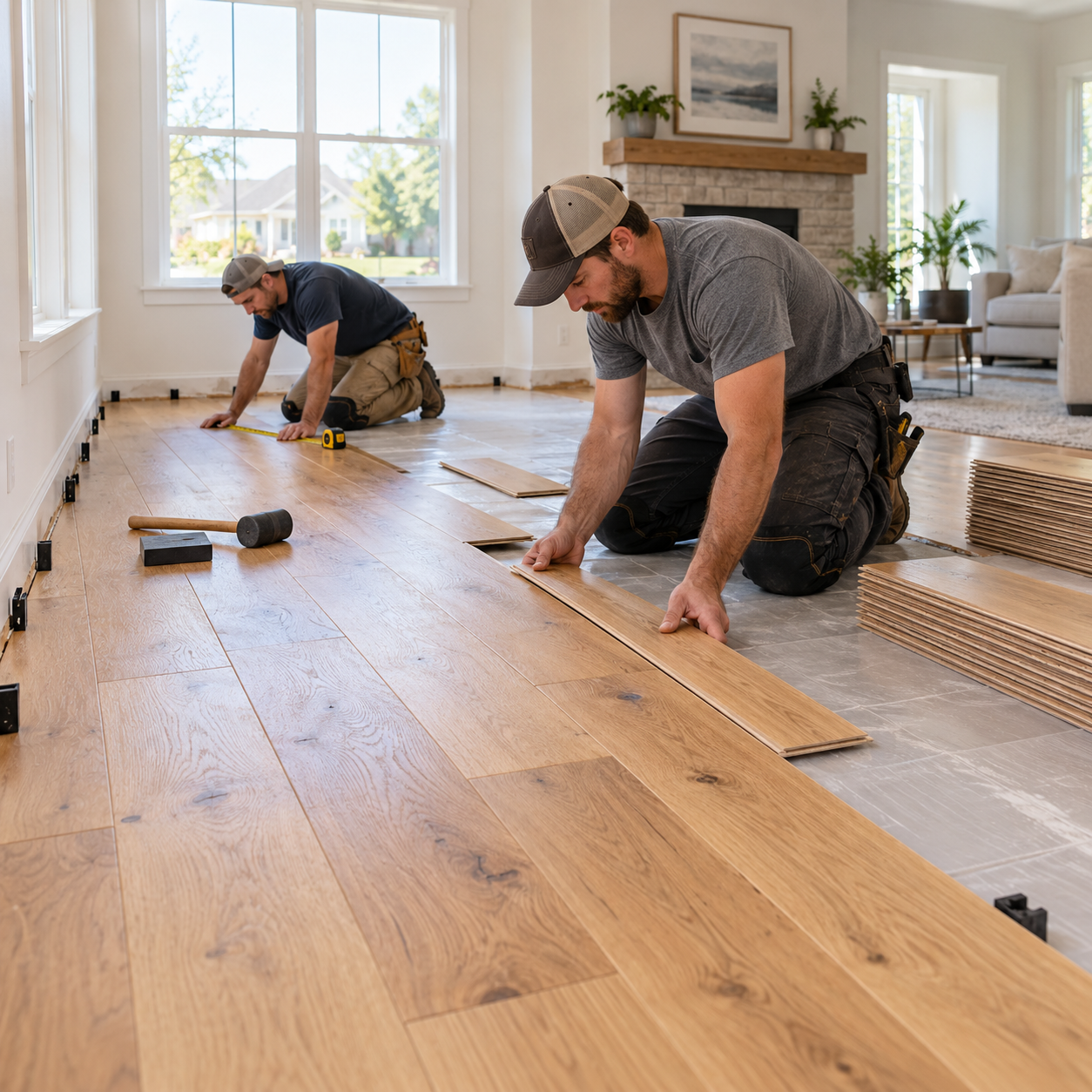
Replacing flooring can change the appearance, comfort and maintenance needs of an entire home. It can also become more expensive than expected when a quote excludes removal, subfloor preparation, underlayment, trim, transitions or furniture moving.
For many common residential materials, flooring installation costs about $4 to $15 per square foot, including materials and professional labor. A 1,000-square-foot project may therefore cost roughly $4,000 to $15,000, although carpet and basic sheet vinyl can cost less while premium hardwood, natural stone, complex tile and specialty patterns can cost considerably more.
The best budget starts with the correct measured area and a clearly defined scope. Homeowners should compare not only the price per square foot but also the material grade, preparation work, installation method, waste allowance and finishing details included in each contractor proposal.
Average Flooring Installation Cost in 2026
| Flooring area | Typical installed cost* |
|---|---|
| 200 square feet | $800–$3,000 |
| 500 square feet | $2,000–$7,500 |
| 1,000 square feet | $4,000–$15,000 |
| 1,500 square feet | $6,000–$22,500 |
| 2,000 square feet | $8,000–$30,000 |
*Planning range based on approximately $4 to $15 per square foot for many common flooring materials. Premium materials, extensive demolition, subfloor repairs, stairs and complex layouts may cost more.
Contractors normally price flooring by square foot, but the floor area is not always the same as the home’s advertised square footage. Closets, hallways, stairs, fixed cabinets and rooms outside the project scope can change the measured quantity.
Flooring Cost per Square Foot by Material
| Flooring material | Typical installed cost per square foot |
|---|---|
| Carpet | $2–$8 |
| Standard vinyl sheet | $2–$7 |
| Standard vinyl plank or tile | $2–$10 |
| Laminate | $4–$14 |
| Luxury vinyl plank or tile | $4–$16 |
| Linoleum | $3–$11 |
| Bamboo | $7–$17 |
| Engineered wood | $7–$20 |
| Solid hardwood | $11–$25 |
| Tile | $10–$50 |
| Marble | $10–$40 |
These are broad installed ranges. Product quality, regional labor rates and the condition of the existing floor can move an individual quote above or below them.
Carpet Installation Cost
Carpet commonly costs $2 to $8 per square foot installed, including material and labor. The final price depends on fiber type, pile, density, stain resistance, padding and room layout.
Ask the installer to identify the carpet manufacturer, product line, face weight or other performance specification, padding type and warranty. A low proposal may include a thinner pad or a lower-grade carpet that cannot be compared directly with a premium alternative.
Seams, stairs, closets and patterned carpet can add labor. Confirm whether removal, disposal, tack strips, transitions and door trimming are included.
Vinyl and Luxury Vinyl Flooring Cost
Standard vinyl flooring generally costs $2 to $10 per square foot installed. Sheet vinyl tends to be the least expensive, while vinyl plank and tile products cost more.
Luxury vinyl plank and luxury vinyl tile—often called LVP and LVT—typically cost $4 to $16 per square foot installed. Product thickness, wear-layer thickness, core construction, attached pad, edge system and installation method all affect the price.
Do not assume every product marketed as waterproof can tolerate moisture beneath the floor. The subfloor or concrete slab may still need moisture testing and correction before installation.
Laminate Flooring Installation Cost
Laminate flooring commonly costs $4 to $14 per square foot installed. It can provide a wood or stone appearance at a lower initial price than many natural materials.
Compare total product thickness, wear rating, water-resistance limitations, underlayment, locking system and warranty conditions. A floating laminate floor also needs a sufficiently flat and stable surface. Uneven areas may require grinding, patching or leveling before the planks are installed.
Hardwood Flooring Installation Cost
Solid hardwood typically costs $11 to $25 per square foot installed, while engineered wood commonly costs $7 to $20 per square foot.
Hardwood pricing varies by species, grade, plank width, thickness, finish and installation method. Solid hardwood is commonly nailed or stapled to a suitable wood subfloor. Engineered wood may be nailed, glued or floated, depending on the product and substrate.
Ask whether the proposal includes acclimation, moisture testing, transitions, vents, baseboard work and site finishing. Unfinished flooring that is sanded and coated after installation has a different scope from prefinished boards.
Tile Flooring Installation Cost
Tile flooring commonly costs $10 to $50 per square foot installed. Ceramic and standard porcelain generally fall toward the lower part of the range, while natural stone, large-format tile, mosaics and complex patterns can cost more.
Tile installation depends heavily on the substrate. The quote should address flatness, crack isolation, backer board or membrane requirements, mortar, grout, movement joints, edge profiles and sealing where needed.
Large-format tile can require additional surface preparation and specialized setting methods. Diagonal, herringbone and other patterns also increase cutting, waste and labor.
Material Cost Versus Labor Cost
Flooring labor commonly costs $2 to $8 per square foot, but simple carpet work may cost less and heavy tile or specialty flooring may cost considerably more.
A complete proposal may contain several different cost layers:
- Flooring material
- Delivery and handling
- Installation labor
- Adhesive, fasteners or mortar
- Underlayment or padding
- Moisture or vapor-control products
- Existing-floor removal and disposal
- Subfloor repair or leveling
- Baseboards, shoe molding and transitions
- Door trimming and appliance handling
- Stair components and finishing
When comparing contractors, request a breakdown that separates the main floor installation from uncertain preparation or repair allowances.
What Affects Flooring Installation Cost?
1. Measured floor area and waste
The contractor should show the net measured area and the material quantity being ordered. Flooring normally requires extra material for cuts, defects, pattern matching and future repairs.
A simple rectangular room may need a smaller waste allowance than a diagonal tile layout, herringbone pattern or floor with many corners.
2. Existing-floor removal
Removing old carpet may cost about $0.70 to $1.60 per square foot, while tile removal may cost approximately $2 to $7 per square foot. Multiple layers, strong adhesives and difficult disposal access increase labor.
Ask whether removal includes staples, tack strips, adhesive residue, mortar, debris hauling and dump fees.
3. Subfloor condition
New flooring needs a sound, clean, dry and sufficiently flat base. Hidden water damage, loose panels, cracks, deflection, high spots and low areas can require additional work.
Subfloor replacement may cost about $2.20 to $4.75 per square foot, but localized structural or joist repairs can cost more. A contractor should explain how unforeseen repairs will be approved and priced.
4. Underlayment and moisture control
Underlayment may cost approximately $0.50 to $3.50 per square foot installed, depending on the product and floor system. Carpet padding commonly costs about $0.75 to $1.75 per square foot installed.
Some products include an attached pad, but that does not automatically eliminate other requirements. Concrete slabs and moisture-prone areas may need testing, vapor control or manufacturer-approved preparation.
5. Installation method
Floating click-lock flooring is often faster to install than glue-down or nail-down systems. However, the best method depends on the product, substrate, room conditions and manufacturer instructions—not price alone.
6. Room shape and obstacles
Closets, islands, doorways, floor registers, columns, angled walls and small connected rooms require more cutting and fitting. Open rectangular spaces generally cost less per square foot than fragmented layouts.
7. Stairs
Stairs require separate components, careful cutting and detailed finishing. Treads, risers, nosings, landings and rail interfaces should be specifically listed rather than assumed to be part of the regular square-foot price.
8. Baseboards, trim and transitions
The installer may remove and reinstall existing baseboards, add shoe molding, or install new trim. Confirm the material, painting, caulking and responsibility for damage.
Transitions are needed where materials, heights or rooms change. The quote should identify reducers, thresholds, stair noses and other profiles.
9. Furniture and appliances
Some contractors include limited furniture moving; others charge separately. Appliance disconnection, moving and reconnection may require additional trades or special handling.
10. Occupied-home logistics
Working in phases, maintaining access, controlling dust and moving belongings between rooms can extend the schedule. Ask how the contractor will protect walls, cabinets, adjacent floors and household contents.
Example Flooring Cost Calculation
Suppose a homeowner is replacing 1,000 square feet of flooring. Using a broad installed range of $4 to $15 per square foot:
| Calculation | Estimated amount |
|---|---|
| 1,000 square feet × $4 | $4,000 |
| 1,000 square feet × $15 | $15,000 |
The preliminary range is therefore $4,000 to $15,000 before extensive demolition, subfloor repair, stairs, premium trim or unusually expensive materials.
The homeowner should then add product-specific allowances and compare the result with detailed local proposals.
What Should Be Included in a Flooring Quote?
A complete written proposal should identify:
- Rooms and measured square footage
- Flooring manufacturer, product line, color and grade
- Material quantity and waste allowance
- Installation direction and pattern
- Installation method
- Underlayment, padding, adhesive, mortar or fasteners
- Moisture testing and vapor-control requirements
- Existing-floor removal and disposal
- Subfloor preparation and repair allowances
- Baseboards, shoe molding and transitions
- Stairs, vents, closets and door trimming
- Furniture and appliance responsibilities
- Dust control, protection and cleanup
- Work schedule and curing or occupancy restrictions
- Payment schedule
- Workmanship and product warranties
- Exclusions and unit prices for additional work
The Federal Trade Commission recommends obtaining multiple written estimates that describe the work, materials, completion date and price. Before hiring, review the 21-point contractor hiring checklist and understand how general contractor fees may affect project pricing.
How to Compare Flooring Contractor Quotes
Normalize the material specification
Two products described as vinyl plank, laminate or engineered wood may differ significantly in thickness, wear layer, core, finish and warranty. Compare exact manufacturer and product information.
Compare preparation separately
One proposal may include basic patching while another assumes a perfectly ready subfloor. Ask each contractor to state the included preparation and the price for additional leveling or repair.
Check the measured and ordered quantities
Confirm that every contractor is pricing the same rooms and that waste allowances are reasonable for the proposed pattern.
Review exclusions
Common exclusions include asbestos or hazardous-material testing, water-damage repair, structural work, painting, plumbing disconnection and appliance handling. Resolve unclear items before signing.
Use milestone-based payments
Payments should correspond to material delivery and defined stages of completed work. Keep written change orders, receipts and warranty information.
Questions to Ask a Flooring Installer
- What measured square footage and waste allowance are included?
- What exact manufacturer, product line and grade are quoted?
- What installation method will be used?
- Is moisture testing included, and what results are acceptable?
- What subfloor preparation is included in the base price?
- How will additional leveling or repairs be priced?
- Are removal, hauling and disposal included?
- Are underlayment, padding, adhesive and transitions included?
- Who moves furniture and appliances?
- How will dust and adjacent finishes be protected?
- When can the floor be walked on or furniture replaced?
- What product and workmanship warranties apply?
Ways to Control Flooring Installation Cost
- Obtain at least three comparable written estimates.
- Choose readily available products and standard patterns.
- Keep one flooring material across connected areas where practical.
- Move small furniture and personal items before installation if permitted.
- Resolve moisture problems before ordering flooring.
- Ask for alternatives at good, better and premium price levels.
- Separate necessary subfloor repairs from optional cosmetic upgrades.
- Retain extra matching material for future repairs.
Avoid choosing a product solely because it has the lowest price per square foot. A material that is unsuitable for moisture, traffic, pets or the existing substrate can create premature failure and replacement expense.
Frequently Asked Questions
How much does flooring installation cost per square foot?
Many common residential flooring projects cost approximately $4 to $15 per square foot installed. Carpet and basic vinyl can cost less, while hardwood, tile, natural stone and specialty patterns may cost more.
How much does it cost to install 1,000 square feet of flooring?
At $4 to $15 per square foot, a 1,000-square-foot project may cost roughly $4,000 to $15,000 before major subfloor repairs, stairs or premium upgrades.
What is the cheapest professionally installed flooring?
Basic carpet and sheet vinyl are often among the lowest-cost professionally installed choices. Suitability, expected life, maintenance and moisture exposure should also influence the decision.
Does flooring installation include removal of the old floor?
Not always. Removal and disposal may be a separate line item. Ask whether the price includes adhesive, staples, mortar, debris hauling and preparation after removal.
Is subfloor repair included in a flooring quote?
Minor preparation may be included, but hidden damage and substantial leveling are commonly extra. The proposal should explain the included allowance and unit price or approval process for additional work.
Should flooring be installed before or after cabinets?
The correct sequence depends on the flooring type, cabinet design, appliance clearances and project scope. Floating floors generally need room to move and should follow product instructions. Coordinate the sequence with the flooring installer and cabinet contractor before work begins.
Final Takeaway
Flooring installation commonly costs $4 to $15 per square foot, but the final total depends on material, removal, subfloor condition, underlayment, layout, stairs, trim and occupied-home logistics.
The strongest proposal is not simply the lowest price. It clearly defines the product, quantities, preparation, installation method, finishing details, exclusions and process for approving additional work.
Sources
- HomeGuide — Flooring Installation Cost
- HomeGuide — Hardwood Flooring Cost
- HomeGuide — Vinyl Flooring Installation Cost
- Federal Trade Commission — How to Avoid a Home Improvement Scam
Editorial Note
Cost ranges are national planning estimates and may not reflect local labor rates, product availability, taxes, disposal fees, substrate conditions or contractor demand. Homeowners should obtain multiple detailed local quotes and confirm manufacturer requirements before ordering materials or approving installation.