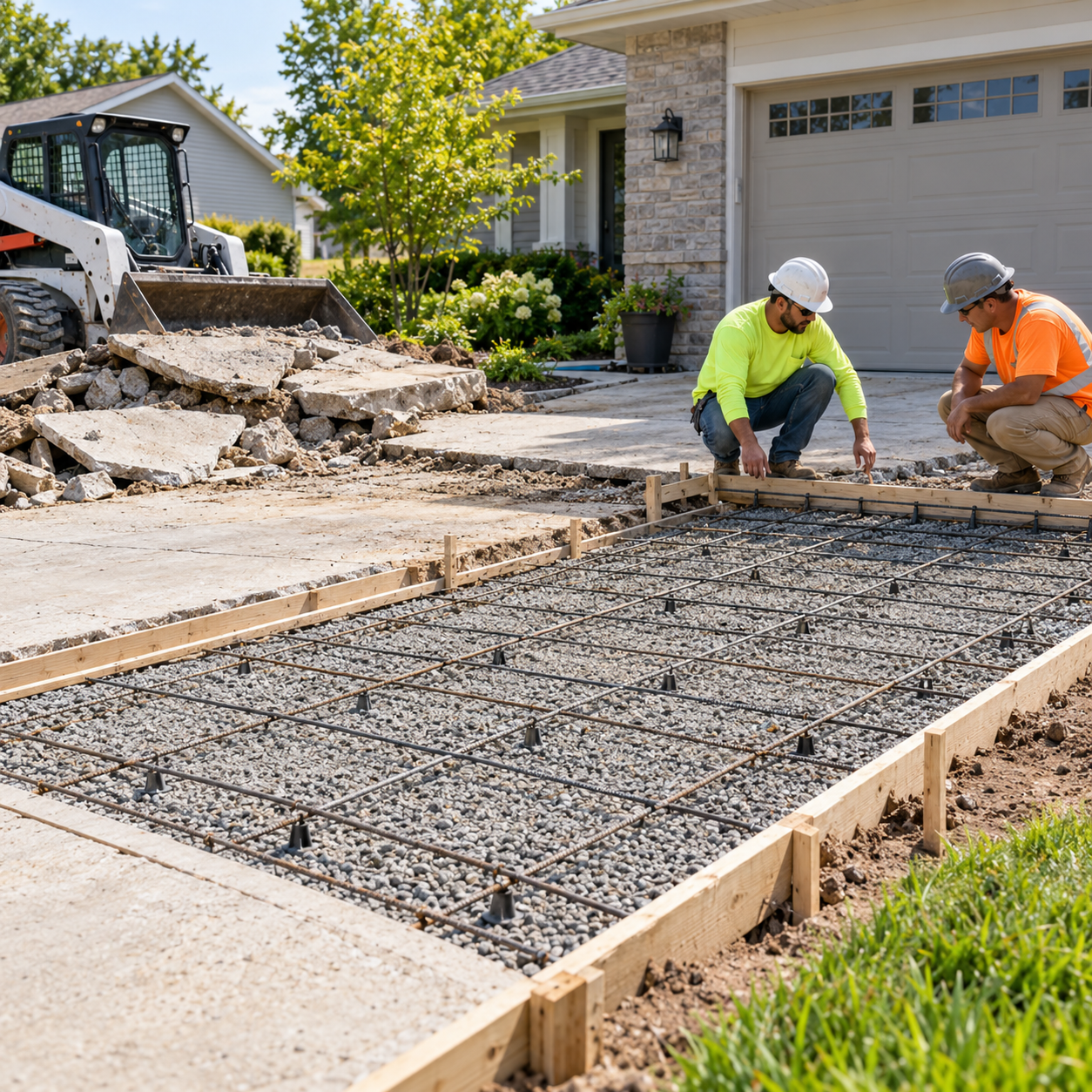
Replacing a concrete driveway involves much more than ordering fresh concrete. The contractor may need to break up and haul away the existing slab, evaluate the base, correct drainage, rebuild the subgrade, install reinforcement and joints, place and finish the new concrete, and protect it while it cures.
In 2026, a basic concrete driveway commonly costs about $6 to $15 per square foot to install, while removal of an existing concrete driveway may add roughly $3 to $8 per square foot, depending on reinforcement, access and disposal conditions. A complete removal-and-replacement project can therefore cost substantially more than a new installation on a prepared site.
This guide explains concrete driveway replacement costs, the factors that change contractor quotes, repair-versus-replacement choices, and the details homeowners should confirm before approving the work.
1. Average Concrete Driveway Replacement Cost in 2026
Published price ranges describe different scopes, so they should not be treated as interchangeable. Some figures cover only new concrete placement, while others include demolition, disposal, base preparation, reinforcement, permits or decorative finishes.
| Cost item | Typical planning range |
|---|---|
| Basic concrete driveway installation | $6–$15 per sq. ft. |
| Six-inch concrete for heavier vehicles | $8–$20 per sq. ft. |
| Existing concrete removal and disposal | $3–$8 per sq. ft. |
| Concrete resurfacing | $3–$7 per sq. ft. |
| Reinforcement allowance | $1–$3 per sq. ft. |
| Stamped concrete driveway | $8–$26 per sq. ft. |
| Stained concrete driveway | $8–$25 per sq. ft. |
| Heated concrete driveway | $13–$28+ per sq. ft. |
| Concrete sealing | $1–$3 per sq. ft. |
HomeGuide reports a typical installed range of $2,400 to $8,600 for a concrete driveway, but complete replacement may cost more when demolition, disposal, difficult access, drainage correction or extensive base work is required. Your useful number is a written local proposal tied to measured area and a defined scope.
2. Concrete Driveway Replacement Cost by Size
The following examples use a broad planning range of $9 to $23 per square foot for basic installation plus removal. They are illustrations, not contractor quotations, and do not include every possible site condition or upgrade.
| Driveway size | Approximate vehicle capacity | Illustrative replacement range* |
|---|---|---|
| 10 × 20 ft. (200 sq. ft.) | One-car parking pad | $1,800–$4,600 |
| 12 × 30 ft. (360 sq. ft.) | Single-car driveway | $3,240–$8,280 |
| 20 × 20 ft. (400 sq. ft.) | Compact two-car area | $3,600–$9,200 |
| 20 × 30 ft. (600 sq. ft.) | Typical two-car driveway | $5,400–$13,800 |
| 24 × 40 ft. (960 sq. ft.) | Large two-car driveway | $8,640–$22,080 |
| 30 × 40 ft. (1,200 sq. ft.) | Three-car or broad parking area | $10,800–$27,600 |
*Calculated only as area multiplied by the stated planning range. Curves, aprons, thickened edges, base replacement, permits, drainage, reinforcement and finishes can change the price.
Measure the full paved area rather than estimating from the number of vehicles. Include the approach, parking pad, turnaround, widened sections and any concrete apron within the contractor’s scope.
3. What Determines the Final Price?
Existing concrete removal
Demolition cost depends on slab thickness, reinforcement, equipment access, haul distance and disposal or recycling fees. HomeGuide reports concrete removal at about $3 to $8 per square foot, with driveway removal commonly totaling $1,200 to $4,500 and sometimes more for larger or heavily reinforced areas.
Base and soil condition
A sound driveway begins below the visible concrete. Soft soil, poorly compacted fill, pumping, erosion, tree roots or an inadequate aggregate base may require excavation, imported material and mechanical compaction. Reusing a failed base solely to reduce the price can reproduce the same settlement problem.
Driveway thickness
A four-inch slab is common for passenger vehicles, but site conditions, local requirements and vehicle loads may justify greater thickness or thickened sections. Six-inch concrete generally costs more because it requires about 50% more concrete than a four-inch slab over the same area.
Reinforcement
Rebar, welded wire reinforcement or properly specified fibers may be proposed to control crack width and improve performance. Reinforcement does not eliminate the need for a stable base, correct concrete placement, properly located joints and curing.
Access and shape
Straight, open driveways are usually easier to remove, form, pour and finish. Narrow side access, steep grades, curves, multiple elevations, remote placement, landscaping protection or concrete pumping can increase labor and equipment costs.
Drainage and grading
The finished surface must direct water appropriately without sending runoff toward the house, neighboring property or an unsafe public area. New drains, culverts, channels, grading or connections can materially increase the project scope.
Finish and appearance
Plain broom-finished gray concrete is normally the economical choice. Color, exposed aggregate, staining, borders, stamping and complex patterns add material, labor and future maintenance considerations.
Local labor, permits and disposal
Labor rates, concrete delivery prices, permit rules, inspection requirements, traffic controls and disposal fees vary significantly by location. A driveway apron or work within a public right-of-way may follow separate municipal standards.
4. Removal and Disposal Costs
A replacement proposal should state whether it includes:
- saw cutting at boundaries;
- breaking and lifting the existing slab;
- handling reinforcing steel;
- loading and transportation;
- landfill, transfer-station or recycling fees;
- removal of unsuitable base or soil;
- protection of the garage slab, foundation, utilities and landscaping; and
- final cleanup.
Ask whether the contractor measured the existing thickness or assumed it. Extra-thick concrete, hidden reinforcement, multiple layers or restricted machinery access may trigger additional charges. If uncertainty cannot be resolved before demolition, request written unit prices and an approval procedure for extra work.
5. Repair, Resurface or Replace?
Full replacement is not always necessary. The choice depends on the cause, depth and extent of damage—not appearance alone.
| Condition | Possible response |
|---|---|
| Isolated stable hairline cracks | Cleaning, sealing and monitoring may be sufficient |
| Minor surface wear or scaling | Surface repair or resurfacing may be considered |
| Limited settlement with an otherwise sound slab | Slab lifting may be evaluated |
| One badly damaged panel | Sectional replacement may be possible |
| Widespread displacement or settlement | Full or substantial replacement may be justified |
| Failed base, drainage or recurring movement | Correct the underlying cause before replacement |
| Extensive deterioration or multiple prior repairs | Replacement may provide better long-term value |
Concrete resurfacing generally costs about $3 to $7 per square foot and can improve a structurally sound surface. It will not correct a failed base, significant slab movement or active structural cracking. Ask for a written explanation of why the existing slab is suitable for an overlay.
6. Site Preparation and Base Construction
After demolition, the contractor should evaluate what remains rather than automatically pouring on the old base. A proper scope may include:
- excavating to the required elevation;
- removing organic, soft or unsuitable material;
- correcting drainage and utility conflicts;
- placing the specified aggregate base in controlled layers;
- compacting the subgrade and base;
- verifying the final slope and elevations; and
- setting forms without disturbing prepared material.
Ask the proposal to identify the base material and compacted thickness. The phrase “prepare as needed” is difficult to compare because contractors may have very different assumptions.
7. Concrete Mix, Thickness and Reinforcement
The contract should identify the concrete strength or mix specification required by the design and local conditions. Cold climates, freeze-thaw exposure, deicing chemicals and heavy vehicles may require specifications different from a mild-climate residential parking pad.
Confirm these details:
- nominal slab thickness;
- thickened edges or apron requirements;
- specified concrete strength;
- air entrainment where appropriate;
- reinforcement type, size and spacing;
- reinforcement support and position within the slab;
- fiber type and dosage if proposed;
- maximum water addition at the site; and
- testing or delivery-ticket documentation.
Do not accept “reinforced concrete” as a complete specification. The quote should state what reinforcement will be installed and how it will be supported during placement.
8. Joints and Crack Control
Concrete shrinks as it dries, and some cracking is possible even with good workmanship. Properly planned contraction joints encourage shrinkage cracks to occur at deliberate lines rather than randomly across panels.
The American Cement Association explains that contraction joints may be formed in fresh concrete or saw-cut after placement. Joint timing, depth, layout and panel proportions matter. Isolation joints may also be needed where the driveway meets structures, columns, curbs or other fixed elements.
Before work begins, ask the contractor to mark the proposed joint layout on the plan. Clarify how joints will align with corners, curves, drains and changes in width.
9. Drainage, Slope and the Driveway Apron
Replacing a driveway is an opportunity to correct ponding or runoff problems, but changing elevations can create new ones. The proposal should address:
- slope away from the garage and house;
- connection to the street or sidewalk;
- water entering from roofs or adjoining land;
- low spots and ponding;
- channel drains or catch basins;
- culverts and roadside drainage;
- runoff onto adjacent property; and
- municipal requirements at the driveway apron.
Do not assume that replacing the visible slab includes work within the public right-of-way. Confirm who owns the apron, which standards apply and whether the municipality requires a separate permit, inspection or approved contractor.
10. Decorative and Optional Upgrades
Decorative choices can improve appearance but raise installation and maintenance costs.
- Stamped concrete: approximately $8 to $26 per square foot, depending on pattern, color and complexity.
- Stained concrete: approximately $8 to $25 per square foot.
- Exposed aggregate: costs more than a basic broom finish and requires careful finishing.
- Borders and contrasting bands: add forming, sequencing and joint-layout work.
- Sealer: commonly $1 to $3 per square foot, with future recoating required.
- Snow-melting system: approximately $13 to $28 or more per square foot for a heated driveway system.
Request samples and addresses of comparable completed work. Confirm whether normal color variation, minor cracking, surface wear, deicing damage and sealer maintenance are excluded from the warranty.
11. Curing and When the Driveway Can Be Used
Curing helps concrete develop strength and durability by controlling moisture loss and temperature after placement. The American Cement Association describes water curing, moisture-retaining coverings and curing compounds as common approaches.
The contractor should state:
- the curing method;
- who maintains coverings or moisture;
- protection from rain, freezing, heat, traffic and pets;
- when forms will be removed;
- when people may walk on the surface;
- when passenger vehicles may use it; and
- when heavy vehicles are permitted.
Do not rely on a universal number of days. Weather, concrete mix, slab design and the engineer or supplier’s requirements affect the safe opening time. Obtain the instruction in writing and follow it.
12. Permits, Utilities and Right-of-Way Work
Driveway requirements are local. A permit may be required for replacement, widening, relocation, drainage changes, a new curb cut or work within the public right-of-way. Local authorities may regulate width, slope, sight distance, sidewalk crossings, culverts and apron construction.
Before demolition, confirm:
- who obtains each permit;
- who requests utility locating;
- whether private utilities require separate locating;
- whether the driveway crosses an easement;
- applicable curb, sidewalk and apron standards;
- required inspections; and
- responsibility for damage to utilities or public improvements.
13. Concrete Versus Asphalt
Homeowners sometimes consider replacing concrete with asphalt. Asphalt generally has a lower initial cost, while concrete may offer a longer service life and different maintenance and appearance characteristics. The correct choice depends on climate, soil, drainage, local contractor capability, expected loads and long-term maintenance.
Do not compare installation prices alone. Compare equivalent scopes for demolition, base preparation, drainage, thickness, edges, permits, restoration, maintenance and warranty.
14. How to Compare Contractor Quotes
Give each contractor the same measured area and questions. A useful proposal should separate:
| Quote section | What should be stated |
|---|---|
| Existing conditions | Measured area, assumed thickness, reinforcement, access and known damage |
| Demolition | Saw cutting, equipment, removal, hauling, disposal and recycling |
| Subgrade and base | Excavation depth, materials, compacted thickness and unsuitable-soil procedure |
| New concrete | Area, thickness, strength, mix requirements and estimated quantity |
| Reinforcement | Type, size, spacing, laps, supports and placement |
| Joints | Type, depth, timing and layout |
| Drainage | Finished slopes, drains, culverts and runoff responsibility |
| Finish and curing | Texture, color, sealer, curing method and protection |
| Authorities | Permits, inspections, apron and right-of-way requirements |
| Commercial terms | Total, allowances, unit prices, exclusions, payments, schedule and warranty |
Use our contractor hiring checklist to verify credentials and written terms. Our guide to general contractor fees explains overhead, markup, allowances and change orders. If driveway movement may relate to soil or structural conditions near the house, review our foundation repair cost guide.
15. Questions to Ask a Concrete Contractor
- What measured square footage is included?
- Does the price include complete removal, hauling and disposal?
- What slab thickness and existing reinforcement have you assumed?
- How will unsuitable soil or a failed base be handled and priced?
- What base material and compacted thickness will be installed?
- What concrete strength, air entrainment and mix requirements apply?
- What reinforcement will be used, and how will it be supported?
- Where will contraction and isolation joints be placed?
- How will the driveway drain after replacement?
- Are the apron, curb, sidewalk and right-of-way work included?
- Who obtains permits and arranges inspections?
- What curing method will be used, and when may vehicles return?
- Which landscaping, irrigation and restoration items are excluded?
- What does the warranty cover, and what cracking is excluded?
- What documentation will be provided at completion?
16. Common Quote Red Flags
Request clarification if a proposal:
- gives only a total price with no measured area;
- omits demolition, disposal or base preparation;
- describes thickness or reinforcement only verbally;
- proposes pouring over unstable or unidentified material;
- ignores visible drainage or settlement problems;
- has no joint plan;
- promises that concrete will never crack;
- does not explain permits or apron responsibility;
- allows unspecified extra work without written approval; or
- requests payment terms that do not match progress or local law.
A lower quote may be legitimate, but only after confirming that it covers the same quantities, materials, preparation, drainage, curing and restoration.
17. Frequently Asked Questions
How much does it cost to replace a concrete driveway?
Basic new concrete commonly costs $6 to $15 per square foot, while removal may add about $3 to $8 per square foot. Complete project pricing depends on size, access, base work, thickness, reinforcement, drainage, permits and finish.
Is it cheaper to resurface or replace a concrete driveway?
Resurfacing at roughly $3 to $7 per square foot is usually cheaper when the existing slab is structurally suitable. Replacement is more appropriate when the slab or base has widespread settlement, displacement or deterioration.
How long does a concrete driveway last?
HomeGuide estimates about 30 to 40 years for a quality concrete driveway with appropriate construction and maintenance. Climate, soil, drainage, loads, deicing exposure and workmanship affect actual service life.
Should a concrete driveway have rebar?
The appropriate reinforcement depends on slab design, soil, climate, loads and local requirements. Ask the contractor or designer to specify the system rather than assuming that one reinforcement approach fits every driveway.
Can new concrete be poured over an old driveway?
An overlay may be suitable in limited circumstances when the existing slab is stable and the added elevation does not create drainage, garage, sidewalk or clearance problems. It will not correct movement caused by a failed base.
When can I drive on a new concrete driveway?
Follow the written instructions from the contractor and concrete supplier. Mix design, curing, temperature, slab thickness and expected vehicle load affect the safe opening time.
18. Homeowner Checklist
Before signing:
- Measure and confirm the full project area.
- Photograph existing cracks, settlement and drainage problems.
- Verify permit and right-of-way requirements.
- Confirm demolition, hauling and disposal.
- Define excavation, base material and compaction.
- State slab and edge thicknesses.
- State the concrete mix requirements.
- State reinforcement type and placement.
- Review the joint layout.
- Confirm finished slopes and drainage.
- Identify apron, curb and sidewalk responsibilities.
- Define finish, color and sealer.
- Obtain curing and traffic instructions.
- List restoration and exclusions.
- Review unit prices, change orders, payments and warranty.
- Keep permits, delivery tickets, photographs, invoices and inspection records.
Final Takeaway
Concrete driveway replacement cost is driven by the complete scope beneath and around the finished surface—not just the price of concrete. Demolition, disposal, base preparation, drainage, thickness, reinforcement, joints, curing, permits and restoration all influence performance and price.
Compare contractor proposals against one written scope and make uncertainties visible. A durable driveway begins with a verified base and drainage plan, continues with properly specified placement and curing, and ends with clear documentation of what was actually installed.
Sources
- HomeGuide, “How Much Does a Concrete Driveway Cost? (2026)”
https://homeguide.com/costs/concrete-driveway-cost - HomeGuide, “How Much Does Concrete Removal Cost? (2026 Prices)”
https://homeguide.com/costs/concrete-removal-cost - HomeGuide, “How Much Does a Driveway Cost? (2026)”
https://homeguide.com/costs/driveway-cost - American Concrete Institute, “ACI PRC-332.1-18: Guide to Residential Concrete Construction”
https://www.concrete.org/store/productdetail.aspx?ItemID=332118&Language=English&Units=US_AND_METRIC - American Cement Association, “Working with Concrete”
https://www.cement.org/cement-concrete/working-with-concrete/ - American Cement Association, “Applications of Cement”
https://www.cement.org/cement-concrete/applications-of-cement/
Editorial Note
Cost figures are national planning ranges compiled from the cited sources and are not contractor quotations. Local labor and concrete prices, site access, soil and base conditions, drainage, demolition, permits, specifications and selected finishes can materially change the final price. Home Decision Compass provides independent educational information and does not replace project-specific advice from a qualified local professional.