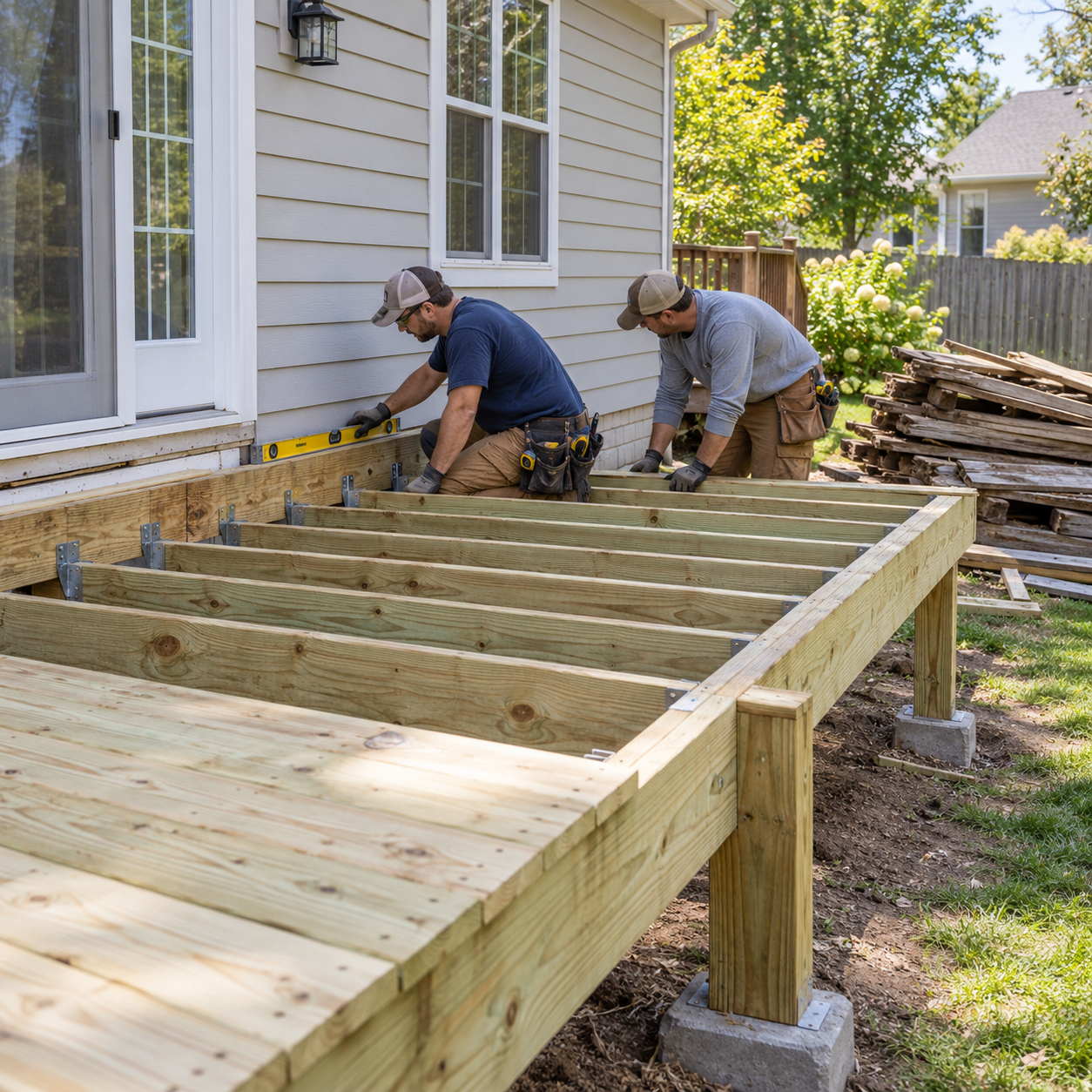
Deck replacement can mean anything from installing new surface boards over a sound frame to demolishing an unsafe structure and rebuilding its footings, posts, beams, joists, stairs and railings. Those scopes are not financially or structurally equivalent.
In 2026, complete deck replacement commonly costs about $30 to $55 per square foot, while material choice, height, access, structural repairs, railings and stairs can push the total higher. Demolishing and removing an existing deck may add $1,000 to $7,000 or more, depending on size and complexity.
This guide explains realistic deck replacement costs, wood and composite options, repair-versus-replacement decisions, structural and safety considerations, and the details homeowners should compare in contractor proposals.
1. Average Deck Replacement Cost in 2026
Published deck prices frequently describe different scopes. A “decking replacement” estimate may cover only surface boards, while a “deck replacement” proposal may include demolition, footings, framing, railings, stairs, permits and restoration.
| Project scope | Typical planning range |
|---|---|
| Simple deck repairs | $100–$750 |
| Average deck repairs | $750–$2,500 |
| Complex deck repairs | $2,500–$10,000+ |
| Complete deck replacement | $30–$55 per sq. ft. |
| Wood deck-board replacement | $25–$50 per sq. ft. installed |
| Composite deck-board replacement | $40–$80 per sq. ft. installed |
| Small deck removal, 100–200 sq. ft. | $1,000–$2,500 |
| Medium deck removal, 200–400 sq. ft. | $2,500–$5,000 |
| Large deck removal, 400+ sq. ft. | $5,000–$7,000+ |
These are national planning ranges, not bids. Local labor, material pricing, snow and wind requirements, soil, permits, access and design can materially change the result.
2. Deck Replacement Cost by Size
The table below applies the broad $30 to $55 per square foot planning range to several deck sizes. It does not add unusual demolition, engineering, premium railings, complex stairs, roofs or difficult foundations.
| Deck size | Approximate replacement range* |
|---|---|
| 10 × 10 ft. (100 sq. ft.) | $3,000–$5,500 |
| 12 × 12 ft. (144 sq. ft.) | $4,320–$7,920 |
| 12 × 16 ft. (192 sq. ft.) | $5,760–$10,560 |
| 16 × 20 ft. (320 sq. ft.) | $9,600–$17,600 |
| 20 × 20 ft. (400 sq. ft.) | $12,000–$22,000 |
| 20 × 24 ft. (480 sq. ft.) | $14,400–$26,400 |
*Illustrative multiplication only. Confirm exactly what the contractor’s square-foot price includes.
Deck height and geometry matter almost as much as floor area. A ground-level rectangle is different from an elevated, multi-level deck with long stairs, extensive guardrails and restricted access.
3. What Determines Deck Replacement Cost?
Demolition and disposal
Removal cost rises with deck size, height, material, complexity, concrete footings and access. Contractors must dismantle the structure safely, separate reusable or recyclable material where practical, haul debris and protect the house and yard.
Structural scope
Surface boards may look like the principal component, but the load-bearing system includes footings, posts, beams, joists, connections and the attachment to the house. Hidden rot, corrosion, undersized members or improper connections can turn a resurfacing job into structural replacement.
Decking material
Pressure-treated lumber generally has a lower initial price. Cedar, hardwood, composite, PVC and aluminum can cost more. Material choice also changes framing spacing, fasteners, installation details, maintenance and warranty conditions.
Height and access
Elevated decks require more fall protection, bracing, staging and material handling. Narrow side yards, steep slopes, landscaping, pools and limited equipment access increase labor.
Railings and stairs
Railings are priced by linear foot and vary widely by material. Stairs require stringers, treads, landings, guards and handrails, and may need separate footings. A deck with a small floor but extensive perimeter railing can be expensive.
Permits and design
Replacement may require drawings, engineering, zoning review, permits and inspections. Local rules may address setbacks, lot coverage, footing depth, frost protection, loads, attachment and guards.
Electrical and added features
Lighting, receptacles, outdoor kitchens, hot tubs, pergolas, privacy screens, built-in seating and under-deck drainage can add significant structural and trade work.
4. Complete Replacement Versus Deck-Board Replacement
Replacing boards only can be reasonable when the supporting structure is sound, correctly built and compatible with the new decking. It is not a safe shortcut when framing or connections are deteriorated.
Before authorizing resurfacing, ask the contractor to inspect:
- footings and their movement;
- posts, bases and ground clearance;
- beams and bearing points;
- joists, blocking and hangers;
- the ledger and house attachment;
- flashing and water management;
- corrosion of fasteners and connectors;
- stairs, stringers and landings;
- railing posts and guard connections; and
- visible alterations or previous repairs.
New composite boards can outlast an old frame. Confirm that joist spacing, flatness, ventilation and fastener requirements meet the decking manufacturer’s instructions.
5. Deck Repair Cost Versus Replacement
HomeGuide reports average deck repairs of $750 to $2,500, with complex work reaching $10,000 or more. Replacement becomes more reasonable when damage is widespread, the structure is near the end of its useful life, or repairs approach a substantial share of rebuilding cost.
| Existing condition | Possible approach |
|---|---|
| Limited loose fasteners or one damaged board | Targeted repair |
| Sound deck needing appearance renewal | Cleaning, staining or refinishing |
| Several deteriorated boards over sound framing | Board replacement or resurfacing |
| Localized framing deterioration | Engineered or code-compliant structural repair |
| Widespread rot, movement or corrosion | Substantial or complete replacement |
| Unsafe ledger, stairs, guards or foundations | Prompt professional evaluation |
| Repeated repairs across an aging structure | Compare full replacement with continued repair |
Do not make the decision only by age. Construction quality, exposure, maintenance, material, drainage and connections determine condition.
6. Wood Deck Replacement Cost
Wood remains common because it is familiar, workable and available in several price levels. Pressure-treated lumber is usually economical; cedar and hardwoods typically cost more.
Wood costs should be evaluated over the ownership period. Depending on species and exposure, maintenance may include cleaning, staining, sealing, checking fasteners and replacing deteriorated boards. Poorly detailed flashing or trapped moisture can damage framing even when the visible surface appears acceptable.
Ask the proposal to state:
- wood species and grade;
- preservative treatment and use category where applicable;
- board dimensions and moisture considerations;
- fastener and connector compatibility;
- cut-end treatment requirements;
- finish or stain system; and
- initial and continuing maintenance.
7. Composite and PVC Deck Replacement Cost
Composite decking may reduce staining and sealing work, but products vary in composition, cap, heat retention, expansion, scratch resistance, span limits and warranty. HomeGuide reports composite deck construction costs that can place a 20-by-20-foot deck around $16,000 to $32,000, depending on product and scope.
When comparing composite proposals, confirm:
- exact manufacturer and product line;
- solid or scalloped board profile;
- color and surface texture;
- joist-spacing requirement;
- hidden or face-fastening system;
- stair-tread and picture-frame details;
- required ventilation and clearance;
- heat and slip considerations;
- approved cleaning methods; and
- labor and product warranty conditions.
Do not compare a premium capped product with an entry-level composite by the word “composite” alone.
8. Deck Removal and Disposal Cost
HomeGuide reports average removal totals of $1,000 to $2,500 for a small deck, $2,500 to $5,000 for a medium deck and $5,000 to $7,000 or more for a large deck.
A removal quote should identify:
- surface boards, railings and stairs;
- framing, ledger and connectors;
- posts and footings;
- concrete removal or abandonment method;
- protection of siding, doors and foundations;
- utility and electrical disconnection;
- hauling, disposal and recycling fees;
- cleanup and grading; and
- temporary protection of doors or elevated openings.
If old materials may contain lead-based coatings or other hazards, stop and determine the correct testing and handling requirements before demolition.
9. Footings, Posts, Beams and Joists
A replacement deck must transfer loads safely to the ground. Footing size and depth depend on design loads, soil, frost conditions, post arrangement and local requirements. Existing footings should not be reused merely because removal is inconvenient.
Ask whether the contractor will verify:
- footing diameter, depth and condition;
- post size, alignment and connection;
- beam size, span, bearing and splices;
- joist size, span, spacing and cantilever;
- blocking and lateral restraint;
- hardware type and corrosion resistance; and
- load requirements for roofs, hot tubs or other concentrated loads.
The American Wood Council’s DCA 6 provides prescriptive guidance for certain single-level residential wood decks, but it is not a universal design for every property. Local codes and project-specific engineering control.
10. Ledger, Flashing and House Attachment
The ledger is a critical connection between many attached decks and the house. Water entry, incompatible fasteners, missing flashing or an improper connection can create hidden structural risk.
The proposal should explain:
- whether the deck will be attached or freestanding;
- condition of the wall and rim area;
- ledger material and fastener schedule;
- flashing and water-shedding details;
- lateral-load connections where required;
- siding removal and reinstatement; and
- inspection before concealed work is covered.
Do not accept a vague promise to “bolt the deck to the house.” Connection details must match the actual wall construction and local requirements.
11. Deck Railing and Stair Costs
HomeGuide reports installed deck-railing ranges of approximately:
- $20 to $60 per linear foot for wood or vinyl;
- $25 to $250 per linear foot for metal or composite; and
- $60 to $600 per linear foot for cable or glass.
Wide ranges reflect material, post systems, height, corners, gates, engineering and installation difficulty. Stair cost depends on rise, width, number of treads, landings, stringer design, guards, handrails and foundations.
Confirm the proposal includes all required:
- guard posts and attachment hardware;
- top and bottom rails;
- balusters, infill, cables or panels;
- graspable handrails where required;
- stair stringers and treads;
- landings and support; and
- code-required openings, height and load resistance.
12. Permits, Codes and Inspections
Deck requirements are local and may change when a deck is enlarged, raised, covered or materially altered. Replacing boards alone may be treated differently from rebuilding structural elements.
Before work begins, confirm:
- whether zoning approval is required;
- applicable setbacks and easements;
- who prepares drawings or calculations;
- who obtains and pays for permits;
- required footing, framing, flashing and final inspections;
- whether existing nonconforming work must be corrected; and
- when the deck may be used after final approval.
Keep approved plans and inspection records with the property documents.
13. Drainage, Moisture and Corrosion
Deck durability depends on how water leaves surfaces and connections. Trapped debris, missing flashing, end grain near soil, blocked ventilation and incompatible metal hardware can accelerate deterioration.
The replacement scope should address:
- slope and drainage at the house;
- ledger and door flashing;
- spacing that allows water to drain;
- protection at joist tops where specified;
- post bases and separation from soil;
- water from roofs and downspouts;
- ventilation beneath low decks; and
- corrosion-resistant fasteners and connectors compatible with the materials.
If deterioration affects the wall, foundation or adjacent siding, separate that repair scope from the deck price.
14. How to Compare Deck Replacement Quotes
Give each qualified contractor the same target design and questions. A useful written quote should separate:
| Quote section | What should be stated |
|---|---|
| Existing conditions | Size, height, materials, observed deterioration and assumptions |
| Demolition | Components removed, footings, hauling, disposal and protection |
| Design | Dimensions, levels, loads, drawings and engineering responsibility |
| Foundations | Footing type, size, depth, quantity and inspection |
| Framing | Species, grade, member sizes, spacing, spans, blocking and hardware |
| House connection | Ledger or freestanding system, flashing and lateral connections |
| Decking | Manufacturer, product, color, profile, fasteners and layout |
| Railings and stairs | Materials, lengths, posts, infill, handrails, stringers and landings |
| Authorities | Zoning, permits, inspections and closeout |
| Commercial terms | Price, allowances, exclusions, schedule, payments, changes and warranty |
Use our contractor hiring checklist to verify credentials and written terms. Our guide to general contractor fees explains markup, overhead, allowances and change orders. If deck movement may involve the house or adjacent support, consult our foundation repair cost guide.
15. Questions to Ask a Deck Contractor
- Is this a board replacement, structural repair or complete rebuild?
- What existing components will remain, and how were they evaluated?
- Does the price include full demolition, hauling and disposal?
- Will existing footings be reused, tested, modified or replaced?
- What design loads and local requirements apply?
- Who prepares drawings and obtains permits?
- What lumber species, grade and treatment will be used?
- What decking manufacturer and product line are specified?
- What fasteners and connectors will be installed?
- How will the ledger and flashing be constructed?
- Are all railings, stairs, landings and handrails included?
- Which inspections must occur before work is concealed?
- What siding, landscaping, electrical or drainage work is excluded?
- What hidden conditions could change the price?
- What do the workmanship and product warranties cover?
16. Common Quote Red Flags
Request clarification when a proposal:
- calls the work “deck replacement” without defining retained components;
- installs new boards without documenting the frame inspection;
- reuses footings without explaining their suitability;
- omits ledger, flashing or house-attachment details;
- specifies only “composite” or “treated wood” without a product or grade;
- has no railing, stair or landing detail;
- dismisses permits without verifying local rules;
- promises that wood will never check or composite will never change appearance;
- leaves disposal, restoration or electrical work unclear; or
- permits extra work without written scope and price approval.
17. Frequently Asked Questions
How much does deck replacement cost?
Complete deck replacement commonly costs about $30 to $55 per square foot. Demolition, elevated construction, composite materials, premium railings, complex stairs, permits and structural work can raise the total.
Is it cheaper to repair or replace a deck?
Repair is normally cheaper when damage is limited and the supporting structure is sound. Replacement may provide better value when deterioration is widespread, important connections are unsafe or repeated repairs approach the cost of rebuilding.
Can I replace deck boards but keep the frame?
Yes, if a qualified evaluation confirms that footings, posts, beams, joists, connections, ledger, flashing, stairs and guards are sound and compatible with the new decking.
Is composite decking more expensive than wood?
Composite commonly has a higher initial material cost but different maintenance requirements. Compare the exact product, framing needs, fasteners, expected maintenance and warranty rather than initial price alone.
Do I need a permit to replace a deck?
Permit requirements depend on local rules and the work scope. Structural replacement, changed dimensions, new footings, stairs or railings often require approval and inspections. Verify before demolition.
How long does deck replacement take?
A simple deck may take days, while large, elevated or complex projects can take several weeks. Design, permitting, inspections, weather, material availability and hidden deterioration affect the schedule.
18. Homeowner Deck Replacement Checklist
Before signing:
- Photograph and measure the existing deck.
- Identify safety concerns and restrict access if necessary.
- Decide whether the target scope is repair, resurfacing or rebuilding.
- Verify zoning, permits and inspection requirements.
- Request a plan with dimensions, levels, stairs and railings.
- Define demolition, disposal and temporary protection.
- Specify footing and framing materials and sizes.
- Specify ledger, flashing and connection details.
- Identify the exact decking and fastening system.
- Specify railings, stairs, handrails and landings.
- Confirm drainage, corrosion protection and ventilation.
- List electrical, siding, landscaping and restoration work.
- Review allowances and hidden-condition unit prices.
- Tie payments to defined progress and inspections.
- Read workmanship and manufacturer warranties.
- Keep plans, permits, inspection records, product documents and invoices.
Final Takeaway
Deck replacement cost depends on far more than the visible floor boards. Foundations, framing, house connections, flashing, railings, stairs, access, permits and demolition determine both price and safety.
Begin with an honest evaluation of what can remain. Then compare contractors against one written design and scope. A clear proposal should show not only how the new deck will look, but how it will support loads, manage water and connect safely for years to come.
Sources
- HomeGuide, “How Much Does It Cost to Build a Deck? (2026)”
https://homeguide.com/costs/cost-to-build-a-deck - HomeGuide, “How Much Does Deck Repair Cost? (2026)”
https://homeguide.com/costs/deck-repair-cost - HomeGuide, “How Much Does Deck Removal Cost? (2026)”
https://homeguide.com/costs/deck-removal-cost - HomeGuide, “How Much Does Composite Decking Cost? (2026)”
https://homeguide.com/costs/composite-decking-prices - HomeGuide, “Porch & Deck Railing Costs in 2026”
https://homeguide.com/costs/deck-or-porch-railing-cost - American Wood Council, “DCA 6: Prescriptive Residential Wood Deck Construction Guide”
https://awc.org/wp-content/uploads/2022/02/AWC-DCA62015-DeckGuide-1804.pdf
Editorial Note
Cost figures are national planning ranges compiled from the cited sources and are not contractor quotations. Local labor and material prices, deck size and height, structural condition, access, design loads, soil, permits, specifications and selected finishes can materially change the final price. Home Decision Compass provides independent educational information and does not replace project-specific advice from a qualified local professional.